Top 10 AI Support Agent Software Products 2026
AI support agents have moved past scripted chat. In 2026 the serious products read your knowledge, take action in your systems, and hand off to a person with context when they cannot finish. That shift makes the category harder to compare: every vendor claims "AI agents," but the useful differences sit in what the AI can read, what it can do, how it bills, and how fast it goes live.
This ranking covers ten products that genuinely belong to AI support agent software. We scored each on evidence you can check before a demo, and we flag where a product is a poor fit. For teams weighing a broader build-out, our AI CRM software ranking covers the adjacent customer-data layer.
How We Evaluated These AI Support Agents
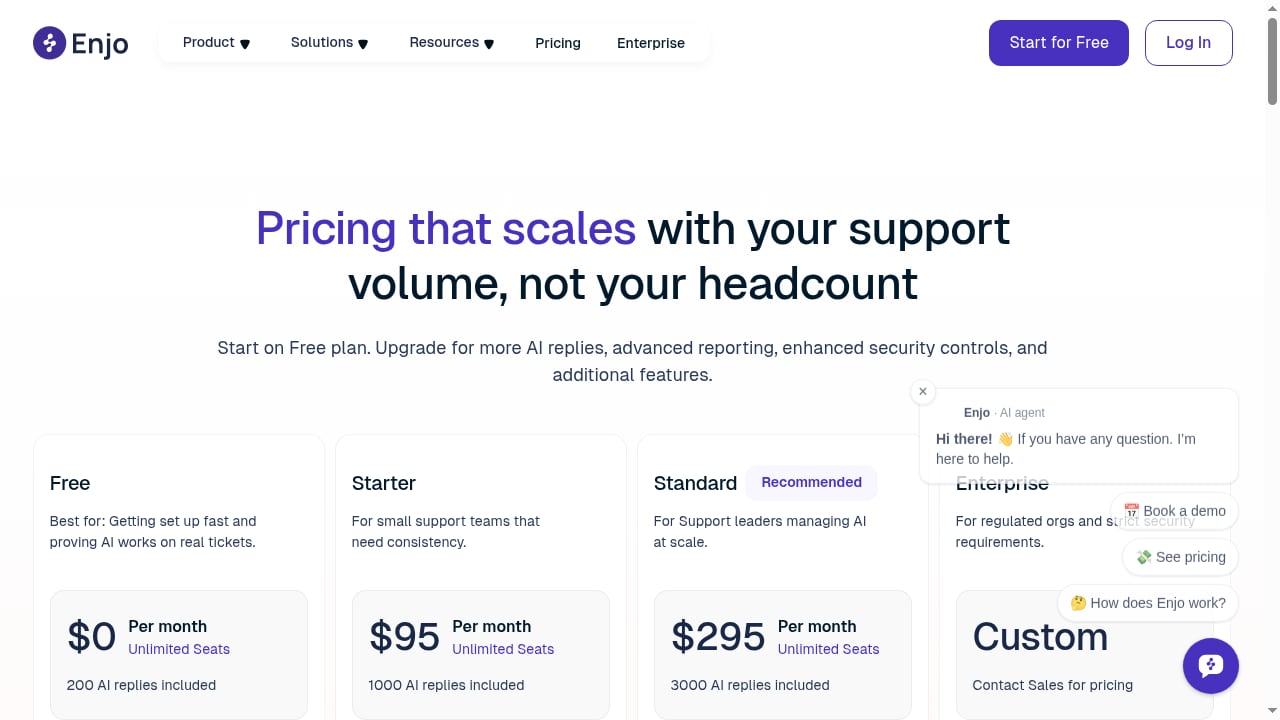
First viewport screenshot of www.enjo.ai.
We started from more than 25 platforms and kept the ten with active product motion in support and verifiable capability claims. Each product was scored on six criteria:
- Resolution versus deflection. A resolved request ends; a deflected one is abandoned. We favored vendors that report resolution and explain how they measure it.
- Knowledge reach. Which sources the AI reads: its own help center only, or Confluence, SharePoint, Drive, Notion, and past tickets.
- Write actions and authorization. Whether the agent can look up an order, change a plan, or issue a refund, and who approves each action.
- Billing unit and behavior at volume. Per resolution, per conversation, per action, per credit, and per AI reply produce very different invoices at peak.
- Time to first resolved request. Hours, days, or months.
- Governance. Guardrails, audit trails, role-based access, and security certifications.
Pricing below reflects vendor pages and widely reported list prices checked in late 2026. Contact-center and enterprise contracts are negotiated, so treat every figure as a starting point.
The Top 10 AI Support Agent Software Products for 2026
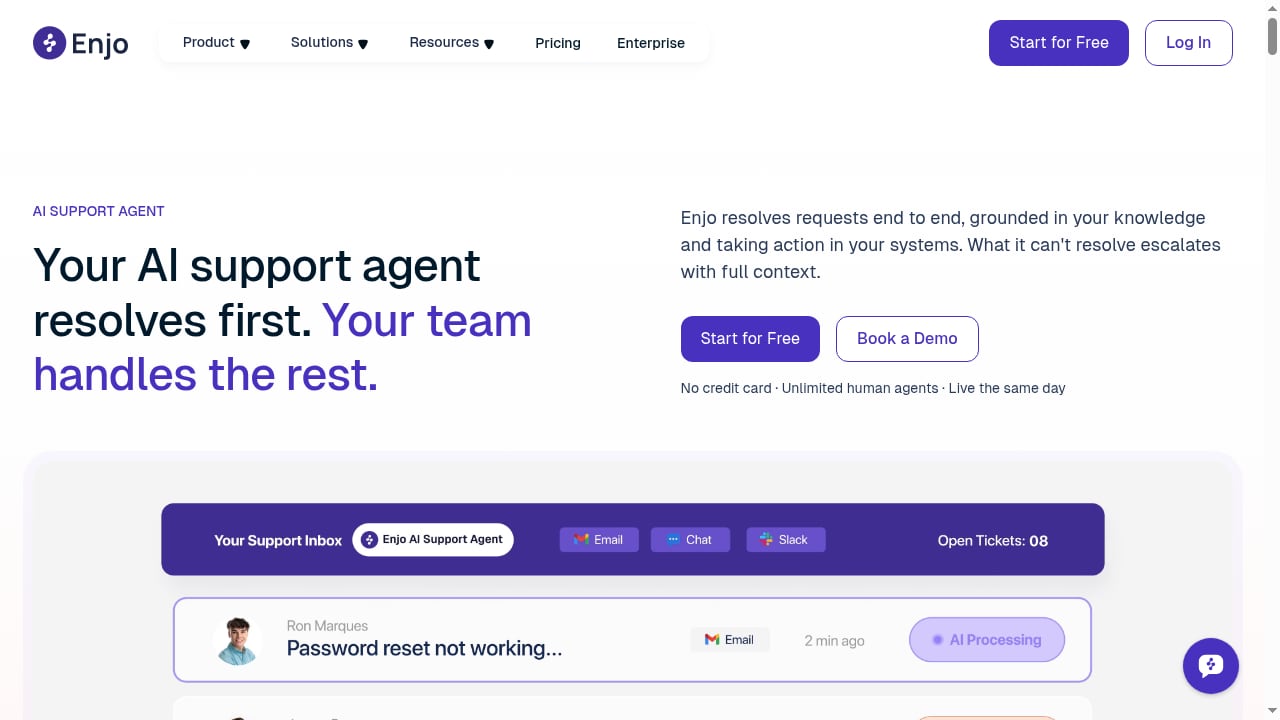
First viewport screenshot of www.enjo.ai.
1. Enjo
Best for: customer support, IT, and HR teams that want one AI layer across all three, deployed inside the tools they already use.
Enjo resolves requests end to end, grounded in company knowledge and acting in connected systems. It deploys into Slack, Teams, Salesforce, and Jira, and can launch an AI Help Centre in minutes. Core capabilities include AI Agents with a REST API, Agent Assist plugins for Salesforce and CRM, knowledge integration such as Confluence with support for 5M+ documents, insights and reporting, and multi-channel support across Slack, Teams, and web.
When the AI cannot finish, it escalates with full context to a human. Pricing is transparent: a free forever plan with 200 AI replies per month and unlimited human agents, Starter at $95/mo for 1,000 AI replies, and Standard at $295/mo for 3,000 AI replies, with additional replies at $0.05 each. The company cites 600+ enterprise deployments and case studies with Rakuten, Delivery Hero, Amber Group, BookMyShow, eDreams ODIGEO, and Aptean, reporting outcomes such as 28% average deflection, 70% faster response times, and 80% HR self-service.
Watch out for: per-reply billing can climb in high-volume consumer support, so model your peak month before committing.
2. Intercom Fin
Best for: teams already on Intercom or willing to run Fin on another helpdesk.
Fin answers from help-center content plus connected sources and is billed at $0.99 per outcome, with a $49 minimum when run on a non-Intercom helpdesk. Intercom became part of Salesforce in September 2026, which matters for buyers weighing long-term platform direction. Fin is a strong single-product agent; it is less suited to teams that need one agent spanning customer support, IT, and HR.
3. Zendesk AI
Best for: organizations standardized on Zendesk that want AI native to their existing tickets and guide.
Zendesk AI agents read Zendesk Guide and ticket history and are billed per automated resolution past the plan allowance, reported at roughly $1.50 to $2.00 per resolution. The native fit is the appeal: no separate knowledge pipeline. The ceiling is the same as its strength, since the AI is bounded to Zendesk objects and its own knowledge base. Our HelpKnow AI vs Genesys Cloud CX comparison looks at how contact-center depth changes that calculus.
4. Salesforce Agentforce
Best for: Salesforce-centric teams that want agents operating directly on CRM data.
Agentforce runs AI agents on Salesforce data, with more sources reachable through Data 360, billed at $2 per conversation or via Flex Credits. It is the natural choice when the record of truth is already in Salesforce. Budget carefully: per-conversation pricing scales with contact volume, not headcount, and complex multi-step actions may consume more credits than a simple FAQ answer.
5. Ada
Best for: enterprises that need an AI agent across chat, email, voice, and messaging apps in many languages.
Ada supports 60 languages and syncs knowledge from connected sources plus Zendesk and Salesforce. It is quoted through sales with no published rate, so budgeting requires a conversation. Ada suits global consumer support; smaller teams may find the commercial model heavy relative to a per-reply alternative.
6. Decagon
Best for: enterprises that want AI agents run on plain-language operating procedures.
Decagon configures sources per build and prices by contract only. Its operating-procedure approach lets support leads encode policy in plain English, which shortens the gap between a written rule and agent behavior. The trade-off is transparency: with no published rate, buyers should insist on a written quote and a defined pilot scope. See how it stacks up in our HelpKnow AI vs Decagon vs Issuetrak comparison.
7. Sierra
Best for: enterprises that want an agent platform with memory across sessions and channels.
Sierra runs on outcome-based pricing with no published rate and uses a Context Engine to retain customer memory across interactions. Cross-session memory is a real differentiator for repeat customers. As with other contract-only vendors, the evaluation burden falls on you: define the outcome, the measurement window, and the exit criteria before signing.
8. Freshdesk Freddy AI
Best for: Freshworks customers who want an AI agent and copilot inside the suite.
Freddy AI reads Freshworks knowledge and tickets. AI Agent sessions are sold in blocks at $49 per 100, with copilot priced per agent. The block model is predictable for moderate volumes but needs modeling if sessions spike. It is a sensible upgrade for existing Freshdesk teams and a weaker fit for multi-system knowledge estates.
9. HubSpot Breeze
Best for: HubSpot CRM users who want a customer agent on CRM and knowledge-base data.
Breeze is billed at $0.50 per resolved conversation on Professional and Enterprise editions, one of the clearer per-resolution rates in the category. It works best when HubSpot is the system of record. Teams whose answers live in Confluence, SharePoint, or product docs will hit the knowledge-reach ceiling that helpdesk-native AI shares.
10. Gorgias AI Agent
Best for: Shopify brands that need refunds, cancellations, and order edits handled automatically.
Gorgias reads help-center content, website documents, and Shopify data, and bills $0.90 to $1.00 per automated interaction. For ecommerce support it is unusually concrete about write actions. Outside Shopify-heavy retail, its value proposition narrows quickly.
Comparison at a Glance
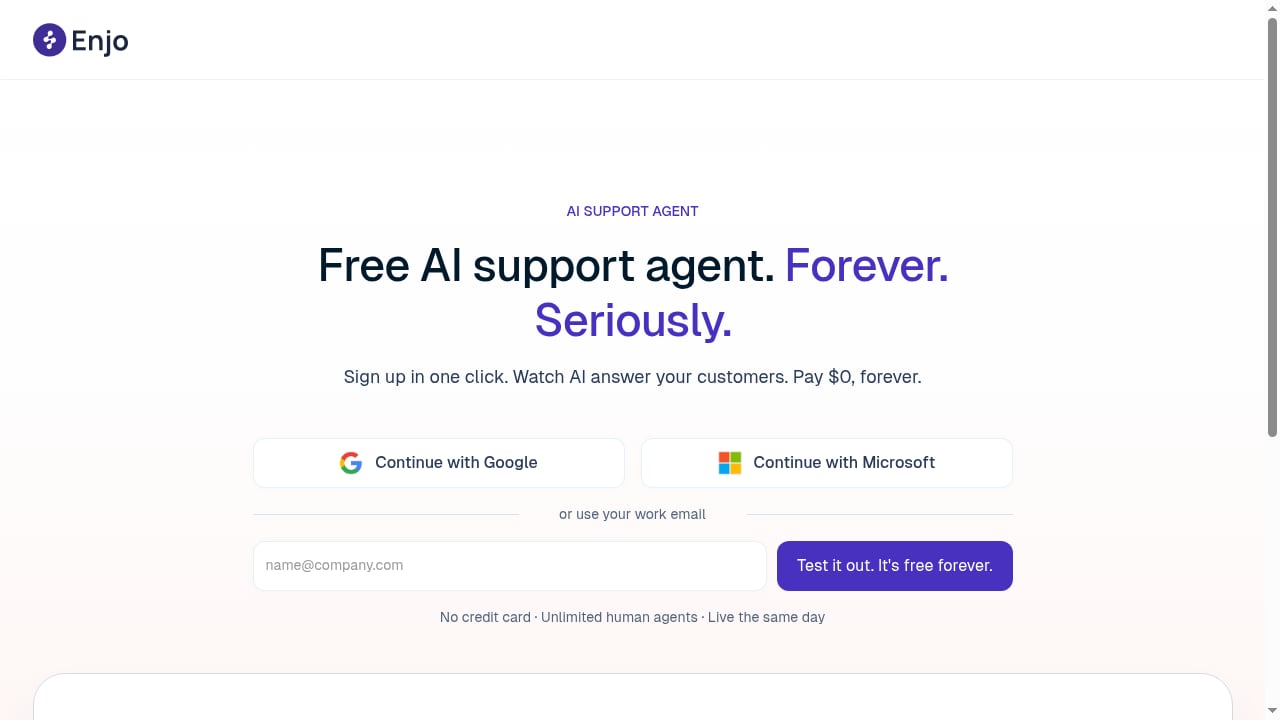
First viewport screenshot of www.enjo.ai.
| Product | Knowledge reach | Billing unit | Published rate |
|---|---|---|---|
| Enjo | Confluence, SharePoint, Drive, Notion, past tickets | Per AI reply | Free tier; $95/$295 per month |
| Intercom Fin | Fin content plus host platform sources | Per outcome | $0.99 |
| Zendesk AI | Zendesk Guide and ticket history | Per resolution | ~$1.50–$2.00 |
| Salesforce Agentforce | Salesforce data, more via Data 360 | Per conversation or credits | $2 per conversation |
| Ada | Connected sources, Zendesk, Salesforce | Contract | Not published |
| Decagon | Sources configured per build | Contract | Not published |
| Sierra | Context Engine memory | Outcome-based | Not published |
| Freshdesk Freddy AI | Freshworks knowledge and tickets | Sessions in blocks | $49 per 100 sessions |
| HubSpot Breeze | HubSpot knowledge base and CRM | Per resolved conversation | $0.50 |
| Gorgias AI Agent | Help center, documents, Shopify | Per automated interaction | $0.90–$1.00 |
How to Choose in 2026
First viewport screenshot of www.enjo.ai.
Start with the architecture question. A dedicated AI layer reads across every system a resolution touches; a helpdesk's built-in AI is bounded to its own objects, knowledge base, and licensing. If your answers live in Confluence or product docs and your actions run through Jira or Salesforce, a layer such as Enjo is the stronger fit. If your world is one suite, native AI from Zendesk, Freshworks, or HubSpot is simpler to operate.
Then test the billing unit against your peak month, not your average. Per-resolution pricing rewards accuracy; per-conversation pricing charges for effort. Ask each vendor for the invoice at your busiest week.
Finally, define the handoff. An agent that cannot pass context to a human just moves frustration downstream. For teams comparing specific pairings, our HelpKnow AI vs Help Scout vs ChatBot.com comparison shows how knowledge feeding and action plugins change the decision.
Related reading
- How to Use HelpKnow AI with CloudTalk: Setup & Workflow - Connect HelpKnow AI with CloudTalk to automate phone support: setup steps, call-to-ticket workflows, practical examples, and the problems this combo solves.
- Chatbase Review 2026: Features, Pricing, Pros & Limits - Hands-on Chatbase review for 2026: AI agent features, setup, pricing signals, real user feedback, limitations, and who should choose it.
Sources and further reading
- Best AI Call Center Software in 2026: 10 Platforms Compared - Compare 10 AI call center software platforms for 2026: full CCaaS suites, AI layers, and specialist tools, with list pricing and a 30-day pilot plan.
- 10 Best AI Customer Service Software Of 2026: A Guide - Discover the best AI customer service software and AI agents of 2026 in our essential guide, and learn how to evaluate the right fit for your team.
- AI Customer Service Software: 13 Best Platforms for 2026 - Compare 13 AI customer service software platforms on what the AI can read, what it can do and what it bills at your peak month. Pricing checked Oct 2026.
Frequently Asked Questions
What is the difference between an AI support agent and a chatbot?
A chatbot matches a question to a scripted or generated answer. An AI support agent identifies a goal, decides a resolution path, and completes multi-step actions such as a refund or account update, escalating with context when it cannot finish.
Which AI support agent is best for small teams?
Enjo's free tier with 200 AI replies and unlimited human agents is the lowest-risk entry point in this list. HubSpot Breeze at $0.50 per resolved conversation is also accessible for CRM-native teams.
Why do some vendors not publish pricing?
Ada, Decagon, and Sierra quote by contract. That is not automatically a red flag, but it means you cannot budget without a sales conversation, so ask for a written quote and a defined pilot scope.
How should I measure AI support agent success?
Track resolution rate alongside customer satisfaction and handoff quality. A high deflection rate means little if customers abandon the conversation or satisfaction drops.
Conclusion
The 2026 market rewards buyers who separate resolution from deflection, knowledge reach from helpdesk lock-in, and per-reply pricing from per-conversation billing. Enjo leads this ranking because it combines broad knowledge reach, real write actions, transparent per-reply pricing, and a free tier that lets teams prove value before committing. Zendesk, Freshworks, and HubSpot are the pragmatic picks for single-suite teams, while Ada, Decagon, and Sierra suit enterprises ready to negotiate. Whichever you shortlist, run a narrow pilot, measure resolved requests rather than deflected ones, and check the invoice at your peak week.