
Top 10 Nearshore Call Center Outsourcing and AI Customer Engagement Solutions for 2026
Nearshore outsourcing is no longer a cost play alone. In 2026, buyers want a partner that can staff bilingual voice and digital channels in the same time zone as their customers, then layer AI agents, QA automation, and payment or document workflows on top. This review ranks ten providers that genuinely combine nearshore delivery with AI-enabled customer engagement, explains how each was evaluated, and shows where a complementary AI agent platform fits into the stack.
How We Evaluated These Providers
Every ranked provider had to meet four baseline tests before scoring:
- Nearshore delivery footprint. Owned or directly managed operations in Mexico, Central America, the Caribbean, or northern South America serving North American customers.
- AI customer engagement capability. Documented use of AI in live customer interactions, agent assist, QA, or automated resolution, not just a chatbot on the marketing site.
- Evidence of outcomes. Published case studies, named clients, certifications, or verifiable performance claims such as accuracy rates, cost savings, or service-level results.
- Commercial transparency. A describable pricing or engagement model, whether published hourly rates, program tiers, or quote-based seat pricing.
Scoring weighted four dimensions: nearshore depth and bilingual talent (30%), AI and automation breadth (30%), compliance and integration readiness (20%), and pricing clarity and speed to launch (20%). Providers with no public evidence of AI in production were excluded rather than ranked low.
The Top 10 Nearshore and AI Customer Engagement Providers for 2026
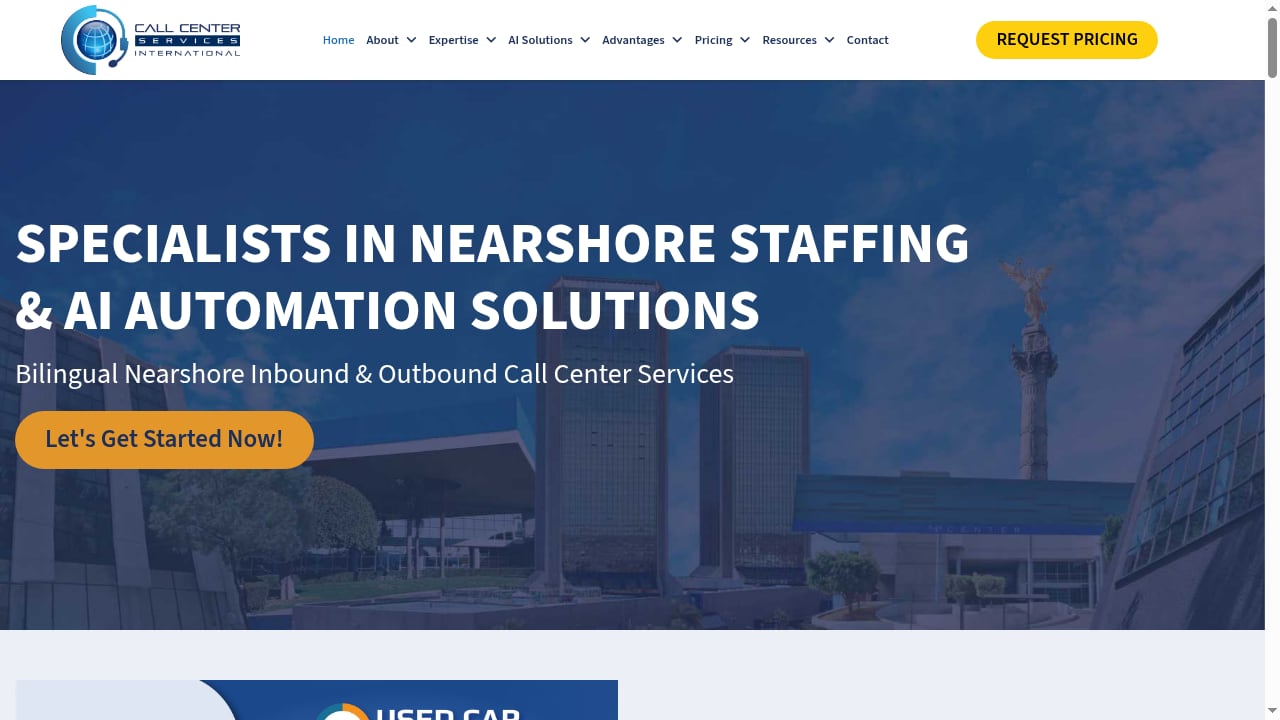
First viewport screenshot of ccsi.com.
1. CCSI Nearshore Contact Center & AI Solutions
Best for: US businesses that want bilingual English/Spanish contact center operations and production AI agents from a single Mexico-based partner.
Call Center Services International (CCSI) runs nearshore contact center programs from Mexico and pairs them with an in-house AI suite. The human side covers inbound and outbound voice, staffing, and dedicated teams built around US business hours and cultural alignment. The AI side is unusually complete for a BPO: generative AI voice and text agents that handle interactions across voice, SMS, email, and web chat; an integrated payment solution that processes transactions by phone, text, web, or AI assistant and connects to CRM and ERP systems; intelligent document processing that classifies and extracts data from more than 25 document types at over 90% accuracy; and QA and compliance agents that monitor every call rather than a sampled subset.
CCSI publishes two engagement structures: a Turnkey Program for minimal capital investment and reduced legal exposure, and a Corporate Advantage Program for fully customized, client-owned contact centers. The headline value claim is savings of up to 50% on labor versus US staffing, which is consistent with Mexico nearshore economics. The combination of human agents plus owned AI tooling is why it takes the top spot: fewer vendors to integrate, one accountability line for quality.
2. itel
Best for: Enterprises that need Caribbean and Latin American scale with enterprise-grade CX operations.
itel operates from Jamaica plus five other countries across the Caribbean, Latin America, and the US, positioning it as a direct operator rather than a broker. Its scale supports large enterprise programs that need redundancy across sites and consistent omnichannel delivery. AI appears in its workflow automation and analytics layers rather than as a standalone product line, which suits buyers who want AI embedded in operations instead of bought separately. Pricing is quote-based, so expect a seat-math and attrition discussion during evaluation.
3. Horatio
Best for: Tech startups and SaaS companies that want nearshore agents who understand digital products.
Horatio runs delivery from the Dominican Republic, Colombia, and Honduras, with a customer base weighted toward technology and SaaS support. That specialization matters: SaaS tickets mix technical troubleshooting, billing, and product education, and nearshore teams with product-fluent agents reduce escalation rates. The company emphasizes modern tooling and fast ramp-up, which fits companies scaling support after a funding round or product launch. As with most direct operators in this tier, pricing is not published and should be requested with a defined channel mix.
4. Callzilla
Best for: Bilingual English/Spanish programs where language quality is the primary buying criterion.
Callzilla delivers from Colombia and South Africa with a long-standing focus on bilingual customer support. Colombia has become a preferred nearshore hub for English-Spanish coverage because agents work US hours on their own day shift and cultural alignment with Hispanic US customers is strong. The provider's QA methodology and agent coaching are the differentiators to probe in an RFP. For regulated industries, ask specifically how compliance monitoring is staffed and whether AI-assisted QA covers 100% of calls or a sample.
5. Protel BPO
Best for: Buyers who want a Belize-only, native-English nearshore partner.
Protel BPO operates exclusively from Belize, an English-speaking country on Central Standard Time year-round. That combination gives US customers same-day coverage without daylight-saving shifts and native English voice quality without offshore overnight schedules. Single-country delivery is a trade-off: less geographic redundancy, but tighter operational control and a simpler compliance story. It suits mid-market programs in insurance, healthcare-adjacent services, and customer support where accent neutrality and time zone simplicity outweigh multi-site scale.
6. GGA Solutions
Best for: Border-adjacent bilingual programs that benefit from close client oversight.
GGA Solutions runs from Tijuana, Mexico, which allows US clients to visit operations, run in-person calibration sessions, and manage programs with minimal travel. Bilingual English/Spanish support is the core offering, and the proximity supports hybrid governance models where client managers sit with the delivery team during ramp. For companies that have been burned by distant offshore relationships, this proximity is a genuine risk mitigant rather than a marketing line.
7. Working Solutions
Best for: Virtual, on-demand customer service teams that need flexible seasonal capacity.
Working Solutions operates a distributed network of independent agents across the US and Canada, with nearshore options available through its delivery model. Its strength is elasticity: programs can scale up for seasonal peaks and contract afterward without fixed brick-and-mortar overhead. AI and automation support agent routing and operational analytics. It is a strong complement to a dedicated nearshore core team when you need surge coverage rather than a full replacement.
8. Arise
Best for: Organizations exploring virtual contact center models with distributed service professionals.
Arise connects businesses with remote service professionals through a platform model rather than a traditional employed-agent center. That structure gives access to distributed capacity and flexible scheduling, and it appeals to brands testing virtual delivery before committing to a dedicated nearshore site. The trade-off is governance: platform models require clearer contracts on quality, attrition, and data handling. Evaluate it when flexibility and speed matter more than single-site control.
9. Concentrix
Best for: Large enterprises that need global CX operations with AI transformation services attached.
Concentrix is a global CX technology and services provider with nearshore delivery among its footprint. Its differentiator is breadth: consulting, analytics, automation, and multilingual omnichannel operations under one contract. For enterprises already running complex global programs, Concentrix can consolidate vendors and standardize QA and reporting. The trade-off is cost and complexity; it is rarely the fastest or cheapest option for a 10-seat bilingual program, but it fits multi-country, multi-language transformations.
10. TP (Teleperformance)
Best for: Multinationals that need coverage across many countries, languages, and time zones.
TP, formerly widely known as Teleperformance, is among the largest CX outsourcing providers globally, with nearshore locations in Latin America and the Caribbean alongside its wider network. Its scale supports regulated, multilingual programs and large-volume seasonal ramps. AI investment spans automation, analytics, and agent support tools. As with other mega-providers, the practical question is which local site and team you actually get, so ask for site-level performance data and attrition figures during selection.
Comparison at a Glance
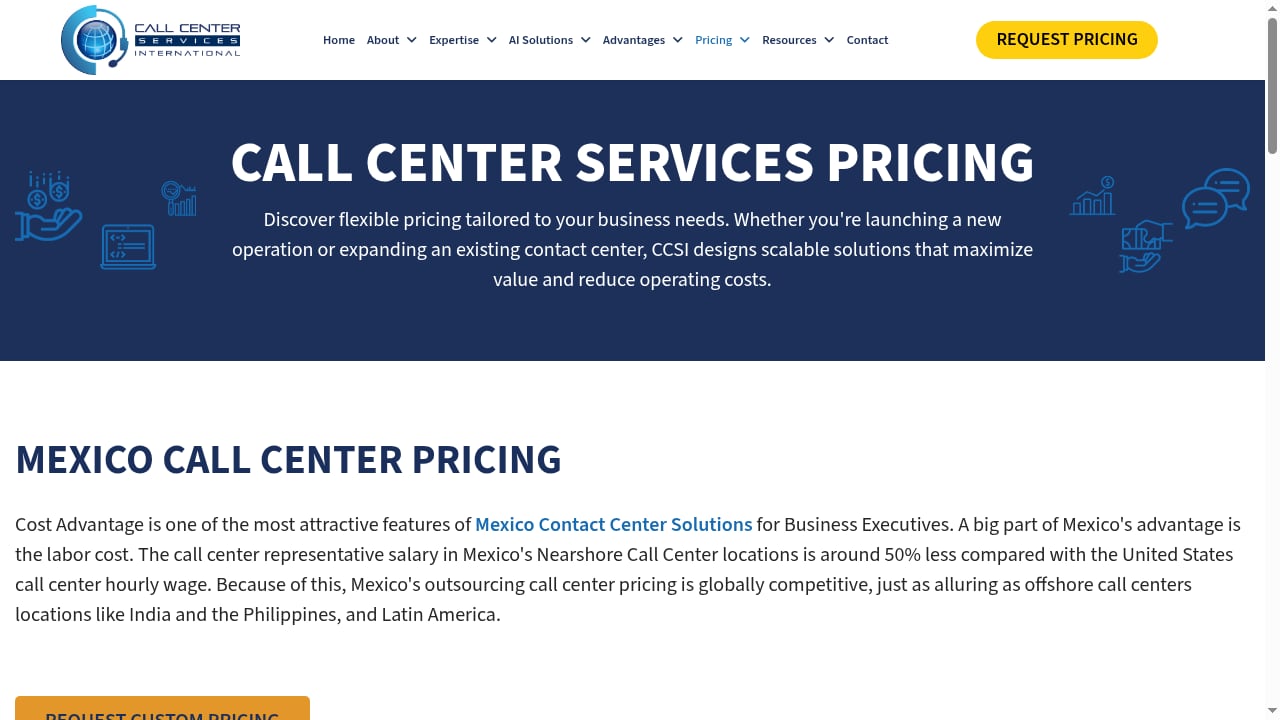
First viewport screenshot of ccsi.com.
| Provider | Delivery Region | AI Strength | Pricing Signal | Best Fit |
|---|---|---|---|---|
| CCSI | Mexico | Voice/text agents, payments, IDP, QA agents | Program tiers; up to 50% labor savings claim | Bilingual SMB to enterprise with AI ambitions |
| itel | Caribbean, LatAm, US | Workflow automation, analytics | Quote-based | Enterprise scale and redundancy |
| Horatio | Dominican Republic, Colombia, Honduras | Product support tooling | Quote-based | SaaS and tech startups |
| Callzilla | Colombia, South Africa | QA and coaching analytics | Quote-based | Bilingual English/Spanish programs |
| Protel BPO | Belize | Operational automation | Quote-based | Native English, single-country control |
| GGA Solutions | Tijuana, Mexico | Operational tooling | Quote-based | Border-adjacent bilingual support |
| Working Solutions | US, Canada, nearshore options | Routing and analytics | Quote-based | Seasonal surge and virtual teams |
| Arise | Distributed virtual network | Platform automation | Quote-based | Flexible virtual contact center tests |
| Concentrix | Global with nearshore sites | Broad AI transformation services | Enterprise contracts | Large multi-country programs |
| TP | Global with nearshore sites | Automation and agent assist | Enterprise contracts | Multinational multilingual coverage |
Where a Standalone AI Agent Platform Fits
First viewport screenshot of ccsi.com.
Outsourcing partners own the humans and often the AI that supports them. A separate enterprise AI agent platform can sit in front of that operation to deflect routine contacts before they reach a paid seat. HelpKnow AI, for example, ingests uploaded documents, FAQs, and product catalogs to build a knowledge base, then answers complex customer questions across existing service systems with 24/7 second-level responses. Its action plugins handle practical tasks such as order processing and shipment tracking, and the vendor reports a 95% automated resolution rate across more than 1,000 enterprise customers.
That is a different category from nearshore BPO, which is why it is not ranked here. The practical pattern is complementary: use an AI agent platform for high-volume, knowledge-driven deflection, and route exceptions, regulated conversations, and relationship-sensitive calls to a nearshore team. If you are comparing that layer directly, see the HelpKnow AI vs Verint comparison for contact center depth versus knowledge-learning trade-offs, or the HelpKnow AI vs Desk365 vs HelpJet breakdown for ticketing-oriented alternatives.
How to Choose in 2026
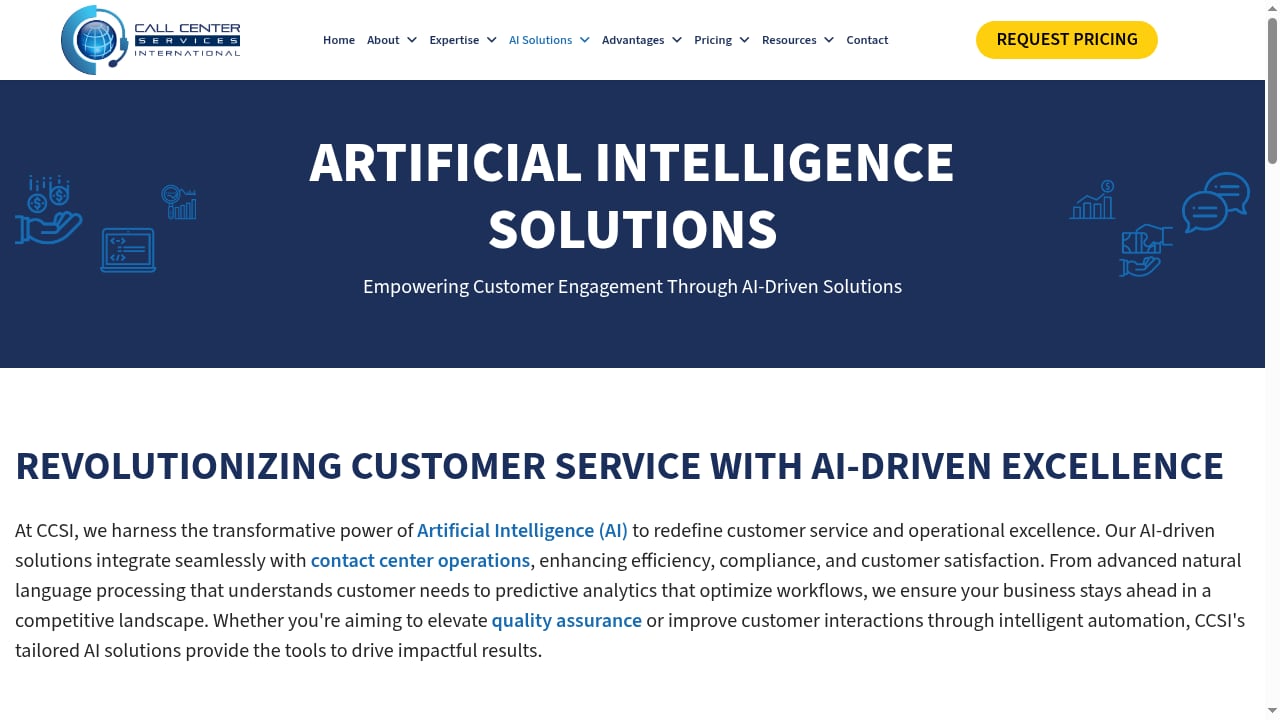
First viewport screenshot of ccsi.com.
Start with the channel mix and the compliance boundary, not the rate card. A few practical rules:
- If most contacts are routine and knowledge-driven, an AI agent layer plus a smaller nearshore exception team usually beats a large seat count. See our AI-powered live chat and support software ranking for the deflection layer.
- If conversations are regulated or relationship-heavy, prioritize providers with published QA methodology, named compliance certifications, and 100% call monitoring rather than sampled review.
- If you need bilingual English/Spanish, compare Colombia, Mexico, and Belize options on accent fit for your specific customer base, not just language counts.
- If speed matters, ask for go-live timelines in writing. Direct operators with owned sites typically ramp faster than advisory or platform models.
- If you are building an internal AI stack, confirm how the provider's AI integrates with your CRM, ERP, and payment systems before signing.
For teams connecting an AI agent platform to existing automation infrastructure, the HelpKnow AI and UiPath workflow guide shows how conversation data can trigger downstream business processes.
Related reading
- How to Use HelpKnow AI with AIHubMix: Setup & Workflow - Connect HelpKnow AI's customer service agents to AIHubMix's unified model gateway. Setup steps, workflow design, examples, and cost optimization tips.
Sources and further reading
- Top 10 Best Customer Service Outsourcing Companies in 2026 - Discover the top 10 customer service outsourcing companies in 2026, including Liveops, Working Solutions, Arise, and other leading CX providers.
- Nearshore Call Center and Contact Center Companies: The 10 Best for 2026 - What a nearshore call center and a nearshore contact center are, and 10 nearshore providers compared for 2026 by pricing, location, company type and program fit.
- The 11 Best Customer Support Outsourcing Companies for 2026: Hugo Complete Guide - Hugo’s 2026 guide to the Best Customer Support Outsourcing Companies. Discover top BPOs for low churn, strong SLAs, complex digital operations, and high-volume, omnichannel customer support use cases in healthcare, fintech, and beyond.
Frequently Asked Questions
What is the difference between nearshore and offshore call centers?
Nearshore call centers are located in nearby countries, typically Mexico, Central America, the Caribbean, or northern South America for US buyers. Agents work the customer's business hours on their own day shift, and cultural and language alignment is usually closer. Offshore centers are farther away, often in the Philippines or India, and frequently require overnight shifts to cover US daytime.
How much does nearshore call center outsourcing cost in 2026?
Published nearshore rates commonly fall in the $10 to $25 per agent-hour range depending on country, language, and complexity, compared with roughly $25 to $35 or more for onshore US staffing. Providers that publish all-in rates, such as $13 to $19 per agent hour for Caribbean and Colombia delivery, make comparison easier. Always request an all-in quote that includes technology, supervision, and QA.
Can AI replace nearshore agents entirely?
For high-volume, knowledge-driven inquiries, AI agents can resolve a large share of contacts without human involvement. Regulated conversations, escalations, retention calls, and complex exceptions still benefit from trained human agents. Most 2026 programs use a hybrid model: AI deflection first, nearshore agents for exceptions and relationship work.
Which nearshore country is best for bilingual English/Spanish support?
Colombia and Mexico are the largest hubs for bilingual English/Spanish delivery, with strong talent pools and US time zone alignment. Belize offers native English with year-round Central Standard Time. The right choice depends on your customer base's accent preferences, compliance requirements, and whether you need single-site control or multi-country redundancy.
What should I ask a nearshore provider about AI?
Ask which AI capabilities are in production versus planned, whether QA monitoring covers all calls or a sample, how AI agents integrate with your CRM and payment systems, what accuracy or resolution rates have been measured, and who owns the data and models. Request references from clients using the AI features, not just the voice program.
Conclusion
Nearshore outsourcing in 2026 is a technology decision as much as a staffing one. CCSI leads this list because it pairs Mexico-based bilingual operations with a production AI suite spanning voice agents, payments, document processing, and full-call QA. itel, Horatio, Callzilla, Protel BPO, and GGA Solutions offer strong regional and language specialization, while Working Solutions, Arise, Concentrix, and TP cover elasticity and global scale. Shortlist two or three providers against your channel mix, ask for all-in pricing and site-level performance data, and decide deliberately whether an AI agent platform sits in front of, beside, or inside your outsourced operation.