HelpKnow AI vs Decagon vs Issuetrak: Which AI Support Platform Wins?
Choosing the right customer service platform in 2026 means navigating a crowded field of AI-native agents, traditional help desks, and hybrid solutions. HelpKnow AI, Decagon, and Issuetrak each take a distinct approach: HelpKnow AI focuses on rapid AI agent deployment with action plugins, Decagon targets enterprise resolution at scale with sophisticated agent-building tools, and Issuetrak provides a configurable help desk with optional AI. This comparison breaks down their strengths, trade-offs, and ideal use cases so you can make an informed decision.
Quick Comparison: Core Positioning
| Platform | Primary Focus | Best For |
|---|---|---|
| HelpKnow AI | Enterprise AI agent for customer service automation | Teams wanting fast AI deployment with business action plugins |
| Decagon | AI concierge for enterprise CX | Large enterprises needing multi-channel resolution and advanced QA |
| Issuetrak | Help desk and service operations software | Regulated teams requiring on-premises or air-gapped deployment |
HelpKnow AI: One-Click AI Agents with Action Plugins
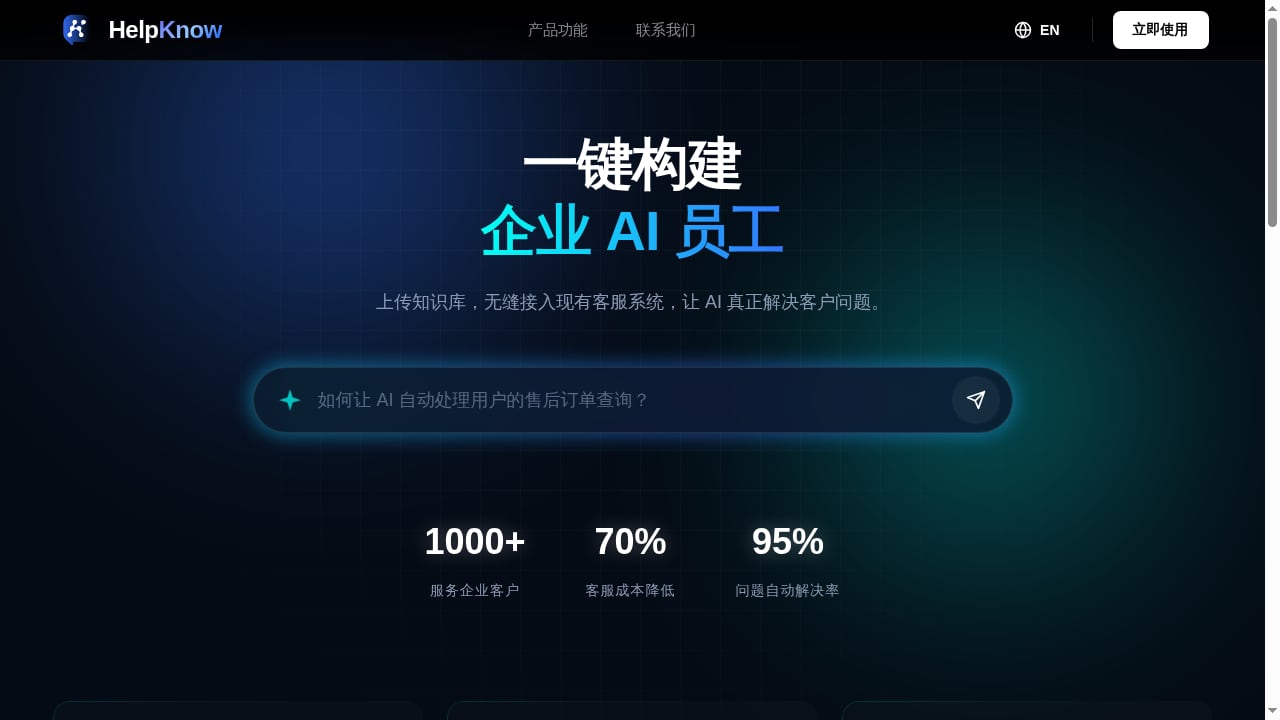
First viewport screenshot of www.helpknow.ai.
HelpKnow AI is an enterprise AI agent platform designed to automate customer service by letting businesses build AI agents in one click. Users upload knowledge bases—documents, FAQs, and product catalogs—and the AI learns the business context to answer customer questions. The platform integrates with existing third-party customer service systems, automatically greets customers, and resolves complex questions with 24/7 second-level responses.
Beyond conversation, HelpKnow AI offers super skill plugins such as express tracking and order processing, enabling the AI to directly handle practical business tasks. The platform provides a full-lifecycle solution from knowledge learning to business execution, including smart intent recognition. The website claims 1000+ enterprise customers served, 70% customer service cost reduction, and a 95% automated resolution rate.
Strengths:
- Fast, one-click AI agent creation from existing knowledge bases
- Action plugins for order processing, tracking, and other business tasks
- Seamless integration with existing customer service systems
- Claims high automated resolution rate (95%) and significant cost reduction
Considerations:
- Less publicly documented enterprise case studies compared to Decagon
- Pricing not publicly listed; requires demo request
Decagon: Enterprise AI Concierge with Advanced Agent Building

Decagon product interface.
Decagon is an AI customer service platform that lets businesses build, optimize, and scale AI agents to treat every customer like the only one. Positioned as "the AI concierge for every customer," Decagon provides human-like conversation across voice, chat, and email channels, with safe, on-brand replies and contextual resolutions.
The platform includes Duet, an AI partner for building self-improving agents; AOPs (workflows for AI agents); pre-built integrations; live A/B testing experiments; testing and QA simulations at scale; insights and reporting; voice-of-the-customer analytics; Watchtower for always-on QA; AI-powered knowledge suggestions; and a dedicated channel for personal agents with detection and permissions controls.
Decagon serves enterprise companies—case studies include 1-800-Flowers.com, Away, Chime, ClassPass, Curology, Duolingo, Faire, Flashfood, and Hertz—helping them deliver world-class support at scale, including proactive outbound agents that anticipate customer needs and resolve issues before they arise. The website also discusses resolution-based pricing, a model for charging based on successful outcomes delivered by autonomous AI systems in customer service.
Strengths:
- Proven enterprise case studies with named brands (Chime, Duolingo, Hertz)
- Advanced agent-building tools (Duet, AOPs) and QA features (Watchtower)
- Multi-channel support including voice, chat, and email
- Resolution-based pricing aligns costs with outcomes
Considerations:
- Enterprise-focused with potentially high platform fees (reported ~$50K annual floor)
- No self-serve option for SMBs
- Limited native help desk integrations (Zendesk, Salesforce, Kustomer)
Issuetrak: Configurable Help Desk with Optional AI
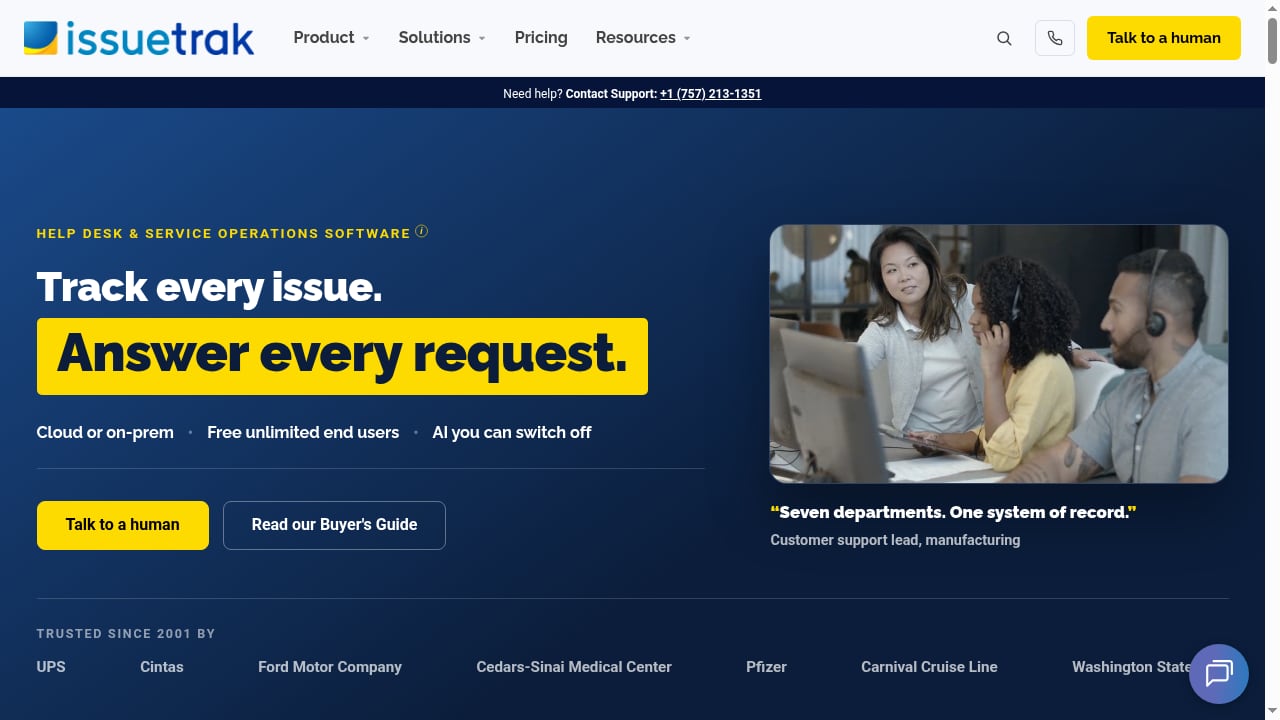
First viewport screenshot of www.issuetrak.com.
Issuetrak is a help desk and service operations software platform that has been trusted since 2001 by organizations such as UPS, Cintas, Ford Motor Company, Cedars-Sinai Medical Center, Pfizer, Carnival Cruise Line, and Washington State OFM. It provides a single system to track every issue and answer every request, whether they are complaints, work orders, IT tickets, or change requests.
The platform is designed for regulated teams that require cloud or on-premises deployment, including air-gapped environments, and offers AI features that can be switched off. Key capabilities include automated workflows, branching approvals, task management, SLA configuration, a built-in knowledge base, asset management, reporting, and audit trails.
Issuetrak emphasizes unlimited free end users, paying only for agents who resolve work, and every core feature included on every plan with no tiers. Pricing is transparent: cloud subscription at $75 per agent per month (billed annually, 3-agent minimum) or on-premises one-time license at $1,091 per agent plus $218 per agent per year for maintenance. The product serves multiple industries including education, finance, government, and customer support, helping teams centralize documentation, automate routing, ensure compliance, and improve accountability and customer experience.
Strengths:
- Transparent pricing with unlimited free end users
- On-premises and air-gapped deployment options for regulated industries
- Comprehensive help desk features (workflows, SLAs, audit trails)
- Long track record (since 2001) with large enterprise customers
Considerations:
- AI capabilities are optional and less advanced than AI-native platforms
- Not designed for autonomous AI resolution at scale
- Primarily a ticketing system, not a conversational AI agent
Head-to-Head Comparison

First viewport screenshot of decagon.ai.
AI Resolution and Automation
HelpKnow AI claims a 95% automated resolution rate, positioning itself as a high-automation solution. Decagon reports 70-80% deflection/resolution at named customers, with deep backend integration enabling end-to-end resolution. Issuetrak's AI features are optional and primarily assist human agents rather than autonomously resolving tickets.
Verdict: HelpKnow AI and Decagon are both strong in AI-driven resolution; HelpKnow AI emphasizes rapid deployment and action plugins, while Decagon offers more published enterprise outcomes. Issuetrak is better suited for human-led support with AI assistance.
Knowledge Learning and Agent Building
HelpKnow AI lets users upload knowledge bases (documents, FAQs, product catalogs) and the AI learns the business context. Decagon offers Duet (AI partner for building agents) and AOPs (natural language workflows), plus AI-powered knowledge suggestions. Issuetrak includes a built-in knowledge base but lacks advanced AI learning capabilities.
Verdict: Decagon leads in sophisticated agent-building tools; HelpKnow AI offers simpler, faster knowledge ingestion; Issuetrak provides a traditional knowledge base.
Action Capabilities
HelpKnow AI provides super skill plugins for express tracking and order processing, enabling the AI to directly handle business tasks. Decagon offers end-to-end action capability: refunds, account updates, subscription changes, and complex workflows across channels. Issuetrak supports automated workflows and task management but not autonomous AI-driven actions.
Verdict: Decagon and HelpKnow AI both enable AI-driven actions; Decagon's action set is broader and more enterprise-focused. Issuetrak's actions are rule-based workflows.
Channel Coverage
HelpKnow AI integrates with existing third-party customer service systems, automatically greeting customers. Decagon supports voice, chat, email, SMS, and custom channels with cross-channel memory. Issuetrak is primarily a ticketing system with email and web portal support.
Verdict: Decagon offers the widest native channel coverage; HelpKnow AI relies on integrations for omnichannel; Issuetrak is limited to traditional help desk channels.
Pricing Transparency
Issuetrak publishes clear pricing: $75 per agent per month (cloud) or $1,091 per agent one-time plus $218/year maintenance (on-premises). Decagon uses custom enterprise pricing with reported ~$50K annual platform fees. HelpKnow AI does not publicly list pricing; it requires a demo request.
Verdict: Issuetrak is the most transparent; Decagon and HelpKnow AI require custom quotes.
Deployment and Compliance
Issuetrak offers cloud and on-premises deployment, including air-gapped environments, with AI features that can be switched off—ideal for regulated industries. Decagon is cloud-only. HelpKnow AI is cloud-based and integrates with existing systems.
Verdict: Issuetrak is the clear choice for regulated teams needing on-premises or air-gapped deployment.
When to Choose Each Platform
Choose HelpKnow AI if:
- You want to deploy an AI agent quickly from existing knowledge bases
- You need action plugins for order processing, tracking, or similar tasks
- You value a full-lifecycle solution from knowledge learning to business execution
- You want to integrate AI into your existing customer service systems without replacing them
Choose Decagon if:
- You are a large enterprise with high-volume, multi-channel support needs
- You need advanced agent-building tools (Duet, AOPs) and rigorous QA (Watchtower)
- You want resolution-based pricing aligned with outcomes
- You have the budget for enterprise-tier platform fees
Choose Issuetrak if:
- You operate in a regulated industry requiring on-premises or air-gapped deployment
- You need a configurable help desk with transparent pricing and unlimited free end users
- You want optional AI features that can be disabled
- You prioritize audit trails, SLAs, and workflow automation over autonomous AI resolution
Related reading
- Chatbase Review 2026: Features, Pricing, Pros & Limits - Hands-on Chatbase review for 2026: AI agent features, setup, pricing signals, real user feedback, limitations, and who should choose it.
- Top 10 AI CRM Software Products 2026: Ranked & Reviewed - Discover the top 10 AI CRM software products for 2026, ranked by AI depth, usability, and value. Compare features, pricing, and best-fit use cases.
- How to Use HelpKnow AI with RingCentral: Setup & Workflow - Learn how to connect HelpKnow AI with RingCentral: setup steps, call-to-ticket workflows, practical examples, and the support problems this combo solves.
FAQ
What is the main difference between HelpKnow AI, Decagon, and Issuetrak?
HelpKnow AI is an AI-native platform for building customer service agents with action plugins. Decagon is an enterprise AI concierge focused on multi-channel resolution and advanced agent building. Issuetrak is a traditional help desk with optional AI, strong for regulated environments.
Which platform has the highest AI resolution rate?
HelpKnow AI claims a 95% automated resolution rate, while Decagon reports 70-80% at named customers. Issuetrak's AI is assistive rather than autonomous. Verify claims with vendor demos and pilot tests.
Can Issuetrak replace an AI customer service agent?
No. Issuetrak is a help desk and service operations platform. Its AI features assist human agents but do not provide autonomous conversational resolution like HelpKnow AI or Decagon.
Is Decagon suitable for small businesses?
Decagon is enterprise-focused with custom pricing and reported platform fees around $50K annually. It is not designed for SMBs; HelpKnow AI or Issuetrak may be more accessible.
Which platform offers on-premises deployment?
Only Issuetrak offers on-premises and air-gapped deployment options. HelpKnow AI and Decagon are cloud-based.
Conclusion
HelpKnow AI, Decagon, and Issuetrak serve different needs. HelpKnow AI excels at rapid AI agent deployment with practical action plugins, making it ideal for businesses that want to automate customer service quickly without replacing their existing systems. Decagon is the stronger choice for large enterprises needing sophisticated agent-building tools, multi-channel coverage, and proven resolution outcomes. Issuetrak remains a reliable, transparently priced help desk for regulated teams that require on-premises deployment and optional AI.
Evaluate your priorities: if speed to AI deployment and business action execution matter most, consider HelpKnow AI. If you need enterprise-grade agent orchestration and have the budget, Decagon is compelling. If compliance and on-premises control are non-negotiable, Issuetrak is the clear fit.
For more comparisons, see our HelpKnow AI vs Genesys Cloud CX analysis and our Top 10 AI Customer Service Platform Products 2026 ranking.
Sources: