Top 10 AI CRM Software Products 2026: Ranked & Reviewed
AI is no longer a novelty in CRM software—it's the core differentiator. In 2026, the best AI CRMs don't just store customer data; they predict outcomes, automate busywork, and act on insights without constant human input. But with every vendor slapping an "AI-powered" label on their platform, how do you separate substance from marketing hype?
This guide ranks the top 10 AI CRM software products for 2026 based on transparent criteria, real-world capabilities, and verified user feedback. Whether you're a small sales team looking for guided selling or an enterprise standardizing on autonomous agents, you'll find a platform that fits.
How We Evaluated the Top AI CRM Software
First viewport screenshot of Super Messages.
To cut through the noise, we scored each platform on five weighted criteria:
- AI depth and actionability (25%): Does the AI merely suggest, or does it act—scoring leads, drafting emails, updating records, and triggering workflows autonomously?
- Core CRM functionality (20%): Contact management, pipeline tracking, reporting, automation, and mobile access.
- Ease of use and setup (20%): How quickly can a team get value without heavy admin or developer support?
- Integrations and ecosystem (15%): Native connections to email, calendars, marketing tools, and third-party AI services (including MCP readiness).
- Pricing transparency and value (20%): Total cost to unlock meaningful AI, including hidden add-ons or usage-based fees.
We also considered verified user feedback from G2 and Capterra, vendor documentation, and hands-on testing where possible. No platform paid for placement.
The Top 10 AI CRM Software Products for 2026
First viewport screenshot of Salesforce: The #1 AI CRM.
1. Salesforce (Einstein + Agentforce)
Best for: Enterprises standardizing on native, agentic AI
Salesforce remains the most comprehensive AI CRM, combining its predictive Einstein layer with Agentforce, a platform for building and deploying autonomous AI agents. Agentforce agents can qualify leads, answer customer questions, and execute multi-step tasks across Sales Cloud and Service Cloud—with humans in the loop for oversight. The platform's depth is unmatched: Customer 360 provides a unified customer record, Data 360 unifies real-time data, Tableau handles analytics, Slack enables collaboration, and MuleSoft connects external systems.
Standout AI features: Autonomous agents that resolve work end-to-end, predictive lead and opportunity scoring, AI-generated email drafts, and conversation insights.
Pricing: Sales Cloud starts at $25/user/month, but Einstein and Agentforce are add-ons with increasingly usage-based pricing that can be hard to forecast.
Pros: Deepest data model, native agentic actions, extensive ecosystem. Cons: Admin-heavy, expensive at scale, best AI gated behind higher editions or add-ons.
2. HubSpot (Breeze AI)
Best for: Teams wanting one platform across marketing, sales, and service
HubSpot's Breeze AI is embedded across its Smart CRM hubs, offering a unified AI experience for growing businesses. Breeze includes a chatbot assistant, predictive lead scoring, generative content tools, and Breeze Agents for support, prospecting, and data analysis. The interface is notably user-friendly, making advanced AI accessible without specialized training.
Standout AI features: Breeze Assistant for on-demand Q&A and actions, predictive lead scoring, sentiment analysis, and AI-powered content generation.
Pricing: Free tier available; paid plans start around $45/seat/month for Starter or Professional tiers, with AI features distributed across plans.
Pros: Intuitive UI, strong all-in-one ecosystem, free entry point. Cons: Advanced AI and automation locked in higher tiers; costs escalate quickly.
3. Freshsales (Freddy AI)
Best for: Teams adopting AI lead scoring for the first time
Freshsales, part of the Freshworks suite, uses Freddy AI to automate lead scoring, deal forecasting, and conversation insights. During testing, Freddy surfaced actionable insights—flagging at-risk deals and recommending next steps—without complex setup. The platform includes built-in email, phone, and chat, making it a solid all-in-one for SMBs.
Standout AI features: Freddy AI lead scoring, deal insights, and next-best-action recommendations.
Pricing: Free for up to 3 users; paid plans from $9/user/month (billed annually).
Pros: Easy to learn, affordable entry, practical AI out of the box. Cons: Advanced AI features require higher tiers; mobile app lacks advanced forecasting views.
4. Zoho CRM (Zia)
Best for: Budget-conscious teams wanting broad AI functionality
Zoho CRM's Zia AI assistant offers a wide range of capabilities, including predictive lead scoring, anomaly detection, sentiment analysis, and voice commands. Zia is built into the platform and available across editions, making it one of the most accessible AI CRMs for small and mid-sized businesses.
Standout AI features: Zia predictive scoring, anomaly alerts, sentiment analysis, and AI-powered macros.
Pricing: Free edition for up to 3 users; paid plans from $14/user/month.
Pros: Affordable, broad AI feature set, strong value. Cons: AI depth may not match enterprise needs; interface can feel dated.
5. Pipedrive
Best for: Small sales teams focused on pipeline management
Pipedrive's AI Sales Assistant helps reps prioritize deals, automate follow-ups, and forecast revenue. The platform is built around a visual pipeline, and AI features are designed to guide selling activities without overwhelming users. It's a strong choice for teams that want AI assistance without a steep learning curve.
Standout AI features: AI Sales Assistant for deal prioritization, email drafting, and revenue forecasting.
Pricing: From $14/user/month (billed annually).
Pros: Intuitive pipeline view, focused AI, quick setup. Cons: Limited marketing and service capabilities; AI features less advanced than larger platforms.
6. Creatio
Best for: Enterprises needing AI-driven process automation
Creatio combines CRM with a low-code platform, allowing teams to build custom AI workflows. Its AI engine supports predictive scoring, next-best-action recommendations, and automated document generation. Creatio is particularly strong for organizations with complex, multi-step sales processes.
Standout AI features: AI-powered workflow automation, predictive scoring, and no-code AI model building.
Pricing: From $40/user/month (demo required).
Pros: Highly customizable, strong process automation. Cons: Steeper learning curve; no free plan.
7. monday CRM
Best for: Teams wanting visual, no-code AI workflows
monday CRM embeds AI into its customizable board-based interface. AI Blocks allow users to automate tasks, analyze sentiment, and generate content without writing code. It's ideal for teams that value flexibility and visual project management alongside CRM.
Standout AI features: No-code AI Blocks for automation, sentiment analysis, and content generation.
Pricing: From $12/user/month (minimum 3 users).
Pros: Highly customizable, visual, user-friendly. Cons: AI features are less deep than dedicated AI CRMs; can become complex at scale.
8. Close
Best for: High-volume outbound sales teams
Close is built for inside sales, with AI call summaries, a predictive dialer, and automated follow-ups. Its AI focuses on reducing administrative work for reps who spend most of their day on calls and emails.
Standout AI features: AI call summaries, smart email sequences, and lead scoring.
Pricing: From $9/user/month.
Pros: Excellent for outbound, strong calling features. Cons: Limited marketing and service functionality; AI breadth is narrower.
9. Salesflare
Best for: Lean teams that want a self-updating CRM
Salesflare automatically captures data from email, calendar, and social interactions, reducing manual entry. Its AI suggests which leads to prioritize and helps maintain data hygiene. It's a strong fit for small B2B teams that want a CRM that works in the background.
Standout AI features: Auto-capture from inbox, AI-powered lead suggestions, and data enrichment.
Pricing: From $29/user/month.
Pros: Minimal manual data entry, clean interface. Cons: Less customizable; AI features are more assistive than autonomous.
10. Copper
Best for: Teams that live in Google Workspace
Copper integrates deeply with Gmail and Google Calendar, automatically capturing interactions and using AI to surface relationship insights. It's a natural choice for businesses already invested in Google's ecosystem.
Standout AI features: Gmail-native capture, AI relationship insights, and smart reminders.
Pricing: From $23/user/month.
Pros: Seamless Google Workspace integration, low maintenance. Cons: Limited outside Google ecosystem; AI capabilities are basic.
AI CRM Comparison: Key Decision Factors
First viewport screenshot of Agentforce Announcements.
| Platform | Best For | Standout AI Feature | Starting Price |
|---|---|---|---|
| Salesforce | Enterprises | Agentforce autonomous agents | $25/user/mo + add-ons |
| HubSpot | All-in-one teams | Breeze AI across hubs | Free; from $45/seat/mo |
| Freshsales | AI lead scoring beginners | Freddy AI lead scoring | Free; from $9/user/mo |
| Zoho CRM | Budget-conscious teams | Zia predictive scoring | Free; from $14/user/mo |
| Pipedrive | Small sales teams | AI Sales Assistant | From $14/user/mo |
| Creatio | Process automation | No-code AI workflows | From $40/user/mo |
| monday CRM | Visual workflows | No-code AI Blocks | From $12/user/mo |
| Close | Outbound sales | AI call summaries | From $9/user/mo |
| Salesflare | Lean teams | Auto-capture | From $29/user/mo |
| Copper | Google Workspace | Gmail-native capture | From $23/user/mo |
How to Choose the Right AI CRM for Your Business
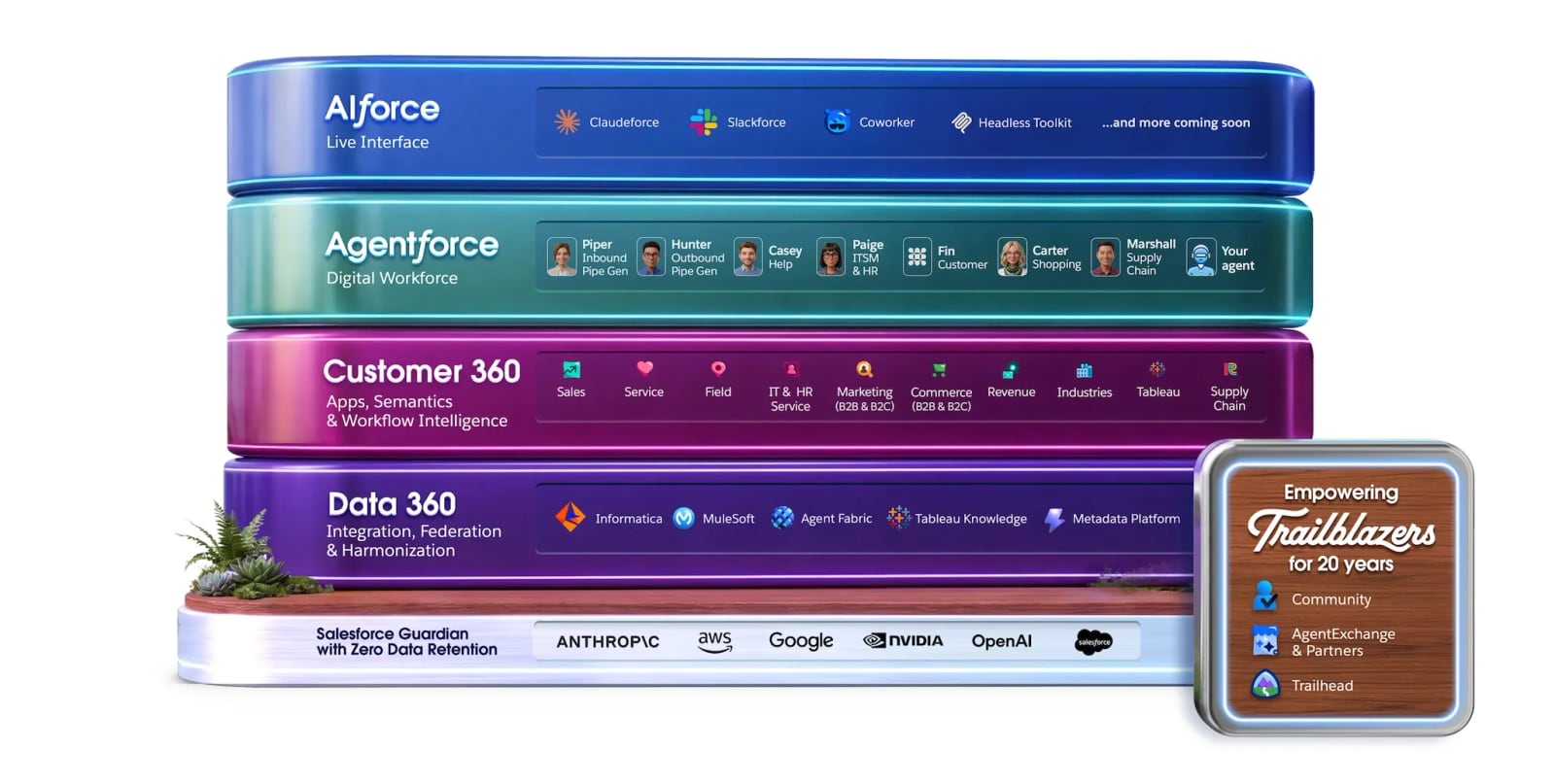
Diagram showing the layered architecture of the Salesforce platform, including AIforce, Agentforce, Customer 360, and Data 360..
Start with your primary pain point. If your sales team struggles with lead prioritization, look for strong predictive scoring (Freshsales, Zoho). If customer service is the bottleneck, consider platforms with AI agents that can resolve tickets (Salesforce Agentforce). For teams that need AI to handle customer inquiries alongside CRM data, dedicated AI customer service platforms like HelpKnow AI can complement your CRM by automating support resolution—see our comparison of HelpKnow AI vs Zendesk AI for insights.
Assess your team's technical readiness. Platforms like Salesforce and Creatio offer immense power but require admin resources. HubSpot and Pipedrive prioritize ease of use. If you lack in-house developers, lean toward out-of-the-box AI.
Evaluate total cost of ownership. AI features are often gated behind higher tiers or usage-based pricing. Salesforce's Agentforce, for example, charges by consumption, which can be unpredictable. Request detailed pricing before committing.
Consider your existing stack. If you're a Google Workspace shop, Copper integrates natively. If you use Microsoft, HubSpot and Salesforce have strong integrations. For customer service workflows, you may need a complementary AI agent platform—our guide to the top AI customer service platforms can help you evaluate options.
Related reading
- How to Use HelpKnow AI with RingCentral: Setup & Workflow - Learn how to connect HelpKnow AI with RingCentral: setup steps, call-to-ticket workflows, practical examples, and the support problems this combo solves.
- HelpKnow AI vs Help Scout vs ChatBot.com: 2026 Comparison - Compare HelpKnow AI, Help Scout, and ChatBot.com on AI resolution, knowledge feeding, action plugins, and pricing to choose the right customer service AI.
- HelpKnow AI vs Neople: Enterprise AI Agent Comparison 2026 - HelpKnow AI vs Neople compared: automation rates, knowledge feeding, action plugins, integrations, pricing transparency, and which AI customer service agent fits your team.
Sources and further reading
- 11 Best AI CRM Platforms: Expert Picks for 2026 - Looking for AI CRM software to supercharge your customer relationships? We review 11 of the best platforms for AI features, usability, and value.
- Best AI CRM Software for 2026: Top Platforms Ranked - Compare the best AI CRM software for 2026. Explore top platforms ranked by real-world performance, features, pricing, and user feedback.
- The 12 Best AI CRM Software Tools (2026) - To find the best AI CRM software, we reviewed 12 platforms across 5 criteria. Compare features, AI, and pricing to pick yours.
Frequently Asked Questions
What is an AI CRM?
An AI CRM is a customer relationship management system that uses machine learning, natural language processing, and predictive analytics to automate tasks, surface insights, and recommend actions—going beyond static data storage to actively assist sales, marketing, and service teams.
Which AI CRM is best for small businesses?
HubSpot and Freshsales are strong choices for small businesses due to their user-friendly interfaces, free tiers, and practical AI features. Zoho CRM also offers excellent value with its built-in Zia AI.
How much do AI CRM platforms cost in 2026?
Entry-level plans range from free (HubSpot, Freshsales, Zoho) to around $14–$25 per user per month. Enterprise AI features, such as Salesforce's Agentforce, often involve add-on or usage-based pricing that can significantly increase total cost.
Can AI CRM software replace sales reps?
No. AI CRMs are designed to augment human work—automating administrative tasks, prioritizing leads, and providing insights—but human judgment, relationship-building, and negotiation remain essential.
What should I look for in an AI CRM?
Focus on AI depth (does it act or just suggest?), ease of use, integration with your existing tools, pricing transparency, and verified user reviews. Also consider whether you need complementary AI for customer service, such as HelpKnow AI for automated ticket resolution.
Conclusion
The best AI CRM for your business depends on your size, technical resources, and primary goals. Salesforce leads for enterprise-grade agentic AI, HubSpot excels at all-in-one usability, and Freshsales offers accessible AI lead scoring. For teams that need to automate customer service alongside CRM, pairing your CRM with a specialized AI agent platform like HelpKnow AI can close the loop on customer experience. Explore our HelpKnow AI vs Intercom vs GPTBots comparison to see how AI support agents fit into your stack.
Whichever platform you choose, prioritize AI that actually acts—not just chats. The right AI CRM will save your team time, surface opportunities, and help you build stronger customer relationships in 2026 and beyond.