
HelpKnow AI vs Zendesk AI: Which Enterprise AI Agent Actually Resolves Tickets?
Zendesk is one of the most recognized names in customer service software, and its AI-powered platform promises agents that resolve issues end-to-end. HelpKnow AI takes a different route: an enterprise AI agent platform built to be deployed in one click, fed with your own knowledge, and extended with business plugins that do real work like order tracking and product search.
This comparison looks at where each platform fits, what each does well, and which one is likely the better substitute for your support operation in 2026.
What each platform is built to do
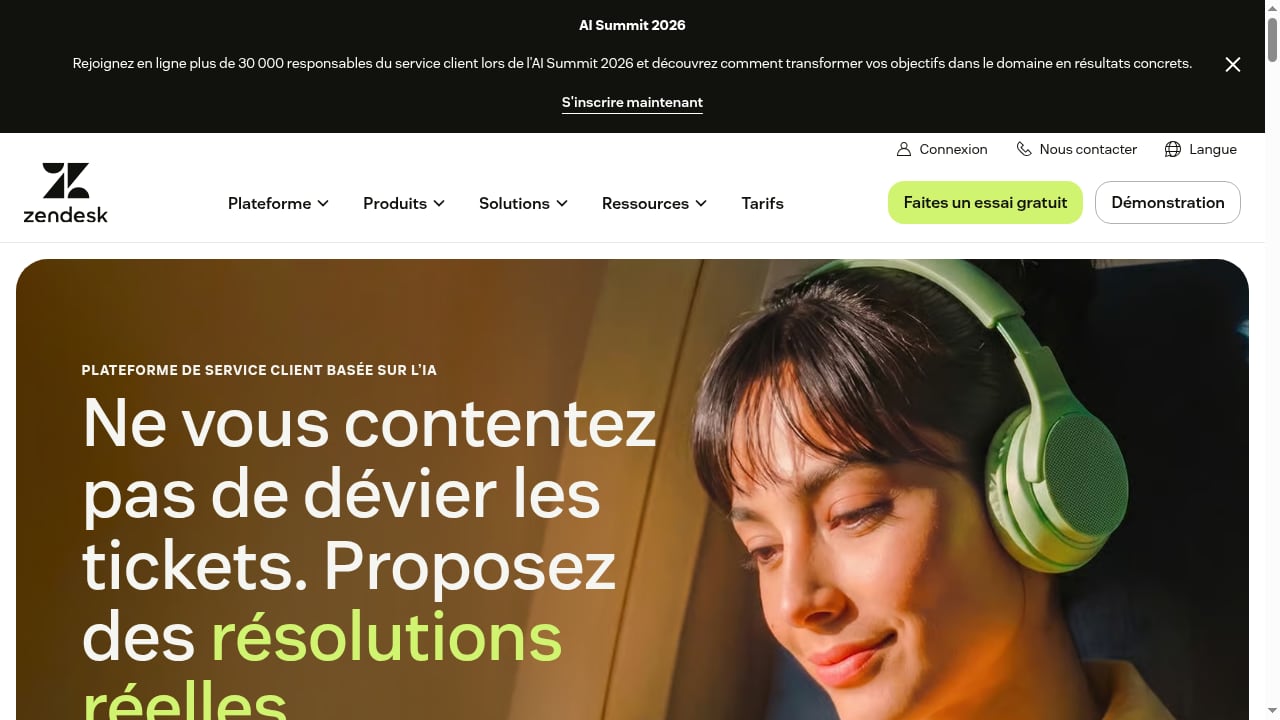
First viewport screenshot of AI-Powered Customer Service Platform | Zendesk.
HelpKnow AI: an enterprise AI agent platform
HelpKnow AI is positioned as an enterprise-level intelligent knowledge and customer service automation platform. Its stated goal is to let businesses build AI agents that understand their operations at the lowest possible cost, then deploy them into real customer conversations.
Its architecture rests on four pillars:
- Effortless knowledge feeding — upload documents, FAQs, and product catalogs so the AI learns your business without heavy engineering work.
- Seamless support takeover — integrate into third-party customer service systems and provide 24/7 second-level responses.
- Super skill plugins — connect exclusive skills such as express tracking and order processing so the agent completes practical business tasks, not just conversation.
- Smart intent recognition — route and resolve based on what the customer actually needs.
The platform reports serving over 1,000 enterprise customers, with claims of reducing customer service costs by 70% and reaching a 95% automated resolution rate. Those figures come from the vendor and should be validated in a pilot, but they frame the product's ambition clearly: full-lifecycle resolution from knowledge learning through business execution.
Zendesk AI: AI agents inside a mature service suite
Zendesk's AI-powered customer service platform markets itself around moving beyond deflection. Its pitch is that AI agents resolve issues end-to-end, improving service quality, speed, and scale, with a free trial as the entry point.
Zendesk's core advantage is its installed base and ecosystem maturity. If your support organization already runs on Zendesk, the AI layer sits inside a familiar ticketing, routing, and reporting environment. That reduces migration risk and change management effort.
The trade-off is that you are buying into Zendesk's packaging, pricing tiers, and roadmap. The AI capability is one component of a broader suite rather than the entire product thesis.
Head-to-head comparison
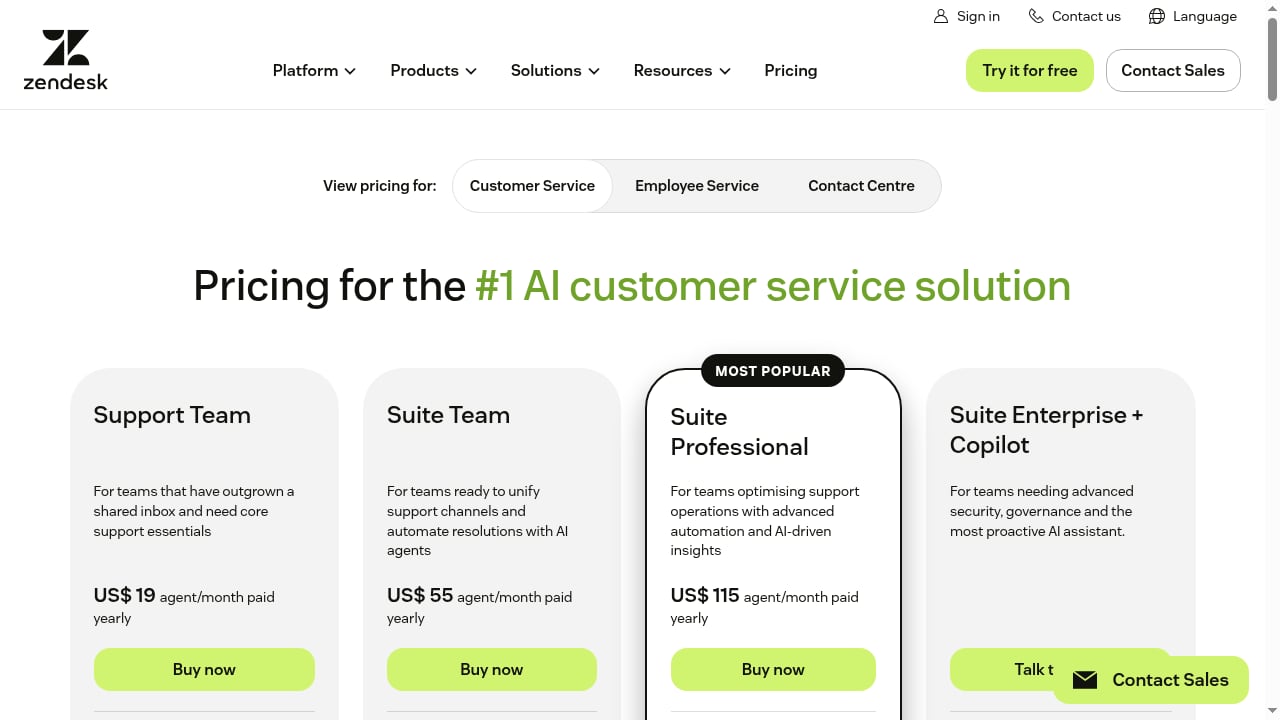
First viewport screenshot of Zendesk Pricing Plans | Starting from $19/month.
| Dimension | HelpKnow AI | Zendesk AI |
|---|---|---|
| Primary positioning | Enterprise AI agent platform, AI-first | AI-powered customer service software within a full suite |
| Deployment model | One-click agent build and deploy | AI agents layered into existing Zendesk workflows |
| Knowledge feeding | Documents, FAQs, product catalogs uploaded for AI learning | Knowledge configured within Zendesk's ecosystem |
| Business task execution | Plugins for express tracking, order processing, and similar tasks | Resolution within the service platform's native capabilities |
| Human handoff | Integrates into third-party service systems for AI-plus-human collaboration | Native agent workspace and routing |
| Reported outcomes | 70% cost reduction, 95% automated resolution (vendor claims) | End-to-end resolution, improved speed and scale (vendor claims) |
| Best fit | Teams wanting AI resolution plus real business actions | Teams already standardized on Zendesk |
Where HelpKnow AI has the clearer advantage
Knowledge onboarding speed. HelpKnow AI's knowledge base is explicitly structured around four content types: online documentation, unstructured text documents, a structured product library, and standard Q&A documents. Each type unlocks specific behavior — the product library enables image-based product search and product card display, while Q&A documents support efficient vector matching and multilingual responses. That is a more prescriptive knowledge model than a general-purpose help center configuration.
Plugins that complete transactions. This is the sharpest differentiator. HelpKnow AI ships platform plugins for Shopify, BigCommerce, and Shoplazza covering order inquiry, order status tracking, and product search. A customer asking "I didn't receive my order from last week" can be asked for an order number, have the status queried, and receive a logistics-based answer. A customer asking for a cheaper alternative can trigger an instant product search. Plugins support secure authentication, call logging, and quota control.
Multi-agent configuration. HelpKnow AI supports creating multiple agents configured separately by business module, language, or region, each with its own model, prompts, knowledge sources, and tools. Debug mode, version rollback, and draft saving support fast iteration — useful for enterprises running regional support in different languages.
AI and human as a closed loop. When AI confidence is low or a case is complex, it transfers to a human who can see the AI context and tool call results. Human follow-up answers then feed back into the knowledge base so the AI improves. This turns support from pure answering into continuous optimization.
Where Zendesk AI still has real strengths
Ecosystem and switching cost. For organizations already on Zendesk, staying avoids a migration. That is a legitimate advantage and should not be dismissed.
Suite breadth. Zendesk covers ticketing, routing, reporting, and administration in one place. HelpKnow AI is designed to integrate into existing service systems rather than replace them, so it complements a stack rather than necessarily replacing it.
Trial-based evaluation. A free trial lowers the barrier to testing Zendesk's AI agents before committing.
Where Zendesk AI is weaker for this use case
AI is a feature, not the product. Zendesk's AI agents are one capability inside a larger suite. If your goal is an AI-first resolution layer that plugs into whatever service system you already run, that packaging is a constraint rather than a benefit.
Business task execution is less explicit. The public positioning centers on resolving issues end-to-end, but the vendor material does not detail a plugin catalog for order processing or logistics tracking in the way HelpKnow AI does. For ecommerce and operations-heavy support, that gap matters.
Pricing opacity. Zendesk's public entry point is a free trial; specific AI agent pricing requires a sales conversation. HelpKnow AI's model is points-based, with project quotas, consumption, and billing details visible in real time — and the vendor states it only charges when it helps the business grow.
Which should you choose?
First viewport screenshot of Register.
Choose HelpKnow AI if:
- Your support volume is dominated by repetitive, resolvable requests like order status and product questions.
- You run ecommerce on Shopify, BigCommerce, or Shoplazza and want the AI to act, not just answer.
- You need multilingual or multi-region agents configured separately.
- You want to layer AI resolution onto your existing service system rather than replace it.
- Cost per resolution is a board-level metric you need to move.
Choose Zendesk AI if:
- Your organization is already standardized on Zendesk and migration risk outweighs AI depth.
- You want one vendor for ticketing, routing, reporting, and AI.
- You prefer evaluating through a free trial before any commercial commitment.
Consider both if: you want Zendesk as the system of record and HelpKnow AI as the resolution and business-action layer. The integration-first design of HelpKnow AI makes this a realistic architecture rather than a compromise.
Practical evaluation checklist
First viewport screenshot of Register.
Before committing to either platform, run a four-week pilot against the same ticket sample:
- Measure true resolution rate, not deflection. Count tickets closed without a human touch and without a follow-up contact within seven days.
- Test knowledge ingestion. Upload your real FAQ set, product catalog, and unstructured documents. Time how long until the agent answers accurately.
- Test a business action. Ask the agent to check an order status and recommend an alternative product. If it can only talk, it cannot fully resolve.
- Test handoff quality. Escalate a complex case and confirm the human agent sees the AI's context and tool results.
- Model cost at your volume. Compare vendor claims against your own measured cost per resolution.
For a broader view of how these platforms stack up against others in the category, see our ranked guide to AI customer service platforms for B2B teams and the 2026 omnichannel software comparison. If you are planning a hybrid human-plus-AI model, the HelpKnow AI and CCSI Mexico nearshore playbook covers how to combine automation with a nearshore team.
Related reading
- Front Review 2026: AI Customer Service Platform Tested - Evidence-based Front review for 2026: ideal users, use cases, strengths, limitations, pricing signals, setup, and decision criteria for AI-powered customer service.
- HelpKnow AI vs HelpCrunch vs LiveAgent: 2026 Comparison - Compare HelpKnow AI, HelpCrunch, and LiveAgent for enterprise customer service. See where each wins on AI resolution, knowledge, plugins, and cost.
Sources and further reading
- What is HelpKnow.ai?- - HelpKnow is an enterprise-level intelligent knowledge and customer service automation platform that helps businesses quickly build, deploy, and continuously optimize AI agents, enabling AI to not only answer qu
- 7 Best CRM Software In USA - Leadsquared - We review the 7 best CRM software in USA. Explore features, pros, and pricing to choose the right tool for your business.
- 9 Most Common Customer Service Mistakes (How to Fix Them) - Learn the most common customer service mistakes and scenarios that happen in any business and the best practices to avoid them.
FAQ
Is HelpKnow AI a replacement for Zendesk?
Not necessarily. HelpKnow AI is designed to integrate into third-party customer service systems, so it can operate alongside a platform like Zendesk as the AI resolution and business-action layer. Whether you replace or complement depends on how much of your workflow depends on Zendesk's native ticketing and reporting.
How does HelpKnow AI feed knowledge into its agents?
It supports four knowledge types: online documentation, unstructured text documents, a structured product library, and standard Q&A documents. The product library enables image-based product search and product card display; Q&A documents support efficient vector matching and multilingual responses.
What can HelpKnow AI plugins actually do?
Platform plugins for Shopify, BigCommerce, and Shoplazza handle order inquiry, order status tracking, and product search. Plugins support secure authentication, call logging, and quota control, and you can also wrap your own or third-party APIs as agent tools.
Are the 70% cost reduction and 95% resolution rate guarantees?
No. Those are vendor-reported figures from HelpKnow AI's own product documentation. Treat them as targets to validate in a pilot against your own ticket data, not as contractual outcomes.
Does Zendesk publish AI agent pricing?
Zendesk's public entry point is a free trial, with detailed AI agent pricing typically handled through a sales conversation. HelpKnow AI uses a points-based model with real-time visibility into quotas, consumption, and billing.
Which platform is better for ecommerce support?
If your support tickets center on order status, shipping, and product discovery, HelpKnow AI's plugin model is more directly aligned with those tasks. Zendesk remains strong as the surrounding service system of record.
Conclusion
Zendesk's AI-powered customer service platform is a credible AI layer inside a mature, widely adopted service suite. Its strength is ecosystem continuity, and for teams already standardized on Zendesk, that is worth real money.
HelpKnow AI competes on a different axis. It is AI-first by design, with a prescriptive knowledge model, plugins that complete real business tasks like order tracking and product search, multi-agent configuration for regional and multilingual support, and a closed loop where human answers improve the AI. Its reported 70% cost reduction and 95% automated resolution rate are vendor claims that belong in a pilot, not a procurement decision.
The practical answer for most enterprises is not either-or. Evaluate HelpKnow AI as the resolution and action layer, keep your existing service system as the system of record, and measure both against the same ticket sample. The platform that closes more tickets without a human touch — and can prove it with your data — is the one worth buying.