Top 10 AI Customer Service Platforms for B2B Teams 2026
B2B support has never looked like consumer support. Ticket volumes are lower, but each conversation carries more revenue, more technical depth, and more systems context. That is why the AI customer service platform for B2B teams category now splits into two distinct jobs: a customer-facing agent that resolves requests end to end, and an agent-facing copilot that makes human specialists faster on everything the AI should not touch alone.
This 2026 review ranks ten platforms that genuinely belong to that category. Every entry is scored on the same transparent criteria, with evidence drawn from vendor documentation, published pricing, and buyer-facing research.
How we evaluated these platforms
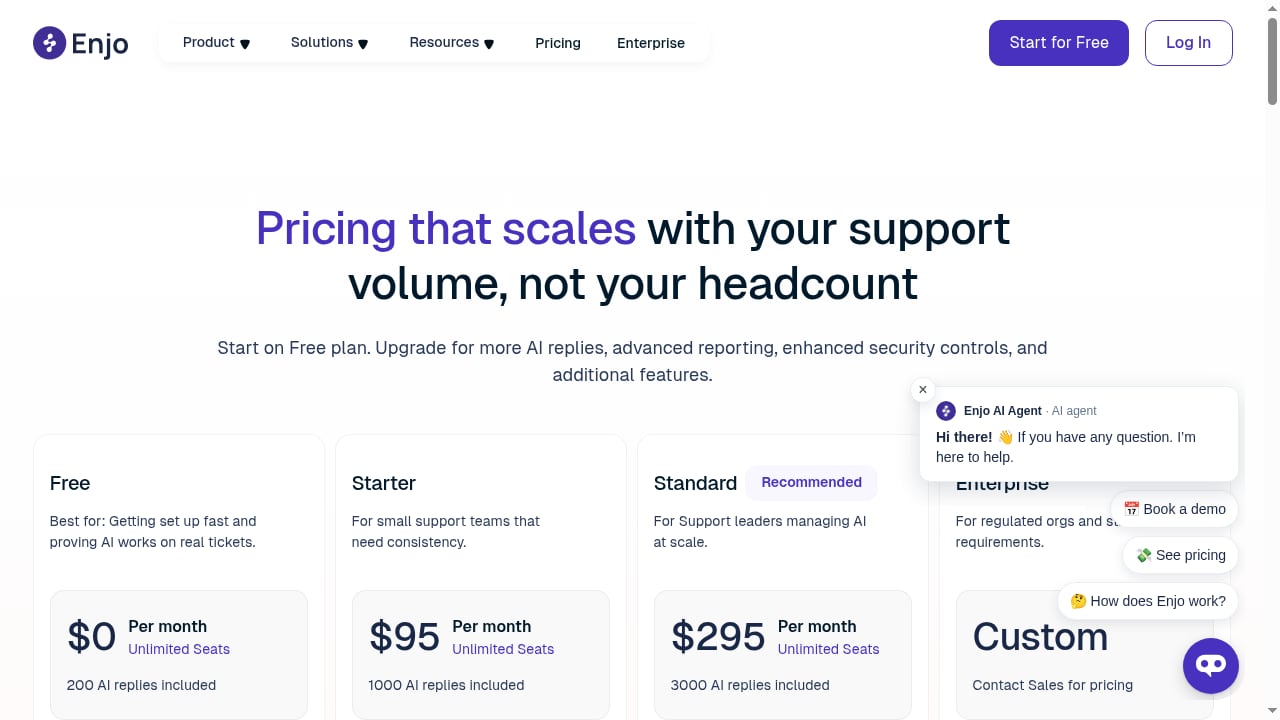
First viewport screenshot of Enjo Pricing | Free & Scalable AI Support Automation Plans.
No single metric decides a B2B support purchase. We weighted six criteria that repeatedly show up in real evaluations:
- Autonomous resolution depth — can the AI resolve a request end to end, including taking action in connected systems, or does it only suggest replies?
- Knowledge source flexibility — does it read only its own help center, or can it index Confluence, Notion, SharePoint, Google Drive, and historical tickets?
- Integration and architecture — native Slack, Microsoft Teams, email, and voice coverage, plus API-first design and bring-your-own-agent support.
- Governance and compliance — SOC 2, ISO 27001, GDPR, audit logs, role-based access, and hallucination controls.
- Pricing predictability — per-seat, per-resolution, per-conversation, or credit-pool models, and how the math behaves at 10, 30, and 100 agents.
- Time to production — days versus multi-quarter rollouts, and whether migration is required.
Market data supports treating AI capability as an entry requirement rather than a differentiator. Salesforce's State of Service: AI Agents Edition found AI agent adoption across service teams rose from 39% to 66% in a single year, with 70% of current users reporting measurable value within 60 days.
The 10 best AI customer service platforms for B2B teams in 2026
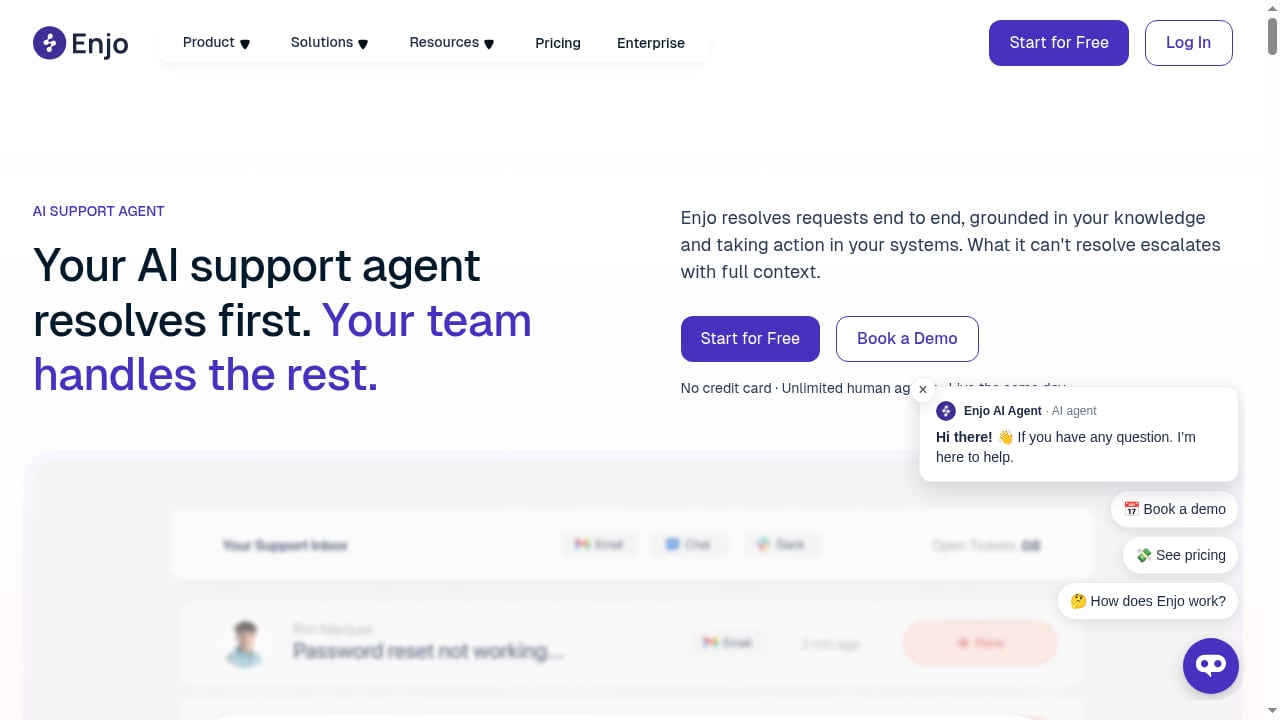
First viewport screenshot of Enjo | AI Support Agent That Resolves Requests End to End.
| Platform | Best for | AI architecture | Pricing signal |
|---|---|---|---|
| Enjo | B2B teams on any helpdesk | Overlay AI agent plus agent assist | Free tier, paid from $95/mo |
| Plain | API-first B2B SaaS | AI-native agent and copilot | From $35/mo |
| Zendesk | Large enterprise | Helpdesk-native AI agents | From ~$55/agent/mo |
| Intercom (Fin) | PLG and chat-first teams | Purpose-trained service model | Per seat plus per resolution |
| Salesforce Agentforce | Salesforce-standardized orgs | CRM-native reasoning engine | ~$2.00 per conversation |
| Ada | Multilingual digital support | Standalone AI-first agent | Outcome-based, quote only |
| Decagon | High-volume consumer brands | Procedure-driven automation | Platform fee plus usage |
| Sierra | Enterprises with build budget | No-code agent studio | Outcome-based, quote only |
| Forethought | Teams on Zendesk, Freshdesk, Salesforce | Overlay triage and assist | Quote only |
| Freshworks Freddy AI | Existing Freshdesk customers | Helpdesk-native agent | $0.10–$0.49 per session |
1. Enjo — best AI layer for B2B teams that want to keep their helpdesk
Enjo resolves support requests end to end, grounded in your knowledge and taking action in your systems. It connects to your existing helpdesk, knowledge sources, and channels — Slack, Microsoft Teams, email, and web — without requiring migration, and it works as a standalone support platform if you are starting fresh.
Why it ranks here: The knowledge module indexes Confluence, Notion, SharePoint, Google Drive, Guru, past tickets from Zendesk, Jira, and ServiceNow, uploaded files, and your website. One knowledge layer powers AI resolution, human agent workflows, and the help center simultaneously. AI Actions connect the agent to Okta for access provisioning, Jira for ticket creation, Salesforce for case lookup, and custom APIs.
Evidence and limits: Troopr Labs, the company behind Enjo, reports 600+ enterprise deployments with 99.9% uptime over seven years, and cites Aptean resolving 300K+ cases a year across 5M+ documents. SOC 2 Type II, ISO 27001, and GDPR compliance are stated. The honest constraint: Enjo is an AI layer, not a ticketing system of record, which is the design intent rather than a gap.
Pricing: Free tier with 200 AI replies and unlimited human seats, Starter at $95/month, Standard at $295/month, Enterprise custom. Additional AI replies cost $0.05 each on Starter and Standard.
2. Plain — best for API-first, developer-heavy B2B SaaS
Plain positions itself as AI-native customer infrastructure rather than a retrofitted help desk. It pairs a customer-facing agent with an agent-facing copilot that reaches into Linear, Sentry, GitHub, Datadog, incident.io, Notion, Slack, HubSpot, and Attio.
Why it ranks here: Plain unifies Slack, Microsoft Teams, Discord, and email natively rather than through notification-only bridges, and its API-first design lets engineering teams wire support into their own systems. Buyer research from Plain's 2026 platform comparison found that roughly a third of teams weighing Zendesk cited engineering time to bend it to a technical B2B workflow as the problem, not raw capability.
Evidence and limits: Starting list price is $35/month. The copilot launched in July 2026 and was free during beta. Teams that need deep voice or contact-center workforce management will find Plain narrower than enterprise incumbents.
3. Zendesk — best for large enterprise scale and compliance
Zendesk remains the incumbent most B2B teams weigh against or leave. Its AI agents run on a Resolution Learning Loop, where resolved inquiries feed back into the system, and Copilot assists human agents.
Why it ranks here: Mature reporting, deep customization, omnichannel routing, and more than 1,800 integrations make it a safe enterprise choice. Its knowledge base powers both self-service and AI resolution.
Evidence and limits: Pricing starts around $55 per agent per month, with AI agents billed per automated resolution, as low as roughly $1.50. One caveat worth verifying in a pilot: if a ticket is reopened and handled by a human, the automated-resolution tag is not always removed, so reported automation rates can run higher than reality. For a deeper breakdown, see this NiCE CXone review 2026 if you are also comparing contact-center suites.
4. Intercom (Fin) — best for PLG and chat-first B2B teams
Fin runs on Fin Apex, a model trained specifically on customer service conversations rather than a general-purpose LLM pointed at a support workflow.
Why it ranks here: It gets a small, digital-first team to a working agent faster than almost anything else in this category, with strong autonomous chat and in-app messaging.
Evidence and limits: Pricing combines per-seat and per-resolution charges, commonly cited around $0.99 per resolution with a minimum outcome commitment. Roughly half of the teams in Plain's buyer conversations flagged pricing, particularly per-resolution AI cost, as a blocker. Salesforce completed its acquisition of Fin on September 10, 2026, and the product continues to serve customers as part of Salesforce's AI Labs — a factor worth weighing in multi-year planning.
5. Salesforce Agentforce — best for organizations standardized on Salesforce
Agentforce runs on Salesforce's Atlas Reasoning Engine, which works through a reason-act-observe loop and exposes reasoning steps for admins to review.
Why it ranks here: Auditability matters when an agent refunds an order or escalates a case, and native access to account and case data is a real advantage for Salesforce-centric teams. Pricing is listed around $2.00 per conversation.
Evidence and limits: The architectural trade-off is real. Atlas reasons over the same account and case data your teams already keep in Salesforce, so a team split across multiple systems will not get the same advantage, and the Salesforce-first assumption can cost more than it saves.
6. Ada — best for multilingual, high-volume digital support
Ada's differentiator is its operating model: your own CX team trains the AI directly, rather than a vendor's engineers tuning it behind the scenes.
Why it ranks here: That model speeds up changes to flows, fixes, and multilingual expansion. Ada is outcome-priced and quote-only.
Evidence and limits: Like every AI-first standalone here, Ada still needs a helpdesk to run human-agent workflows. Budget for a separate system of record.
7. Decagon — best for high-volume consumer brands with complex workflows
Decagon uses Agent Operating Procedures: natural-language workflow instructions compiled into code, built for multi-step requests like refunds and account changes.
Why it ranks here: It handles multi-step automation well, and its concierge model — where Decagon's team manages the retrieval layer and knowledge base logic — suits enterprises without in-house AI engineers.
Evidence and limits: That same concierge model is a constraint for teams that want to own tuning themselves. Pricing is a platform fee plus per-conversation charges, quote only.
8. Sierra — best for enterprises with time and budget to build
Sierra's agent handles conversations across channels, draws on company knowledge, connects to business systems, and takes actions on customers' behalf. Agent Studio is a no-code environment for configuring journeys, knowledge, integrations, simulations, and guardrails, and Ghostwriter can generate or modify workflows from SOPs, transcripts, or plain-English descriptions.
Why it ranks here: Simulation and edge-case testing before changes go live is a genuinely strong governance feature for regulated enterprises.
Evidence and limits: Every path runs through a sales call and a scoped pilot, and case studies put real deployments at four to 10 weeks. That is the most involved evaluation process on this list.
9. Forethought — best overlay for teams on Zendesk, Freshdesk, or Salesforce
Forethought's pitch is reaching across systems no single vendor owns, sitting on top of Zendesk, Freshdesk, or Salesforce instead of forcing a switch.
Why it ranks here: For teams that cannot migrate, an overlay that adds triage, solve, and assist capabilities is a pragmatic path to AI resolution.
Evidence and limits: Zendesk acquired Forethought on March 26, 2026. It still works across other help desks today, but the company behind it is also a single-platform vendor already on this list — a consolidation risk to monitor at renewal.
10. Freshworks Freddy AI — best value for existing Freshdesk customers
Freddy AI Agent is built into Freshdesk and can take actions such as tracking orders or processing refunds through platforms like Shopify, Stripe, and FedEx.
Why it ranks here: It is the lowest-friction AI upgrade for teams already on Freshdesk, with per-session pricing between $0.10 and $0.49.
Evidence and limits: Freshworks splits Freddy into three products — AI Agent, AI Copilot, and AI Insights — and what you get depends on the plan, which makes the product mix and pricing harder to parse. Verify exactly which Freddy components your tier includes.
How to choose: a decision framework for B2B teams
First viewport screenshot of Agentforce Pricing Breakdown.
Start with your helpdesk reality. If you cannot migrate, prioritize overlays like Enjo or Forethought. If you are consolidating, helpdesk-native agents from Zendesk, Freshworks, or Salesforce reduce integration surface.
Match pricing model to volume. Per-resolution billing looks cheap in a demo and unpredictable at scale. Model the real monthly cost at 10, 30, and 100 agents before signing. Per-seat plus usage hybrids need the same stress test.
Audit knowledge reach. If your answers live in Confluence, Notion, and past Jira tickets rather than helpdesk articles, an AI locked to one helpdesk's data will miss most of them. Knowledge source flexibility is often the deciding criterion for B2B SaaS teams.
Check governance before pilots. SOC 2, ISO 27001, GDPR, audit logs, RBAC, and hallucination controls should be table stakes. Ask how automated-resolution metrics are counted, especially when tickets reopen.
Plan the human handoff. The strongest platforms preserve full conversation history and customer context through escalation. Test that handoff explicitly in your pilot.
If you are also evaluating adjacent categories, this Top 10 AI agent platforms for customer support and content 2026 covers platforms that blend support automation with content operations.
Where adjacent enterprise AI agents fit
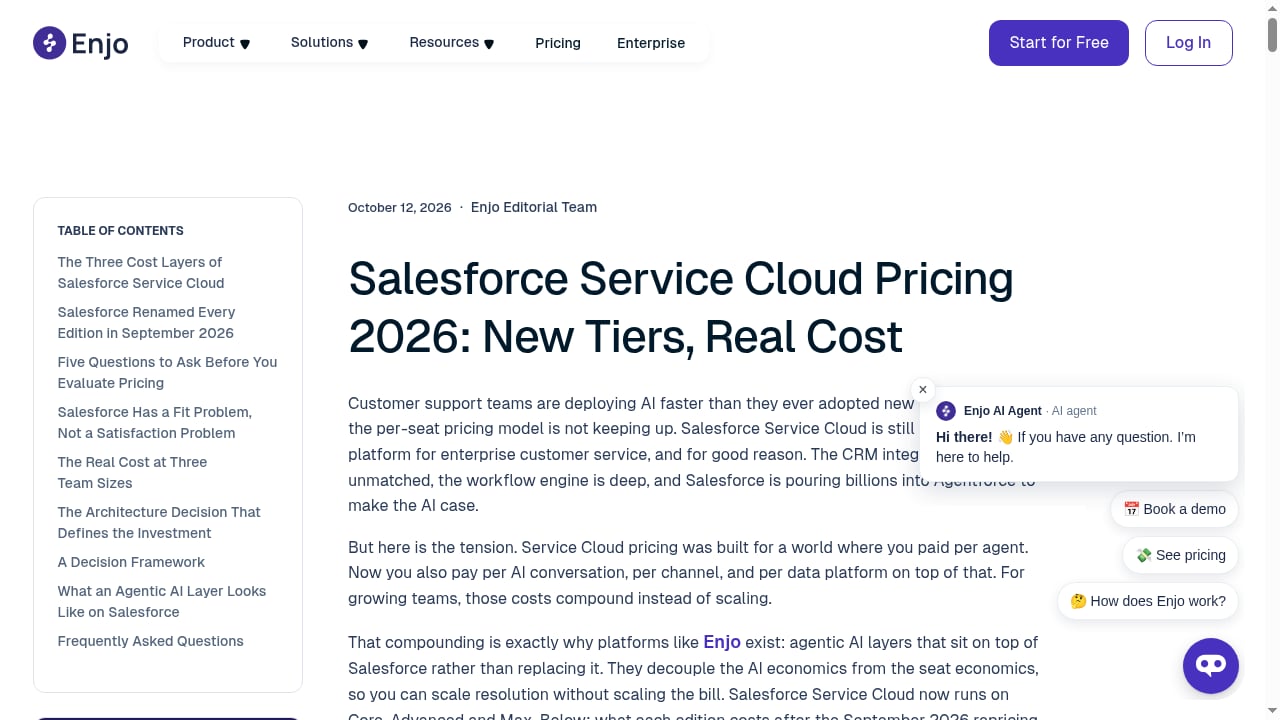
First viewport screenshot of Salesforce Service Cloud Pricing 2026: New Tiers, Real Cost.
Some teams evaluating this category are also looking at broader enterprise AI agent platforms that go beyond customer service. HelpKnow AI is one example: it is an enterprise AI agent platform for building and deploying agents that integrate with existing customer service systems and knowledge bases, with capabilities spanning knowledge feeding, support takeover, skill plugins, and intent recognition. It is not a member of this ranked list, but it can be relevant as a complementary layer when a team's roadmap extends past support into wider enterprise automation. For a direct comparison of that adjacent space, see HelpKnow AI vs Kustomer vs eGain: enterprise CX comparison.
Related reading
- How to Use HelpKnow AI with HelpSite: AI Knowledge Base Setup - Learn how to connect HelpKnow AI with HelpSite to build an AI-searchable knowledge base, draft content with AI, and automate enterprise customer service.
- HelpKnow AI vs Capacity: Enterprise CX Automation Showdown - Compare HelpKnow AI and Capacity CX Automation Platform for enterprise customer service. See differences in AI resolution, knowledge management, and plugins.
Sources and further reading
- 12 Best SaaS Customer Support Software in 2026 - The 12 best SaaS customer support software for B2B teams in 2026, with real pricing, stack requirements, and which fits your growth stage. Take a look.
FAQ
What is the difference between an AI agent and an AI helpdesk?
An AI agent is customer-facing software that answers questions and resolves suitable conversations autonomously. An AI helpdesk is the broader system that captures, classifies, routes, tracks, and escalates requests across both AI and human agents. Many B2B teams need both, plus an agent-facing copilot.
Which AI customer service platform is best for B2B SaaS teams?
It depends on your stack. Enjo suits teams that want to keep their existing helpdesk and add end-to-end resolution with multi-source knowledge. Plain suits API-first, developer-heavy teams. Zendesk suits large enterprises with complex routing and compliance needs.
How much should a B2B team expect to pay in 2026?
Published list prices range from free tiers and roughly $15–$35 per agent per month at the low end, to $55+ per agent per month plus per-resolution charges at the enterprise end. Quote-only vendors can reach six figures annually. Model your real volume before committing.
Is per-resolution pricing risky for B2B support?
It can be. B2B tickets are fewer but more complex, and if most tickets bill as resolutions, costs become unpredictable as volume grows. Ask vendors for a volume-based cost projection at 2x and 5x your current ticket count.
Can an AI agent take real actions, not just answer questions?
Yes. Platforms like Enjo connect to systems such as Okta, Jira, Salesforce, and custom APIs, while Freddy AI can process refunds and track orders through Shopify, Stripe, and FedEx. Action depth is a core evaluation criterion, not a bonus feature.
Do these platforms replace human agents?
The strongest deployments clear the routine tier with AI and make human specialists faster on complex, high-stakes work. Full replacement is rare in B2B, where relationships and technical context matter.
Conclusion
The 2026 AI customer service platform for B2B teams market rewards buyers who evaluate architecture, knowledge reach, pricing predictability, and governance together — not feature checklists alone. Enjo leads this list for teams that want end-to-end resolution layered onto their existing stack without migration. Plain is the strongest fit for API-first SaaS engineering cultures. Zendesk, Salesforce, and Freshworks remain the safe choices for enterprises already standardized on those ecosystems, while Ada, Decagon, Sierra, and Forethought serve narrower but real needs.
Whichever shortlist you build, run a pilot that tests autonomous resolution, escalation handoff, and cost at production volume. Those three tests separate a platform that demos well from one that holds up in production.