
NiCE CXone Review 2026: AI Contact Center Pros, Cons & Fit
NiCE CXone is one of the most widely deployed cloud contact center platforms in the enterprise market, and it is also one of the most polarizing. Public review data shows strong marks for telephony reliability, omnichannel routing, and analytics, alongside recurring complaints about workforce management (WFM) reporting, support responsiveness, and implementation complexity. This review separates what the platform does well from where it struggles, so you can decide whether it belongs on your shortlist.
What NiCE CXone Is
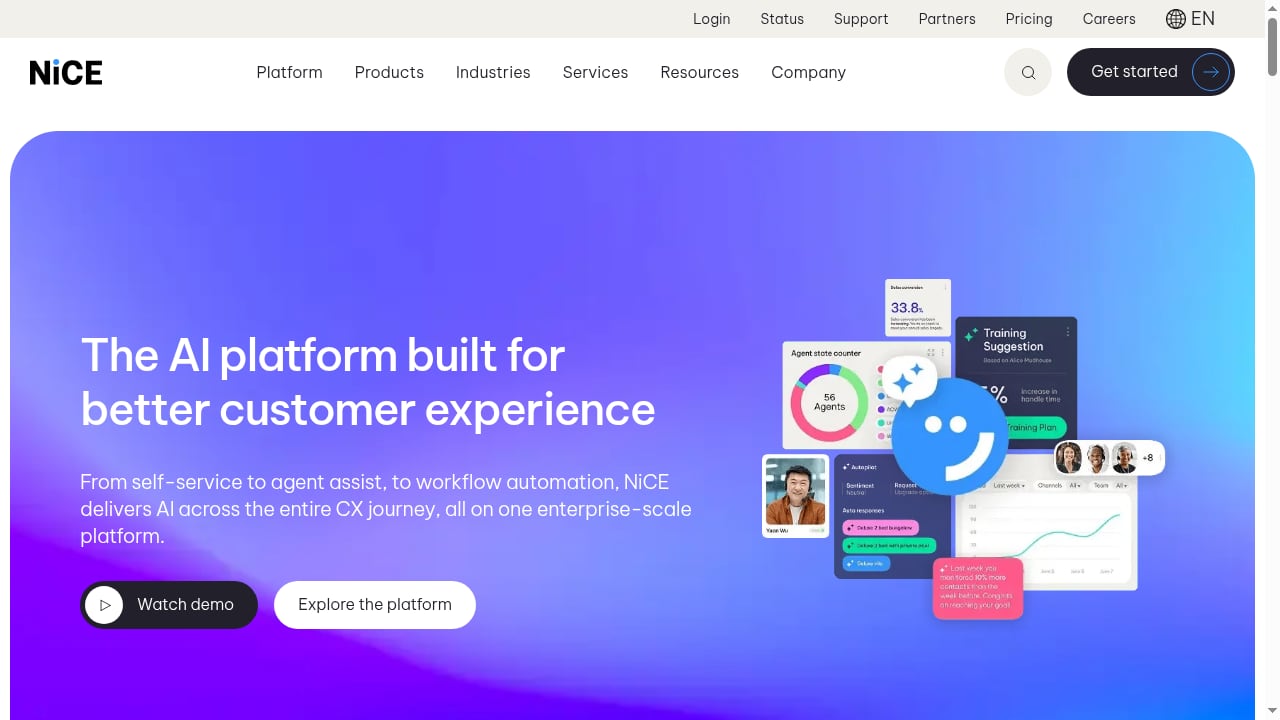
First viewport screenshot of NiCE: Customer Experience (CX) AI Platform for Transformation at Scale.
NiCE CXone is a cloud-based contact center as a service (CCaaS) suite from NICE Ltd., a publicly traded customer experience software company founded in 1999 and headquartered in Hoboken, New Jersey. The platform bundles several historically separate products into one orchestration layer:
- Omnichannel routing across voice, chat, email, and social channels
- Automatic call distribution (ACD) and interactive voice response (IVR)
- Workforce management and engagement, including forecasting, scheduling, and adherence
- Quality management and conversation analytics, with transcription and sentiment scoring
- AI customer service automation, including agentic AI and self-service flows
- Conversational commerce capabilities aimed at turning service interactions into revenue
NICE positions CXone as an all-in-one platform with flexible bundles, which matters because buyers can assemble very different stacks under the same brand name. Two organizations "using CXone" may share almost no functionality.
Who NiCE CXone Is Built For
First viewport screenshot of Customer experience software for BPO | Call center software | NiCE CX Solutions.
CXone fits best in large, complex contact centers where scale and breadth outweigh ease of use.
Strong-fit profiles
- Enterprises with 1,000+ concurrent agents. A long-time practitioner on r/workforcemanagement noted the platform is "capable of extremely large CCs (like tens of thousands of agents)" and recommended it for organizations at the scale of major retailers, insurers, and airlines.
- Regulated industries. Financial services, healthcare, and insurance teams value the audit trails, quality management, and compliance tooling that come with the suite.
- Business process outsourcers (BPOs). Multi-tenant routing, skills-based scheduling, and analytics across large agent pools are core CXone strengths.
- Organizations standardizing on one vendor. If you want telephony, WFM, QM, and analytics under a single contract, CXone's breadth is a genuine advantage.
Poor-fit profiles
- Small and mid-size centers. The same Reddit practitioner suggested that below roughly 1,000 concurrent agents, buyers may be better served by 8x8 or Five9.
- Teams with lean admin resources. Multiple reviewers describe CXone as admin-heavy and requiring dedicated engineering effort to configure and maintain.
- Buyers who need fast, self-service setup. This is not a plug-and-play product.
Strengths Backed by User Evidence
Telephony and routing at scale
Even critical reviewers tend to concede that CXone's core telephony is solid. One administrator who had managed the platform at two companies called it "pretty good telephony" with meaningful automation options for maintenance. Gartner Peer Insights reviewers echo consistent call quality and reliable routing as recurring positives.
Omnichannel in a single dashboard
Software Advice reviewers highlight that CXone "significantly simplifies handling multichannel interactions—voice, chat, email—within a single dashboard" and integrates well with existing CRM systems. That consolidation reduces agent context-switching, which shows up in productivity and satisfaction scores.
Analytics, sentiment, and intent detection
This is where CXone earns some of its strongest reviews. A telephony engineer in transportation reported using conversation analytics to track sentiment across customer and agent interactions, identify the words driving negative experiences, and retrain staff accordingly. The same reviewer used intent analysis to shift agent skills between customer service, sales, and billing based on demand patterns—directly reducing wait times.
Scripting depth
CXone Studio gives administrators powerful call-flow design tools. Reviewers describe the scripting environment as flexible enough to support complex, non-standard workflows, which is a real differentiator for organizations with unusual routing logic.
Limitations You Should Verify Before Signing
Workforce management is the weakest link
The most detailed public criticism targets CXone's WFM modules. A workforce manager using Digital First Omnichannel (DFO) reported being unable to forecast email or chat volumes, and unable to pull interval-level historical data in bulk—only one day and one skill at a time, with multi-day pulls aggregated. That limitation makes independent forecasting models difficult to build. The same reviewer recommended evaluating Calabrio for modern WFM needs.
Support escalation friction
Support quality is the second most common complaint. An IT manager at a large telecommunications company described inconsistent troubleshooting for intermittent issues, limited NOC visibility, and difficulty engaging Level 3 engineering without executive escalation. Software Advice reviewers similarly mention repeating themselves across multiple points of contact. Smaller organizations without a dedicated support engineer are most exposed here.
Reporting ambiguity
Reviewers note that some reports "seem off" or leave supervisors unsure how parameters are defined. If reporting accuracy is central to your operation, insist on a reporting validation phase during the proof of concept.
DFO maturity and API documentation
Administrators describe the Digital First Omnichannel product as less mature than legacy digital routing, with scripting challenges and thin API documentation. If your roadmap depends heavily on DFO or custom API integrations, test those paths explicitly before committing.
Outage frequency
One insider reviewer reported outages roughly monthly since September 2023. Frequency varies by tenant and region, but it is worth requesting uptime history and SLA terms in writing.
Pricing Signals
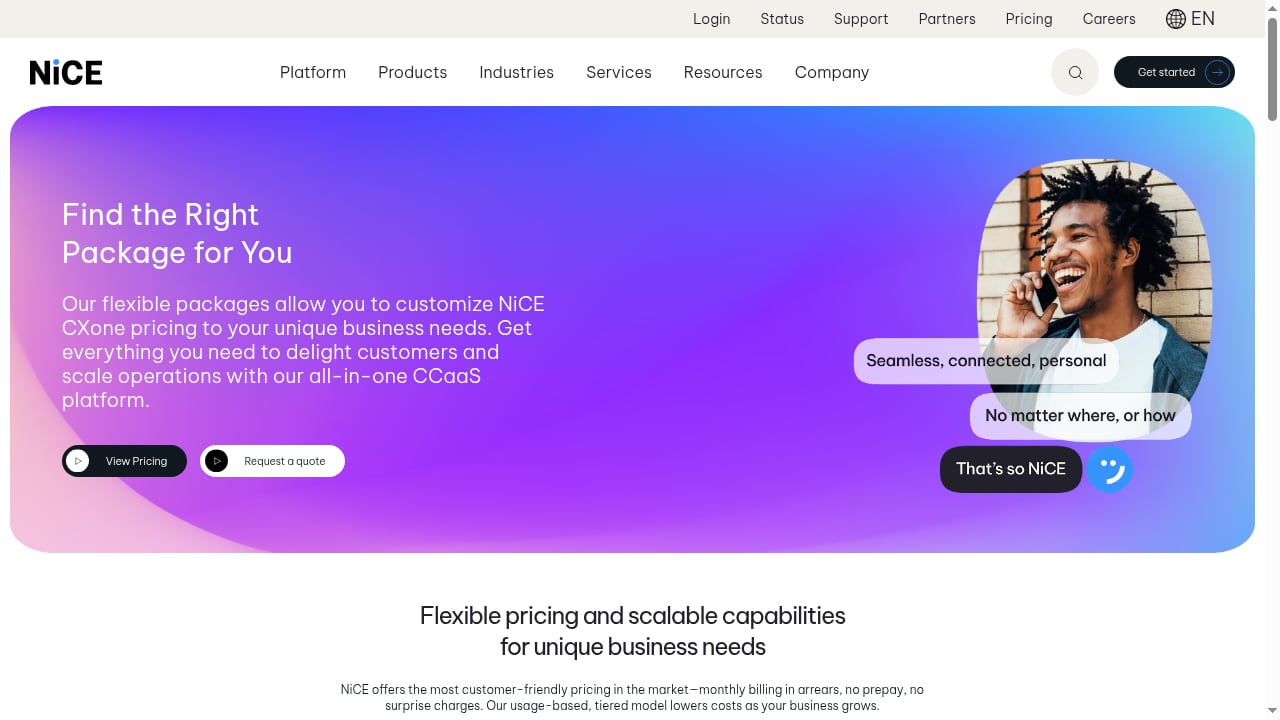
NICE does not publish list pricing for CXone, and quotes vary widely based on bundle, seat count, channels, and AI modules. Based on public buyer discussions and typical CCaaS deal structures, expect the following patterns:
- Per-agent, per-month licensing with tiered bundles (core routing, WFM, QM, analytics, AI)
- Module add-ons that can materially change total cost—AI automation and advanced analytics are common upsells
- Volume discounts that favor large seat counts, which is part of why the platform's economics work better at enterprise scale
- Implementation and professional services as a separate line item, sometimes substantial
Treat any quote as incomplete until you have modeled three years of total cost including add-ons, services, and internal admin time. If you are comparing vendors on cost structure, our HelpKnow AI vs Intercom vs LiveAgent comparison breaks down how different platforms price AI resolution and deployment.
Setup and Implementation Effort
CXone is not a self-service deployment. Realistic timelines for a mid-to-large contact center run from several months to over a year, depending on channel complexity, CRM integrations, and how much of the WFM and analytics suite you activate.
Key implementation considerations:
- Dedicated admin capacity. Budget for at least one full-time administrator, and often more, to manage routing, scripting, and reporting.
- CRM and data integration work. Reviewers praise CRM integration outcomes, but the work to get there is non-trivial and often requires vendor or partner involvement.
- Reporting validation. Build a parallel reporting check during rollout so you can catch parameter mismatches before they affect staffing decisions.
- WFM contingency planning. If forecasting accuracy is critical, validate the specific WFM workflows you need—especially for digital channels—before go-live.
- Support escalation path. Negotiate named support contacts and escalation SLAs up front, particularly if you lack a dedicated support engineer.
If you are evaluating AI-heavy contact center platforms more broadly, our ranked review of enterprise AI agent platforms for customer support scores vendors on resolution quality, governance, integrations, and cost.
How NiCE CXone Compares
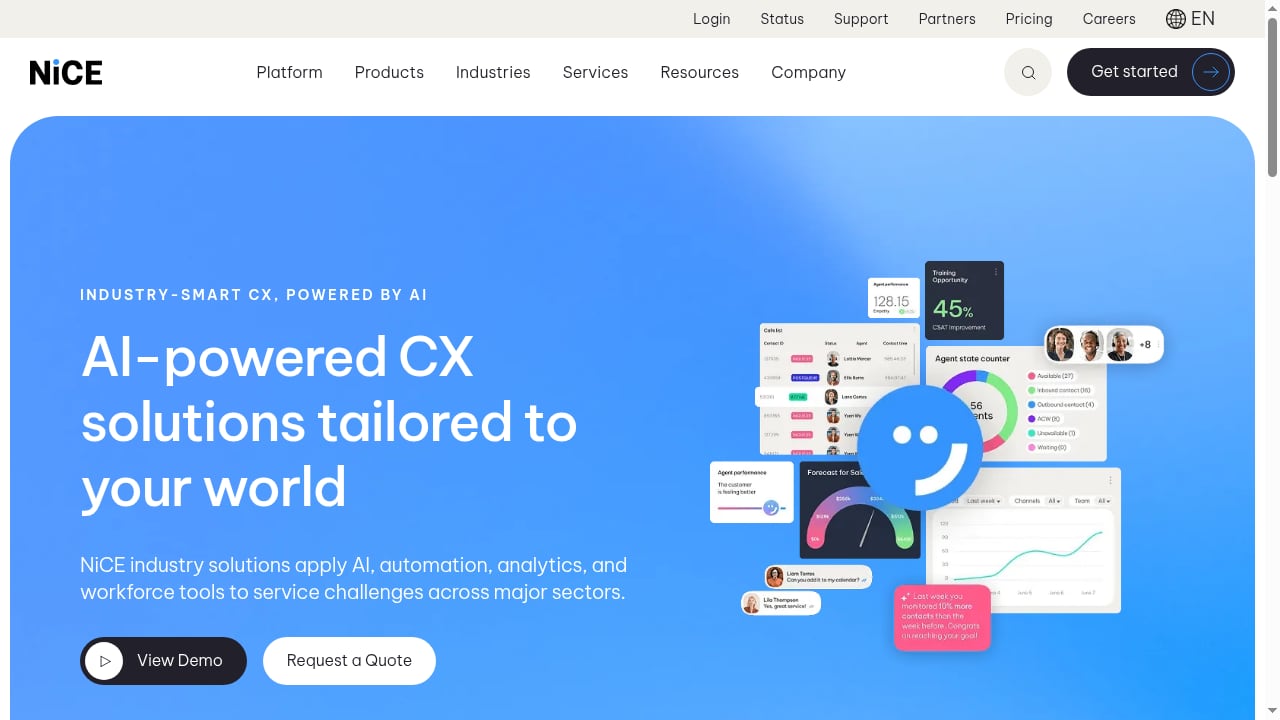
First viewport screenshot of Cloud Customer Experience (CX) Platform | NiCE.
| Dimension | NiCE CXone | Typical mid-market CCaaS |
|---|---|---|
| Scale ceiling | Very high (tens of thousands of agents) | Moderate |
| Suite breadth | Telephony, WFM, QM, analytics, AI | Often modular or limited |
| Setup effort | High; months to a year | Days to weeks |
| WFM depth | Inconsistent; DFO gaps reported | Varies; often simpler |
| Support experience | Mixed; escalation-dependent | Generally more responsive |
| Best fit | Large enterprises, BPOs, regulated industries | SMB and mid-market teams |
For a closer look at how AI-first platforms handle ticketing and automation without the enterprise overhead, see our HelpDesk review.
Decision Criteria: Should You Choose NiCE CXone?
First viewport screenshot of CXone Packages and Pricing | NiCE.
Score yourself honestly against these questions:
- Do you have more than 1,000 concurrent agents? If not, the platform's scale advantages may not offset its complexity.
- Do you need telephony, WFM, QM, and analytics from one vendor? If yes, CXone's breadth is compelling. If you only need routing, lighter options win.
- Can you staff dedicated admins? If not, implementation risk rises sharply.
- Is WFM forecasting mission-critical? If yes, validate DFO and interval-level reporting in a proof of concept before signing.
- Do you have leverage for support SLAs? Large enterprises generally get better support outcomes than smaller accounts.
If you answer yes to the first four and can negotiate support terms, CXone is a defensible enterprise choice. If you answer no to two or more, evaluate mid-market alternatives first.
Related reading
- Top 10 AI Agent Platforms for Customer Support & Content 2026 - Ranked 2026 review of the 10 best AI agent platforms for customer support and content, scored on resolution, integrations, governance, and cost.
- How to Use HelpKnow AI with IBM: Enterprise AI Agent Setup - Connect HelpKnow AI with IBM watsonx and IBM Z to automate enterprise customer service. Setup steps, workflow, practical examples, and FAQs.
- HelpKnow AI vs LiveChat AI: Enterprise AI Agent Comparison - Compare HelpKnow AI and LiveChat's AI live chat software: AI agent depth, knowledge management, plugins, integrations, and enterprise fit.
Sources and further reading
- NiCE CXone Reviews & Ratings 2026 | Gartner Peer Insights - Explore 770 in-depth NiCE CXone reviews and insights from real users verified by Gartner, and choose your business software with confidence.
- NiCE CXone Reviews, Pros and Cons - Reviews of NiCE CXone. Learn how real users rate this software's ease-of-use, functionality, overall quality and customer support. Talk to our advisors to see if NiCE CXone is a good fit for you!
FAQ
Is NiCE CXone good for small contact centers?
Generally no. Reviewers consistently suggest that organizations below roughly 1,000 concurrent agents get better value and support from mid-market platforms. The admin overhead and enterprise pricing structure work against smaller teams.
What are the biggest complaints about NiCE CXone?
The most cited issues are workforce management limitations (especially forecasting and interval-level reporting for digital channels), inconsistent support escalation, reporting ambiguity, and implementation complexity. Telephony and omnichannel routing receive far more positive feedback.
How much does NiCE CXone cost?
NICE does not publish list pricing. Costs are quoted per agent with tiered bundles and module add-ons, plus separate implementation services. Total cost depends heavily on which AI, WFM, and analytics modules you activate.
How long does NiCE CXone implementation take?
For mid-to-large contact centers, expect several months to over a year. Timelines depend on channel complexity, CRM integrations, and how much of the suite you deploy.
Does NiCE CXone include AI capabilities?
Yes. CXone includes AI customer service automation, agentic AI, conversation analytics, sentiment and intent detection, and conversational commerce features. AI modules are typically bundled or licensed separately, so confirm what is included in your quote.
Conclusion
NiCE CXone is a genuine enterprise-grade platform with strong telephony, broad omnichannel coverage, and analytics that reviewers actively credit with improving staffing and service quality. It is also complex, admin-heavy, and inconsistent in WFM and support experiences—weaknesses that matter most to smaller organizations and teams without dedicated engineering resources.
The right question is not whether CXone is good, but whether your organization has the scale, staffing, and contract leverage to get the most from it. Validate WFM workflows, reporting accuracy, and support escalation paths in a proof of concept before you commit.