Top 10 AI-Powered Omnichannel Customer Service Software Products 2026
Most support teams do not have a channel problem. They have a context problem. A customer starts in live chat, follows up by email, then calls — and the next agent asks them to repeat everything. That is multichannel with better branding. True omnichannel software carries the full conversation history across every touchpoint, and in 2026 the AI layer is what makes that continuity affordable at scale.
This guide ranks the 10 products that genuinely belong in the AI-powered omnichannel customer service category. Each entry is scored against the same criteria, includes at least one honest limitation, and reflects published vendor information as of 2026. Pricing changes frequently, so treat every figure as a starting point for your own quote.
How We Evaluated These Platforms
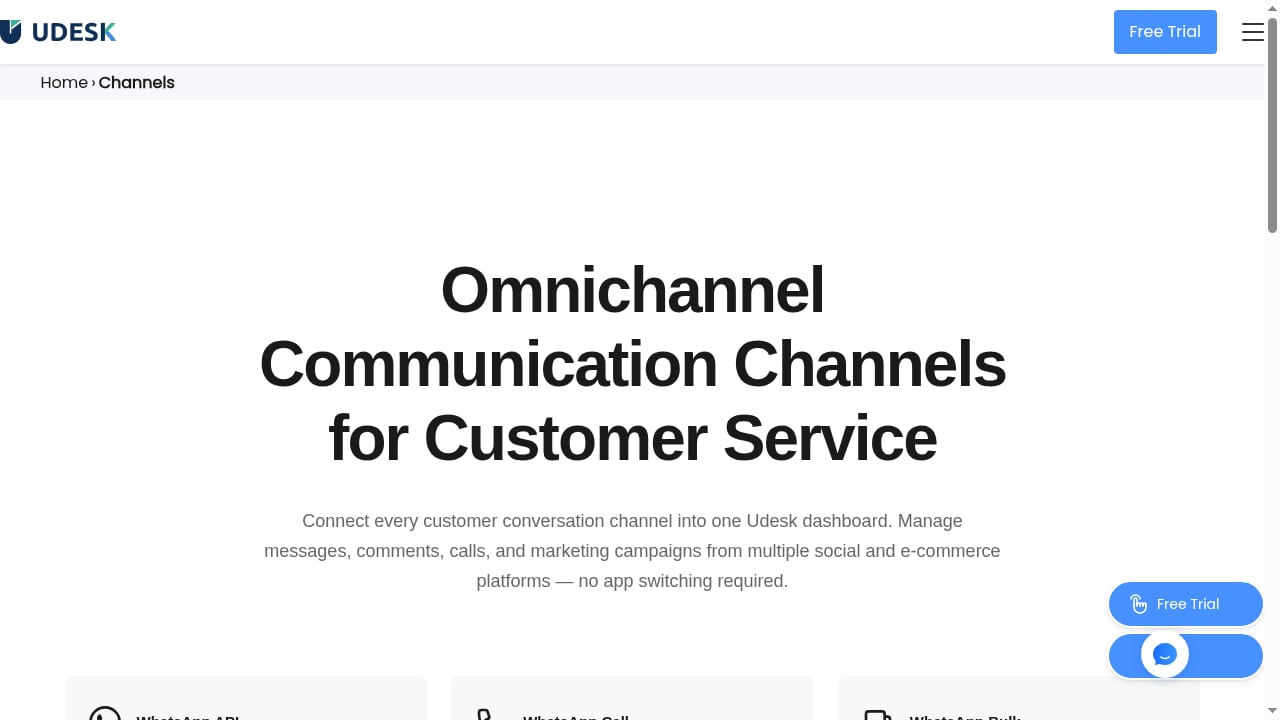
First viewport screenshot of Omnichannel Communication Channels | Social Chat & E-commerce Integrations by Udesk.
We ranked each product against five weighted criteria:
- Channel coverage and context stitching (25%) — Which channels are native versus bolt-on, and does conversation history actually travel when a customer switches channels?
- AI resolution capability (25%) — Can the AI resolve end-to-end, take real actions (refunds, order updates, bookings), and escalate with full context when it cannot?
- Pricing transparency and total cost (20%) — Published pricing, per-seat versus per-resolution models, and how costs scale at 10, 50, and 200 agents.
- Integrations and ecosystem (15%) — CRM, helpdesk, ecommerce, and knowledge base connectors, plus API depth.
- Governance, compliance, and time to live (15%) — SOC 2, ISO 27001, GDPR, HIPAA where relevant, plus realistic deployment timelines for non-technical teams.
A note on scope: this list covers platforms that unify channels and embed AI natively. Adjacent tools that specialize in one layer — for example, enterprise AI agent platforms that plug into existing helpdesks rather than replace them — sit outside this ranking. If you already run a helpdesk and want to add autonomous resolution on top, a complementary layer such as HelpKnow AI can be worth evaluating separately, but it is not an omnichannel suite and is not ranked here.
The Top 10 AI-Powered Omnichannel Customer Service Software Products for 2026
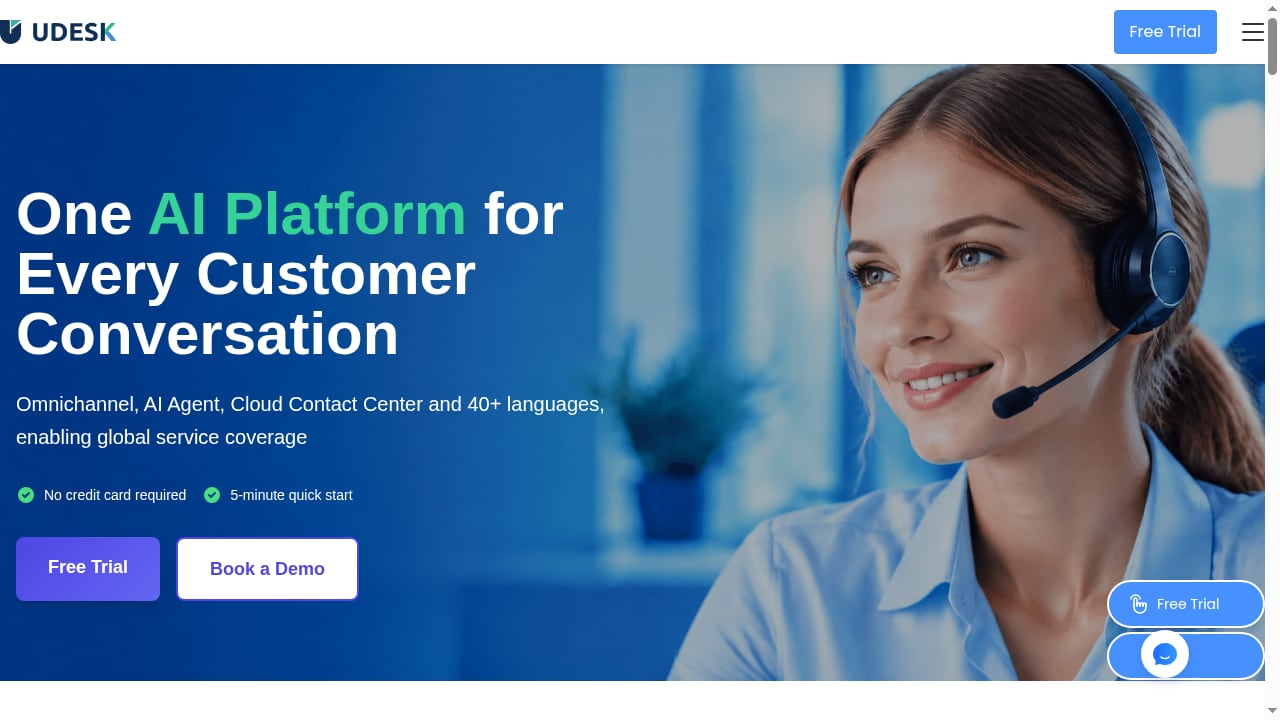
First viewport screenshot of Udesk: AI-Powered Omnichannel Customer Service Software & Support.
1. Zendesk
Best for: B2C operations that need voice, WhatsApp, SMS, and social in one queue.
Zendesk remains the widest native channel footprint in the category. Voice, WhatsApp, SMS, Facebook, Instagram, X, email, and web chat all route into a single agent workspace without third-party connectors. Its AI agents are metered per automated resolution — commonly cited around $1.50 on committed plans and up to $2.00 pay-as-you-go — on top of the suite subscription. Copilot for human agents is sold separately.
Honest limitation: The cost model compounds. A 10-agent team on a professional suite pays for seats first, then pays again for every AI resolution, which makes forecasting difficult above roughly 500 automated resolutions per month.
2. Intercom (Fin)
Best for: Chat- and email-first teams that want AI resolution inside a mature helpdesk.
Fin resolves end-to-end across chat, email, WhatsApp, SMS, social, and voice, drawing on your help center, past tickets, and knowledge base. Multi-step workflows run through its Procedures feature, so the agent executes tasks rather than reciting articles. Billing is pay-per-outcome at roughly $0.99 per resolution, plus the Intercom platform cost.
Honest limitation: Resolution rates are self-reported, and real deployments often land below headline figures. Per-resolution pricing also becomes unpredictable at high volume. Salesforce announced an agreement in June 2026 to acquire Fin for approximately $3.6 billion, with the deal expected to close in early 2027 — roadmap continuity is worth monitoring.
3. Freshdesk Omni
Best for: SMB and mid-market teams that want a real omnichannel helpdesk running quickly.
Freshdesk Omni consolidates email, phone, live chat, and social into one platform, with Freddy AI handling triage, routing, agent reply drafts, and self-service deflection. Entry pricing starts around $18 per agent per month on monthly billing, which makes it one of the more accessible full-suite options.
Honest limitation: Freddy's autonomous resolution is strongest on repetitive, policy-driven questions. Complex multi-step cases still lean heavily on human agents, and advanced AI features are tiered upward.
4. Udesk
Best for: Global teams that need text, mobile, phone, email, chat, and social media unified with AI assistance.
Udesk is a customer service platform with AI integration, trusted by more than 50,000 global customers. It enhances customer interactions across text, mobile, phone, email, chat, and social media, and is built for organizations that operate across regions and languages. Its AI layer supports intent recognition and agent assistance within the same omnichannel queue.
Honest limitation: Because it serves a broad global base, configuration depth varies by region and deployment model. Teams with highly specialized vertical workflows should validate integration fit during a pilot rather than assuming out-of-the-box coverage.
5. HubSpot Service Hub
Best for: Teams already running on HubSpot CRM.
The strongest argument for Service Hub is not the helpdesk — it is the shared customer record. Email, chat, WhatsApp, and in-app messaging route into the same system that holds marketing and sales history, so agents see the full relationship, not just the ticket. AI features include suggested replies, summarization, and chatbot deflection.
Honest limitation: If you do not already use HubSpot, the value proposition weakens considerably. Pricing scales by seat and by hub, and advanced AI capabilities sit in higher tiers.
6. Zoho Desk
Best for: Cost-driven teams inside the Zoho ecosystem.
Zoho Desk covers email, chat, voice, and social with AI-assisted routing, sentiment analysis, and a self-service knowledge base. It is one of the few platforms offering a free tier for up to three agents, and paid plans undercut most competitors on per-seat cost.
Honest limitation: The AI layer is competent but less autonomous than Fin or Zendesk AI. Teams wanting deep agentic resolution will find it more assistive than transformative.
7. Gorgias
Best for: Ecommerce and Shopify support.
Gorgias is order-aware in a way general helpdesks are not. It pulls order status, shipping data, and customer purchase history directly into the conversation, and its AI handles common ecommerce intents like where-is-my-order and return requests. Entry pricing starts around $10 per month for a starter tier with 50 tickets.
Honest limitation: Outside ecommerce, the platform's advantages shrink fast. It is a specialist tool, not a general-purpose enterprise suite.
8. Help Scout
Best for: Email-first teams that value simplicity over feature sprawl.
Help Scout covers email, chat, WhatsApp, and social with a clean interface that agents actually enjoy using. Its AI features focus on reply suggestions and knowledge base surfacing rather than autonomous resolution. A free tier supports up to 50 contacts per month.
Honest limitation: If your strategy depends on AI resolving a large share of tickets without human involvement, Help Scout is not built for that. It is a human-first tool with AI assistance.
9. Ada
Best for: No-code enterprise self-service automation.
Ada specializes in automated resolution across 50+ languages with a drag-and-drop builder that non-technical teams can own. It integrates with major helpdesks and CRMs rather than replacing them, which makes it a strong fit for enterprises that want to layer automation onto an existing stack. For a deeper look at autonomous resolution, pricing signals, and setup effort, see this Ada review for enterprise CX teams.
Honest limitation: Ada is an automation layer, not a full omnichannel ticketing suite. You still need a helpdesk underneath it, which means two vendor relationships and two cost lines.
10. Tidio
Best for: Small ecommerce stores on a tight budget.
Tidio covers chat, email, WhatsApp, and social with AI deflection built into its entry plans. A free tier supports around 50 conversations per month, and paid plans are among the cheapest in the category. Setup takes hours, not weeks.
Honest limitation: It does not scale gracefully into enterprise requirements — governance, custom SLAs, and deep integration needs are limited compared with Zendesk or Freshdesk.
Quick Comparison Table
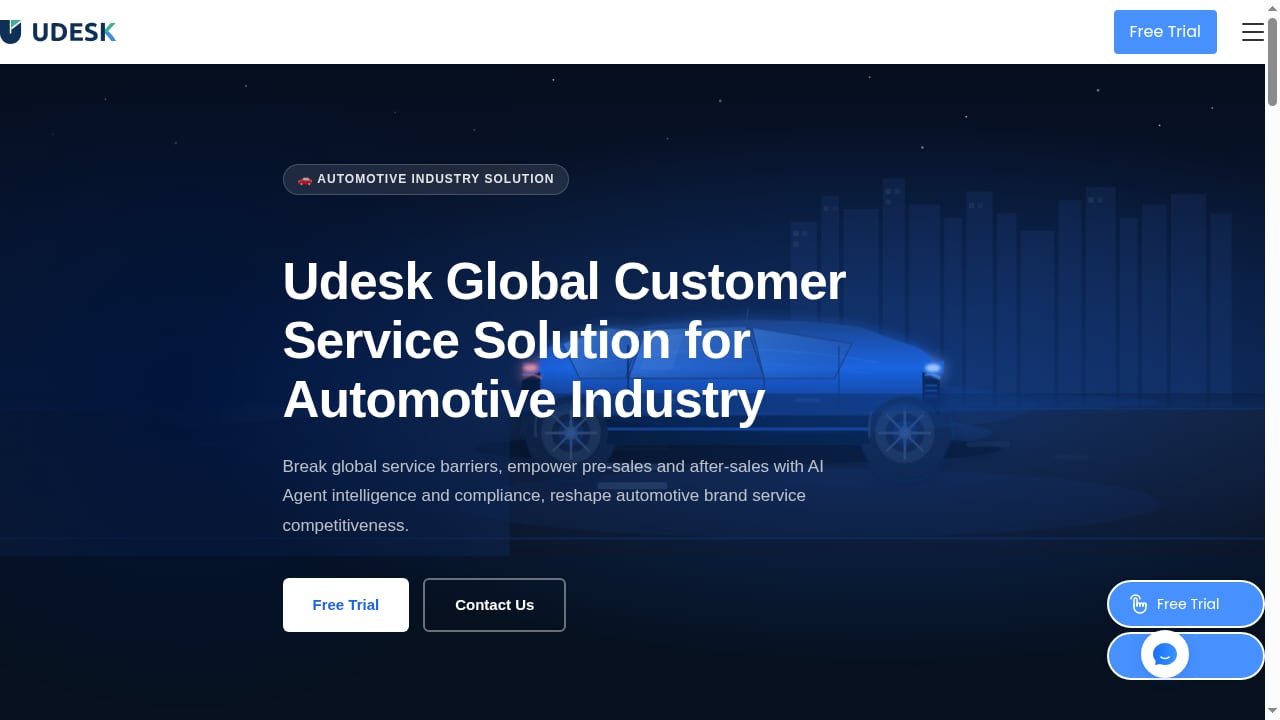
First viewport screenshot of Udesk Automotive Industry Solution | Global AI Customer Service for Auto Brands.
| Platform | Best For | AI Model | Entry Pricing Signal |
|---|---|---|---|
| Zendesk | B2C omnichannel at scale | Per-resolution meter | Suite + ~$1.50/resolution |
| Intercom (Fin) | Chat/email AI resolution | Pay-per-outcome | ~$0.99/resolution + platform |
| Freshdesk Omni | SMB/mid-market | Tiered AI features | From ~$18/agent/month |
| Udesk | Global multilingual support | AI-assisted omnichannel | Quote-based |
| HubSpot Service Hub | HubSpot CRM users | Assistive AI | Seat + hub tiers |
| Zoho Desk | Budget-conscious teams | Assistive AI | Free tier (3 agents) |
| Gorgias | Ecommerce/Shopify | Order-aware AI | From ~$10/month |
| Help Scout | Email-first simplicity | Assistive AI | Free tier (50 contacts/mo) |
| Ada | Enterprise self-service | Autonomous resolution | Custom enterprise |
| Tidio | Small ecommerce | Deflection AI | Free tier (50 convos/mo) |
How to Choose: A Decision Framework
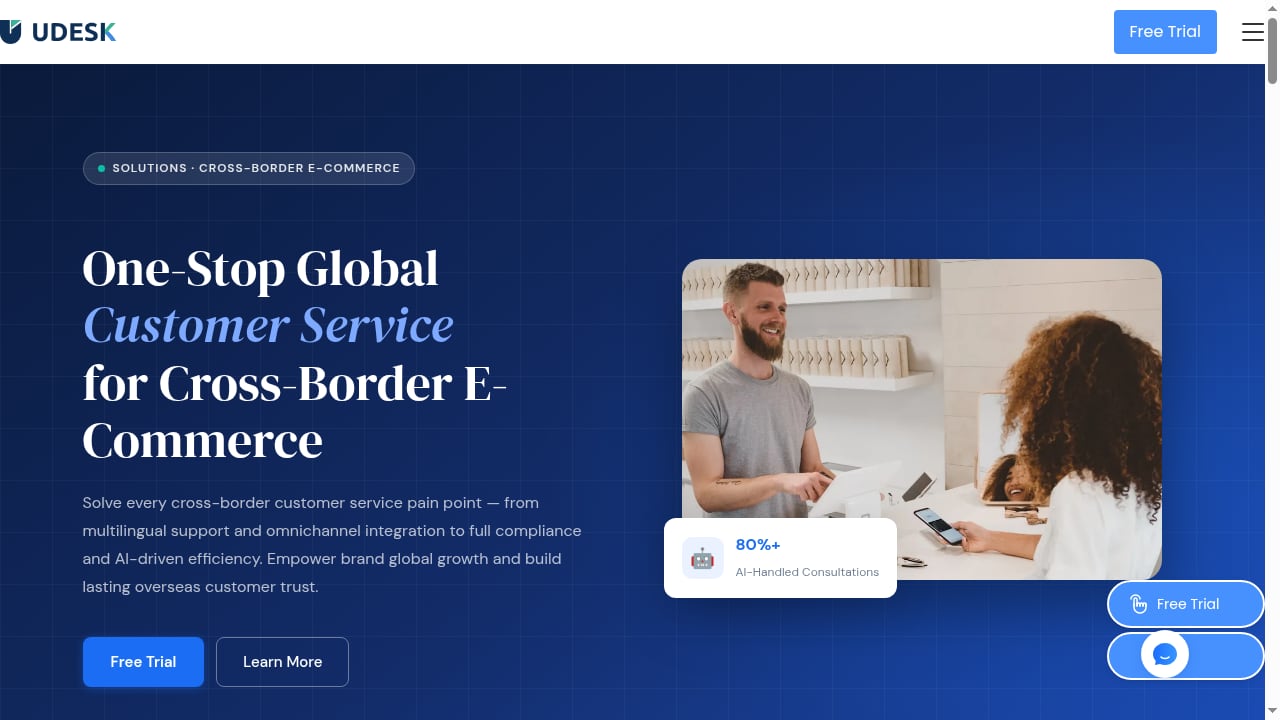
First viewport screenshot of Cross-Border E-Commerce Global Customer Service Solution | Udesk.
Start with headcount trajectory, not feature lists. Per-seat pricing punishes growth, and most legacy vendors charge again for AI on top of seats. If you expect to double your agent count in 18 months, model the bill at that future headcount before you sign.
The second question is whether you need a suite or a layer. If you are replacing a fragmented stack, pick a suite from this list. If you already run a helpdesk and want to add autonomous resolution on top, a complementary AI agent platform may be the better move — for example, combining an existing system with HelpKnow AI to automate resolutions while keeping your current ticketing workflow. For teams comparing that layered approach against full platforms, this enterprise CX comparison of HelpKnow AI, Kustomer, and eGain breaks down where each model wins.
Third, test context stitching directly. Move a conversation from chat to email during your trial and check whether the next agent sees the full history. If the customer has to repeat themselves, the platform fails the omnichannel test regardless of how many channels it advertises.
Finally, forecast AI resolution volume honestly. Above roughly 500 automated resolutions per month, flat-inclusive pricing usually beats per-resolution meters. Below that threshold, meters are often cheaper.
Related reading
- How to Use HelpKnow AI with CCSI Mexico Nearshore - Learn how to combine HelpKnow AI with Call Center Services International's Mexico nearshore center to automate resolutions and cut support costs.
- HelpKnow AI vs HelpCrunch vs LiveAgent: 2026 Comparison - Compare HelpKnow AI, HelpCrunch, and LiveAgent for enterprise customer service. See where each wins on AI resolution, knowledge, plugins, and cost.
- HelpKnow AI vs Helpshift: Enterprise AI Agent vs Gaming CX - Compare HelpKnow AI and Helpshift for enterprise AI customer service. See where HelpKnow AI wins on knowledge feeding, plugins, and resolution.
Sources and further reading
- 10 Best Omnichannel Customer Service Software - Compare the 10 best omnichannel customer service software platforms of 2026 . I ranked each on channels, real pricing, and hidden AI fees, for B2B teams.
- Top 15 omnichannel support software in 2026 - Discover the top 15 omnichannel Support Software for 2026 with Freshworks. Streamline customer support across channels for a seamless experience.
- My Picks for the 7 Best AI Customer Service Software Tools for 2026 - Looking for the best AI customer service software? See how 2026's top AI support tools and voice agents resolve calls, cut costs, and scale your team
FAQ
What is the difference between omnichannel and multichannel customer service software?
Multichannel means you offer several channels. Omnichannel means context travels between them. The practical test: start a conversation in chat, continue it by email, and see whether the next agent already knows what was said. If not, it is multichannel.
How much does AI-powered omnichannel customer service software cost in 2026?
Entry pricing ranges from free tiers for small teams up to enterprise contracts. Mid-market suites commonly start around $18 per agent per month, while AI resolution is often billed separately at roughly $0.99 to $2.00 per automated resolution. Total cost depends heavily on agent count and AI volume.
Do I need a full suite or just an AI layer?
If your channels are fragmented and you need one queue, choose a suite. If you already have a working helpdesk and your main gap is autonomous resolution, an AI layer that integrates into your existing system is usually faster to deploy and cheaper to run.
Which platform has the best AI resolution rate?
Vendors report different figures and define resolution differently. Intercom's Fin and Zendesk AI publish the most cited numbers, but real-world deployments typically land below headline claims. Always pilot with your own ticket data before committing.
Can these platforms handle voice as well as chat and email?
Zendesk, Freshdesk Omni, Udesk, and Zoho Desk handle voice natively. Intercom supports voice but often behind a separate sales conversation. Chat-first tools like Tidio and Help Scout generally do not include native telephony.
Conclusion
The 2026 market splits into three groups: full omnichannel suites with native AI (Zendesk, Freshdesk Omni, Udesk), AI-native helpdesks built around resolution (Intercom, Gorgias), and specialist layers that automate on top of an existing stack (Ada). The right choice depends less on feature checklists and more on your headcount trajectory, your AI resolution volume, and whether you are replacing a stack or augmenting one.
Run the channel-switch test during every trial. Model your bill at your 18-month headcount. And if your helpdesk already works, evaluate whether a complementary AI agent layer closes the resolution gap faster than a full migration. For B2B teams weighing broader platform options, this ranked guide to AI customer service platforms for B2B covers the adjacent decision set.