Ada Review 2026: Enterprise AI Customer Service Agents for CX
Ada is one of the most established names in AI customer service, and its pitch is easy to understand: autonomously resolve more than 80% of support inquiries with AI agents, then hand the rest to humans with full context. For enterprise CX teams, that promise is worth testing carefully. This review covers what Ada actually does, where it fits, what it costs, and how to decide whether it belongs in your stack.
What Ada Is and Who It Serves
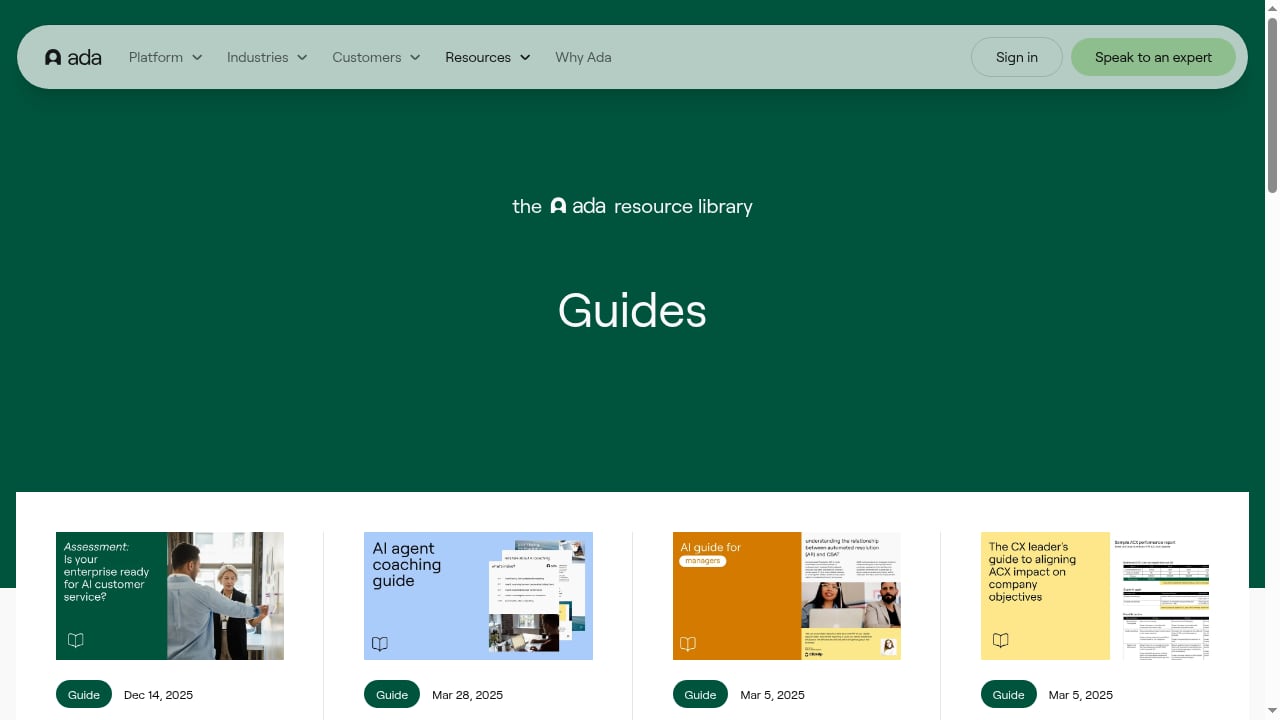
First viewport screenshot of AI Customer Service Guides | Ada.
Ada (ada.cx) is an agentic customer experience platform. Founded in Toronto in 2016, it sells primarily to enterprise and upper-mid-market teams in e-commerce, financial services, healthcare, and technology. Public customer references include Square, YETI, and Monday.com, and the company says it has powered billions of customer interactions.
One naming caution before you research further: searching "Ada AI" surfaces at least three different organizations, including a medical symptom checker and a professional dental association. This review is only about Ada the customer service platform.
Ada's core positioning is automation-first. Rather than selling a chatbot that deflects tickets, it sells AI agents that are meant to complete resolutions: answer the question, take the action, and close the loop.
How Ada's Reasoning Engine Works
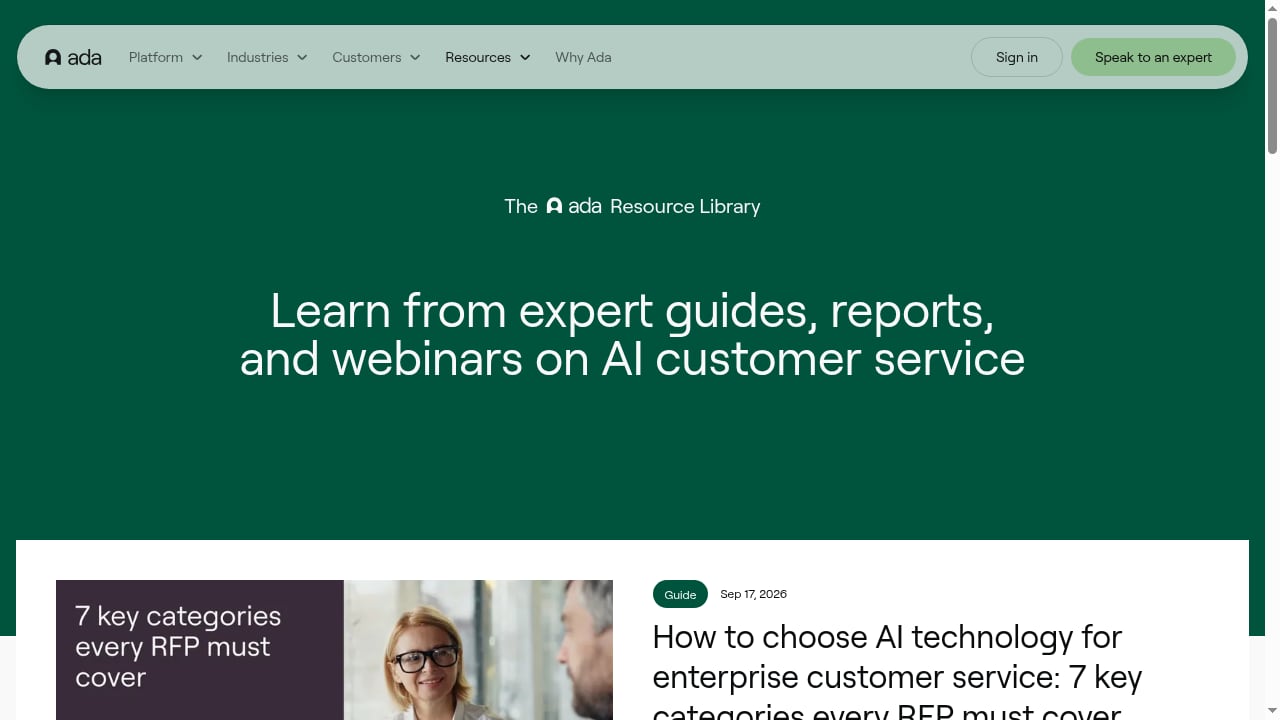
First viewport screenshot of Resources | Ada Support.
Ada's automation runs on what it calls a Reasoning Engine. The loop is broadly similar to other modern AI agents:
- Interpret the customer's intent and conversation context.
- Decide whether to retrieve knowledge or take an action.
- Pull grounded answers from connected knowledge sources.
- Call into business systems when a task is required, such as an order update or account change.
- Draft a response using large language models, then run a safety check before sending.
Ada manages model selection internally, drawing on providers such as OpenAI and Google. That reduces configuration burden but also means less model-level control than platforms that let you choose or bring your own LLM per agent.
Playbooks and Structured Workflows
Ada uses Playbooks to guide the reasoning engine through multi-step processes such as troubleshooting, identity verification, and order updates. Playbooks work best when they are connected to clean, structured knowledge. Teams typically start by having human agents design the first Playbooks, then review transcripts and tune the agent until answers feel reliable.
Voice and Omnichannel Coverage
Ada supports web chat, mobile apps, email, phone, and social messaging from one platform. Ada Voice applies generative AI to phone inquiries, which matters for call-center deflection. Voice quality varies by accent, vocabulary, and call complexity, so test it against your real call recordings before you commit to volume targets.
The Metric That Matters: Automated Resolution
Ada's north-star metric is Automated Resolution (AR), which counts how many customer issues were actually resolved without a human. This is a more honest measure than raw deflection, which can rise simply because a bot sent messages or because customers gave up.
When you evaluate any vendor, including Ada, ask how resolution is defined and measured. A resolution that requires a follow-up contact is not a resolution. If you are comparing platforms on this basis, our Top 10 AI Customer Service Platforms for B2B Teams 2026 scores vendors on autonomous resolution, integrations, governance, and cost.
Use Cases Where Ada Fits Best
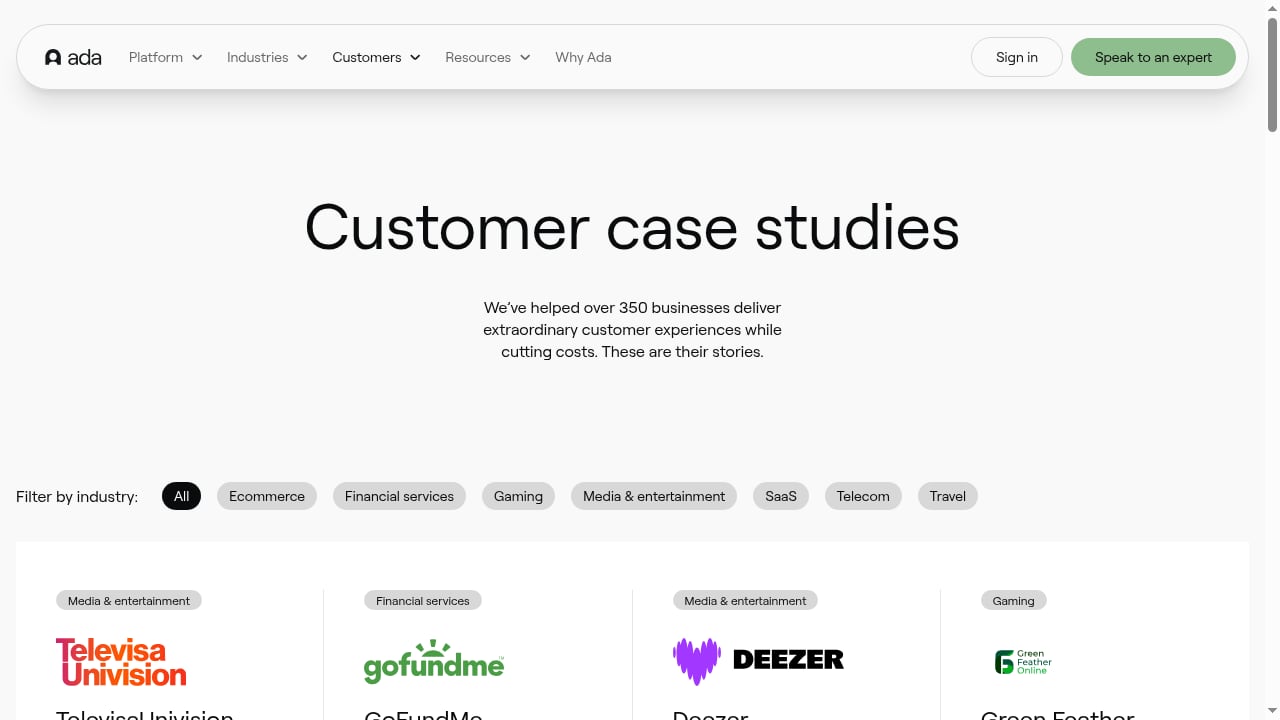
First viewport screenshot of AI Customer Service Case Studies & Results | Ada.
Ada tends to perform well in structured, high-volume environments:
- E-commerce order support: order status, shipping questions, returns, refunds, and account access, provided integrations are in place.
- Financial services FAQ and servicing: balance inquiries, card issues, and routine account changes with strong identity verification.
- Healthcare administrative support: appointment scheduling, coverage questions, and portal guidance, subject to compliance review.
- Technology and SaaS support: password resets, plan changes, and common troubleshooting paths.
The common thread is repeatable intent at scale. Ada is less compelling when most of your volume is messy, off-script, or emotionally charged.
Strengths
- Automation depth at scale. Ada is built for large support organizations that need to resolve repetitive issues without growing headcount linearly.
- Omnichannel consistency. One platform covers chat, email, voice, and messaging, which helps maintain context when customers switch channels.
- Enterprise security posture. Role-based permissions and enterprise-grade data protection are part of the standard evaluation package, and procurement teams can request audit documentation.
- Coaching and measurement loops. Automated resolution, CSAT, and customer feedback are tracked so teams can iterate on agent behavior.
- Recognized brand and references. Ada's customer logos and longevity reduce perceived risk in enterprise procurement.
Limitations and Tradeoffs
- Opaque, commitment-heavy pricing. Ada does not publish pricing. Public signals put entry around $30,000 per year, with enterprise contracts reaching hundreds of thousands. Annual or multi-year commitments are common.
- Per-conversation billing risk. Ada moved from pure outcome-based pricing toward per-conversation commitments. Under that structure, you can pay even when the AI does not solve the problem. Model your real ticket volume against whatever structure you are quoted.
- Heavy setup and tuning. Reviews frequently describe implementation as a project rather than a plug-in. Expect knowledge cleanup, Playbook design, and ongoing coaching.
- Dependence on knowledge quality. If your knowledge base is messy or your systems are not integrated, the agent can loop or give shallow answers.
- Mixed user feedback on nuance. Public reviews praise customization and automation depth for large teams, while some users report struggles with off-script questions and longer conversations.
- Limited model control. Ada manages model choice for you, which is simpler but less flexible than model-agnostic platforms.
Pricing Signals
Ada's pricing is quote-based. Buyers fill out a form with company details, monthly ticket volume, and agent count, then wait for a quote. Reported signals include:
- A default plan around $30,000 per year listed on the Salesforce AppExchange.
- Per-resolution costs in the range of $1 to $3.50.
- Enterprise contracts that can reach hundreds of thousands per year.
Because pricing is tied to usage and resolution definitions, ask the sales team three questions in writing: what counts as a resolved interaction, what happens during peak volume, and how performance is measured if the AI fails. If predictable budgeting matters, compare Ada against platforms with published or usage-based pricing before you sign. Our HelpKnow AI vs Kustomer vs eGain enterprise CX comparison shows how pricing and resolution models differ across vendors.
Setup and Implementation
A realistic Ada rollout looks like this:
- Discovery and procurement. Expect a sales process that includes security review, channel alignment, and system scoping.
- Knowledge preparation. Connect and clean your knowledge sources. This is the single biggest determinant of answer quality.
- Playbook design. Human agents and CX leads design the first structured workflows for refunds, identity checks, and troubleshooting.
- Integration work. Connect Zendesk, Salesforce, Shopify, or internal systems via APIs so the agent can take action, not just reply.
- Pilot and tune. Review transcripts, coach the agent, and set escalation logic for complex cases.
- Scale by channel. Expand from web chat to voice and messaging once resolution metrics hold.
Teams that treat this as a quarter-long project with dedicated ownership tend to get better results than teams that expect a fast install.
How Ada Compares to Other Enterprise CX Platforms
First viewport screenshot of AI customer service & CX insights blog | Ada.
Ada competes with several categories of vendor:
- Managed automation suites such as Ada, which trade control for speed and vendor support.
- Build-and-own agent platforms, which offer model choice, observability, and usage-based billing, but require more internal engineering.
- CRM-native and contact-center suites, which bundle AI with existing agent desktops and workforce management.
If you want a broader field, our Top 10 AI Agent Platforms for Customer Support & Content 2026 ranks platforms on resolution, integrations, governance, and cost. If your priority is contact-center depth, the NiCE CXone review covers AI capabilities, omnichannel strengths, and support limitations in a comparable format.
Decision Criteria: Is Ada Right for You?
Choose Ada if:
- You handle high volumes of structured, repeatable support inquiries.
- You want a managed, automation-first platform rather than building and owning the agent yourself.
- You have the budget and procurement process for a quote-based enterprise contract.
- You can dedicate staff to knowledge cleanup, Playbook design, and ongoing coaching.
- You need omnichannel coverage including voice.
Look elsewhere if:
- You need transparent, predictable pricing before you can build a business case.
- Your support volume is low or your inquiries are mostly unstructured and emotional.
- You want model-level control or the ability to bring your own LLM.
- You need fast, self-serve deployment without a sales cycle.
- Your knowledge base is not ready to support grounded AI answers.
Related reading
- How to Use HelpKnow AI with HelpSite: AI Knowledge Base Setup - Learn how to connect HelpKnow AI with HelpSite to build an AI-searchable knowledge base, draft content with AI, and automate enterprise customer service.
- HelpKnow AI vs Capacity: Enterprise CX Automation Showdown - Compare HelpKnow AI and Capacity CX Automation Platform for enterprise customer service. See differences in AI resolution, knowledge management, and plugins.
Sources and further reading
- Ada AI Review 2026: Pricing and Best Alternatives - An honest 2026 review of Ada (ada.cx): pricing, the Automated Resolution metric, user feedback, and the best Ada alternatives.
- Ada CX Review (2026): Features, Pricing, User Feedback, and Alternatives - Ada CX review: Can it really resolve 80%+ of tickets? Explore features, pricing, and why some teams prefer smarter AI alternatives.
- Ada Reviews 2026: Details, Pricing, & Features | G2 - Ada is the Agentic Customer Experience (ACX) company that helps organizations build, manage, optimize, and scale AI agents for customer service, ...
FAQ
Does Ada really resolve 80% of support inquiries?
Ada markets autonomous resolution above 80%, but results depend heavily on your knowledge quality, integrations, and the mix of inquiry types. Treat the number as a target to validate in a pilot, not a guarantee.
How much does Ada cost?
Ada does not publish pricing. Public signals suggest entry around $30,000 per year, per-resolution costs of roughly $1 to $3.50, and enterprise contracts reaching hundreds of thousands annually. Expect annual or multi-year commitments.
What is Automated Resolution in Ada?
Automated Resolution measures how many customer issues were resolved without a human. It is a stricter and more useful metric than deflection, which can be inflated by abandoned conversations.
Does Ada support voice?
Yes. Ada Voice applies generative AI to phone inquiries. Test it against your actual call volume, accents, and complex scenarios before relying on it for deflection targets.
How long does Ada implementation take?
Reviews consistently describe setup as a project rather than a quick install. Knowledge preparation, Playbook design, integration work, and tuning typically span weeks to a full quarter depending on scope.
What are the best Ada alternatives?
Alternatives include build-and-own agent platforms, CRM-native suites, and contact-center platforms. The right choice depends on whether you prioritize control, pricing transparency, or bundled contact-center functionality.
Conclusion
Ada is a credible enterprise AI customer service platform with real automation depth, strong omnichannel coverage, and a resolution metric that is more honest than most. Its weaknesses are equally clear: opaque, commitment-heavy pricing, meaningful setup effort, and a heavy dependence on the quality of your knowledge and integrations.
If you have high-volume structured support, an enterprise budget, and a team ready to own tuning, Ada deserves a place on your shortlist. If you need pricing transparency, model control, or fast deployment, compare alternatives before you commit. Either way, run a pilot against your hardest 20% of conversations, because that is where the real decision gets made.