Top 10 AI Customer Service Platform Products 2026
Buyers in 2026 are not short of AI customer service platforms. They are short of platforms that actually close the request. The category has split into two camps: tools that deflect tickets with a helpful article, and tools that read intent, pull the right knowledge, and take real action mid-conversation — issuing a refund, updating a record, booking a slot. This ranking focuses on the second camp, because that is where the measurable ROI lives.
Below are ten products that genuinely belong to the AI customer service platform category, scored on transparent criteria, with the evidence behind each placement. Pricing and capability signals reflect publicly available vendor information and third-party comparisons as of 2026 and should be re-verified before contracting.
How We Evaluated These Platforms
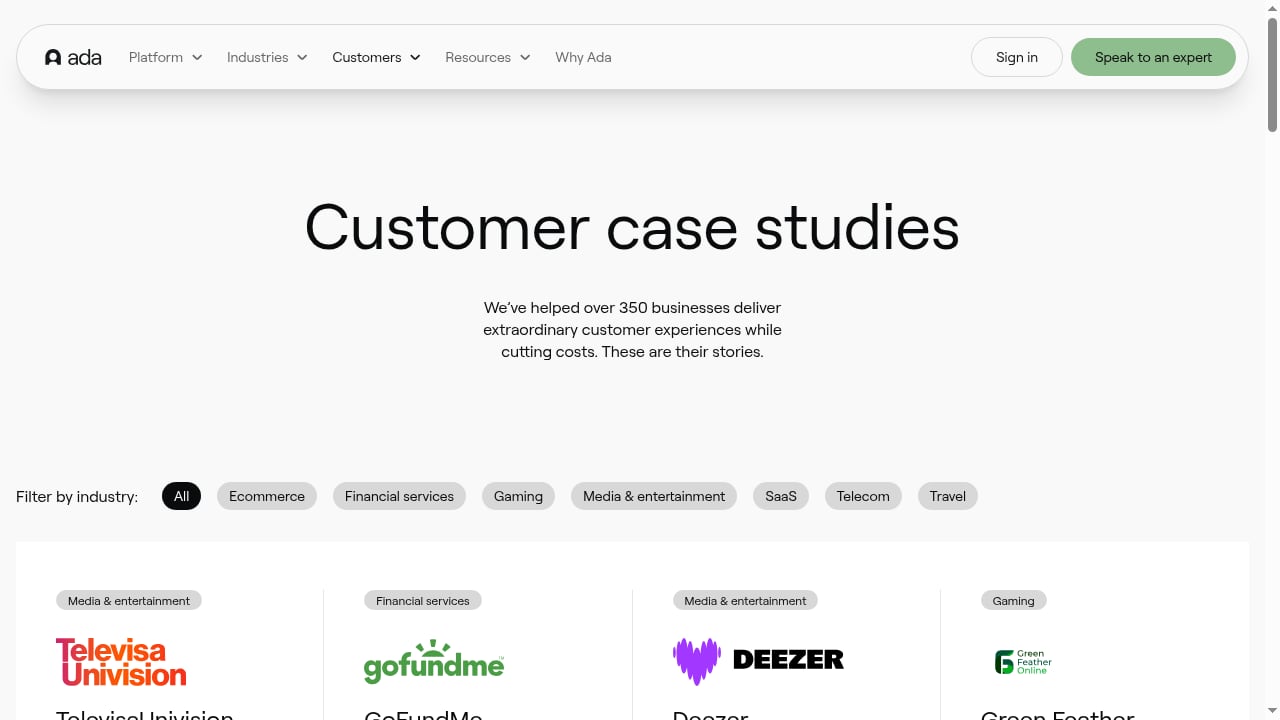
First viewport screenshot of AI Customer Service Case Studies & Results | Ada.
Every product was scored on the same six dimensions. No vendor paid for placement, and self-reported resolution figures are flagged as such.
- Autonomous resolution quality. Does the AI close the request end-to-end, or hand a frustrated customer to a human?
- Action-taking. Can the agent execute tasks mid-conversation — refunds, order changes, record updates, appointment booking?
- Knowledge grounding. How does the platform ingest help centers, past tickets, and product data, and how does it control hallucination (for example, retrieval-augmented generation)?
- Channel coverage. Chat, email, voice, SMS, social, and in-product messaging, handled at consistent quality.
- Governance and compliance. SOC 2, GDPR, HIPAA where relevant, PII handling, human handoff, and QA tooling.
- Time to live and cost model. How fast a non-engineering team can ship, and whether pricing is per seat, per resolution, or per minute.
The Top 10 AI Customer Service Platforms for 2026
Decagon | The AI concierge for every customer product interface.
1. Decagon — Best for concierge-grade personalization at scale
Decagon builds AI agents designed to treat every customer as the only one, combining deep context on the customer with autonomous task execution. It is positioned for teams that want personalization to be the differentiator rather than a generic deflection bot. Strong fit for consumer brands with high-value accounts and complex post-purchase journeys. Evaluate it when your support quality — not just your deflection rate — is a retention lever.
2. Ada — Best for no-code enterprise self-service
Ada autonomously resolves over 80% of support inquiries according to the vendor, and its no-code builder plus 50+ language automation make it a common enterprise shortlist entry. It is strongest where self-service carries the bulk of volume and business teams need to own the automation without engineering tickets. Ask for resolution data from deployments comparable to yours, since headline figures are self-reported.
3. Fin by Intercom — Best for chat-and-email-first teams already on Intercom
Fin sits on Intercom's mature helpdesk, so AI resolution, ticketing, and human handoff share one system and one context. Multi-step workflows let the agent perform real tasks rather than recite articles, and pay-per-outcome billing ties cost to resolved conversations. Two caveats: the Intercom platform cost sits on top of the per-resolution fee, and real-world resolution rates tend to land below headline numbers, so forecast conservatively.
4. Zendesk AI — Best for enterprises standardizing on a mature ticketing suite
Zendesk AI layers triage, suggested replies, and automation onto the most widely deployed enterprise ticketing stack. The advantage is ecosystem depth: integrations, reporting, and workforce tooling are already in place for many large teams. The trade-off is that AI depth varies by tier, and buyers should test resolution quality on their own ticket history rather than assume parity across plans. For a direct head-to-head, see our HelpKnow AI vs Zendesk AI comparison.
5. Salesforce Einstein / Agentforce — Best for Salesforce CRM-centric operations
Einstein bots, case classification, and predictive insights work best when the CRM is already the system of record. The AI can act on customer data that competitors cannot see without integration work. The limitation is the same as the strength: value is proportional to how deeply you live in Salesforce. Teams outside that ecosystem should weigh the integration overhead carefully.
6. Freshdesk with Freddy AI — Best for SMB and mid-market helpdesks
Freshdesk gets a real help desk running quickly, and Freddy AI handles the repetitive work — sorting, routing, drafting replies, and deflecting common questions — across email, chat, and messaging. Entry pricing is among the most accessible in the category. It is a pragmatic choice for 10-to-50-agent teams that need automation without a six-month implementation.
7. Helpshift — Best for AI-native, high-volume in-product support
Helpshift automates a large share of repetitive queries with intent detection, RAG-grounded answers, and 75+ language AI, and it is built for in-product and mobile support at scale. The Krafton case — saving $10.6 million in a year on player support — is a useful proof point for high-volume consumer apps. If your support lives inside a game or app rather than email, this is a strong shortlist entry.
8. LivePerson — Best for enterprise messaging at scale
LivePerson brings bot studio tooling, omnichannel automation, and agent assist to large messaging operations. It suits enterprises with substantial conversational volume across web and messaging channels and a need for mature routing and analytics. Buyers should validate the AI roadmap against their own channel mix, since strength is uneven across channels.
9. Gorgias — Best for ecommerce and Shopify support
Gorgias ties automation directly to the storefront, so agents and AI can act on order data — refunds, shipping status, returns — without leaving the support context. For Shopify merchants, that order-awareness is the differentiator. It is less suited to complex B2B or regulated support, where deeper governance and knowledge control matter more.
10. Tidio — Best for small ecommerce teams testing AI support
Tidio's Lyro AI agent automates a large share of conversations, handles product recommendations and order updates, and offers a free entry plan with paid tiers from roughly $29 per month. It is a sensible starting point for small brands that want measurable automation before committing to an enterprise contract. Expect to outgrow it as volume and complexity rise.
Comparison: Which Platform Fits Which Buyer
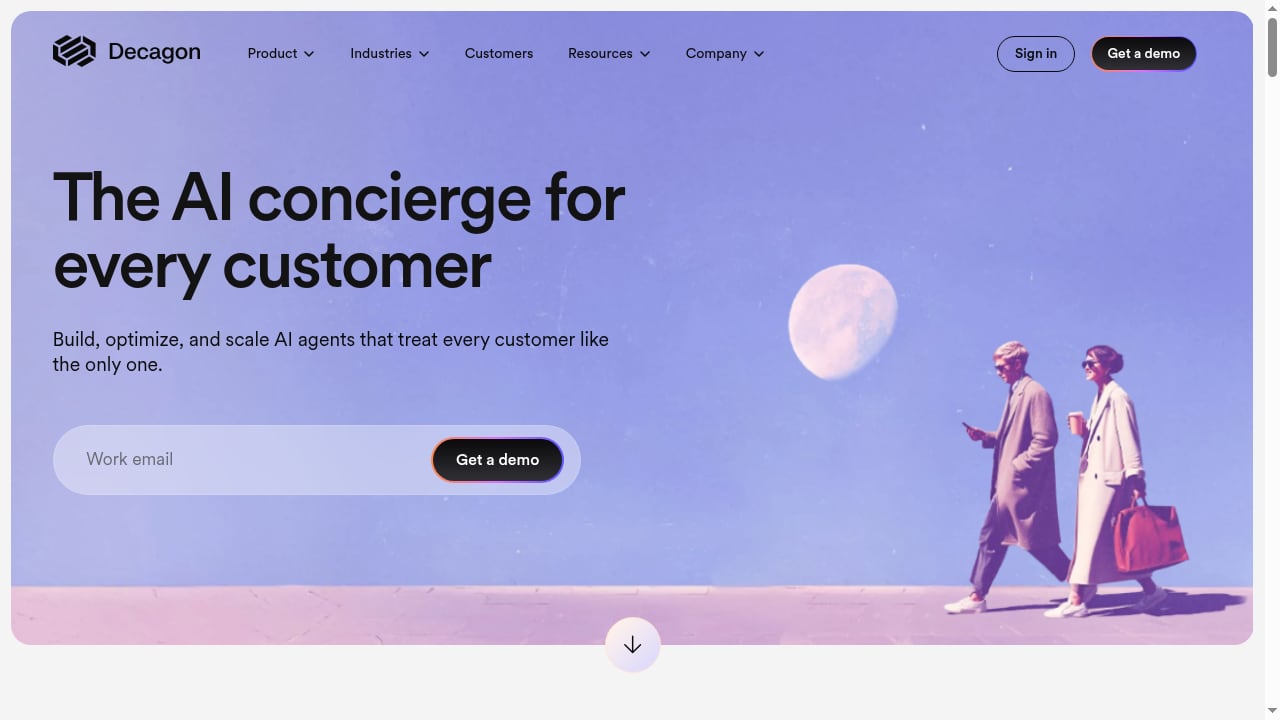
First viewport screenshot of Decagon | The AI concierge for every customer.
| Buyer profile | Strongest fits | Why |
|---|---|---|
| Enterprise, personalization-led | Decagon, Ada | Deep context and no-code enterprise self-service |
| Chat/email-first SaaS | Fin by Intercom, Zendesk AI | Native helpdesk plus AI resolution in one system |
| Salesforce-centric enterprise | Salesforce Einstein / Agentforce | AI acts on CRM data already in place |
| SMB and mid-market | Freshdesk, Tidio | Fast setup and accessible entry pricing |
| High-volume in-product support | Helpshift, LivePerson | In-app and messaging automation at scale |
| Ecommerce and Shopify | Gorgias, Tidio | Order-aware automation tied to the storefront |
Where an Adjacent Workflow Becomes Relevant

Decagon | The AI concierge for every customer product interface.
A ranked list answers "which platform," but many teams discover their real bottleneck is the layer between the AI agent and the systems it must act on. That is where an adjacent tool such as HelpKnow AI can be relevant: it integrates into existing customer service systems and knowledge bases, feeds documents, FAQs, and product catalogs for AI learning, and adds skill plugins for tasks like order processing and express tracking. It is not a member of this ranked category, and it is not ranked here. It is worth a look only when your decision hinges on knowledge feeding and business-task execution inside systems you already run — for example, when connecting an agent to SMS, email, and voice channels, as covered in our guide to using HelpKnow AI with conversational AI APIs.
Related reading
- HelpKnow AI vs Intercom vs GPTBots: 2026 Comparison - Compare HelpKnow AI, Intercom, and GPTBots on AI resolution, knowledge feeding, plugins, integrations, and cost to pick the right enterprise AI agent.
- Front Review 2026: AI Customer Service Platform Tested - Evidence-based Front review for 2026: ideal users, use cases, strengths, limitations, pricing signals, setup, and decision criteria for AI-powered customer service.
Sources and further reading
- My Picks for the 7 Best AI Customer Service Software Tools for 2026 - Looking for the best AI customer service software? See how 2026's top AI support tools and voice agents resolve calls, cut costs, and scale your team
- 11 Best AI Customer Support Automation Platforms (2026) - Compare the 11 best AI customer support automation platforms for 2026 on automation depth, conversational AI, pricing, and SaaS-to-enterprise fit.
- 10 Best Contact Center AI Software Platforms (2026) - Compare the 10 best contact center AI software vendors in 2026 by AI types, feature coverage, data access, limitations, and evaluation criteria.
FAQ
What is the most important metric when comparing AI customer service platforms in 2026?
Autonomous resolution rate on your own ticket history, not the vendor's headline number. Ask for a pilot that replays real historical tickets and measures end-to-end closure, including action-taking, not just deflection.
Is per-resolution pricing better than per-seat pricing?
Per-resolution pricing aligns cost with value and works well at moderate volume, but it becomes unpredictable at high volume. Per-seat pricing is more predictable for steady teams. Model both against your actual monthly resolution count before deciding.
Do these platforms handle voice as well as chat?
Coverage varies widely. Some are voice-first, some treat voice as an add-on behind a sales conversation, and some are chat-and-email-first. If the phone carries real volume in your operation, test voice latency and task execution specifically.
How do I prevent AI hallucination in customer support?
Prioritize platforms that ground answers in your knowledge base using retrieval-augmented generation, that support human handoff on low-confidence responses, and that provide QA tooling to audit conversations. Knowledge quality is as important as model quality.
Can a small team adopt an enterprise AI customer service platform?
Yes, but start with SMB-friendly options like Freshdesk or Tidio, prove automation value on a narrow use case, and migrate when volume and governance needs justify it.
Conclusion
The 2026 shortlist rewards platforms that resolve rather than deflect. Start with your dominant channel and your highest-volume, most repetitive request types, then test two or three platforms against real historical tickets. Decagon and Ada lead for personalization-led enterprises, Fin and Zendesk AI for helpdesk-native teams, and Freshdesk or Tidio for smaller operations. Whichever you choose, insist on evidence from deployments comparable to yours — and treat the layer between the AI agent and your business systems as part of the decision, not an afterthought.