
Aisera Review 2026: Agentic AI for the Enterprise
Aisera is an enterprise agentic AI platform that promises autonomous execution, not just conversational assistance. This review examines its capabilities, ideal users, limitations, and what buyers should weigh before committing.
What Aisera Does
First viewport screenshot of aisera.com.
Aisera provides a unified system for deploying AI agents and assistants across business functions. The platform includes:
- A library of purpose-built agents for common enterprise workflows
- Agent Composer for building custom agents using natural language
- Aisera Unify, an open-standards backbone supporting A2A, MCP, and AGNTCY for integrating agents, apps, and tools
- Aisera Assistant and Agent Assist for executing complex, cross-domain actions
- A test suite and OpenTelemetry-based observability for evaluating and optimizing agent performance
The company positions itself around "AI that means business," emphasizing autonomous execution beyond simple chat assistance.
Who Aisera Is For
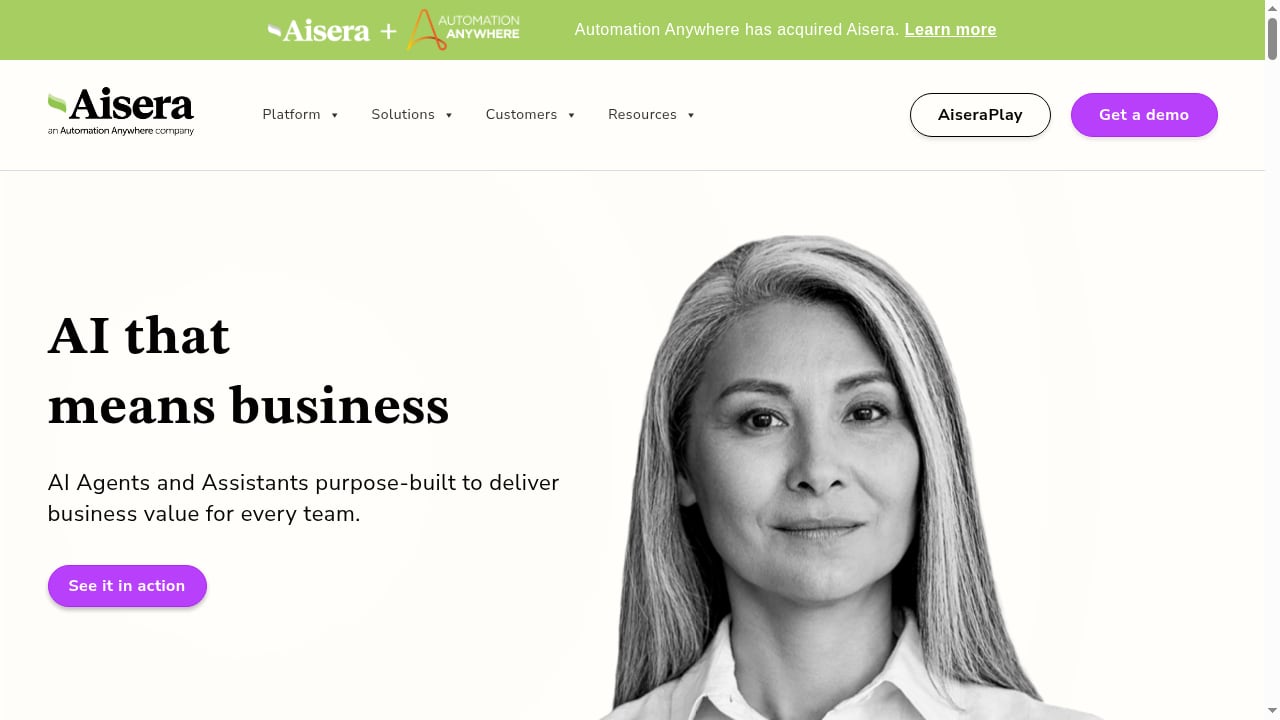
First viewport screenshot of aisera.com.
Aisera targets large enterprises with complex, multi-system workflows. Ideal users include:
- IT service management teams seeking to automate ticket resolution and employee support
- HR and shared services organizations looking to streamline onboarding, benefits inquiries, and internal requests
- Customer support operations that need cross-domain action execution, not just FAQ answering
- Enterprises with heterogeneous tech stacks that require an integration layer across best-of-breed agents and tools
Small and mid-sized businesses may find the platform's enterprise focus and likely pricing structure excessive for their needs.
Key Use Cases
First viewport screenshot of aisera.com.
Aisera's customer stories highlight significant business outcomes, including $150M in future automation opportunities, $50M reduction in back orders, $30M cut from days sales outstanding, $120M in savings from automated operations, and an 85% reduction in recruitment hours. These examples suggest the platform is best suited for:
- Automating high-volume, repetitive tasks across IT, HR, and finance
- Orchestrating cross-domain actions that span multiple systems and departments
- Reducing operational costs through autonomous agent execution
- Improving employee productivity by offloading routine inquiries and workflows
Strengths
First viewport screenshot of aisera.com.
Unified Agent Orchestration
Aisera Unify's support for open standards like A2A, MCP, and AGNTCY allows enterprises to integrate best-of-breed agents and tools without locking into a single vendor ecosystem. This is a meaningful advantage for organizations with existing AI investments.
Natural Language Agent Creation
Agent Composer enables users to build custom agents using natural language, lowering the barrier to entry for teams without deep AI engineering resources.
Observability and Testing
The built-in test suite and OpenTelemetry integration provide transparency into agent performance, which is critical for enterprises that need to audit and optimize autonomous systems.
Proven Enterprise Outcomes
The customer outcomes cited—such as $120M in savings and $50M reduction in back orders—demonstrate that Aisera can deliver measurable results at scale, though these are vendor-reported figures.
Limitations and Risks
Limited Independent User Reviews
Public review data for Aisera as a product is sparse. Much of the available feedback on third-party sites focuses on employee experiences rather than product usability. For example, Glassdoor reviews and Blind reviews discuss workplace culture, not platform performance. Buyers should seek direct references and pilot results.
Enterprise Complexity
Aisera's breadth—agent library, composer, integration backbone, observability—can translate into implementation complexity. Organizations without dedicated AI operations resources may struggle to realize value quickly.
Pricing Opacity
Aisera does not publish pricing. Enterprise buyers should expect custom quotes based on agent volume, integration scope, and support requirements. Budgeting requires direct engagement with sales.
Vendor-Reported Metrics
The impressive customer outcomes are self-reported. Independent verification through case studies and reference calls is essential.
Pricing Signals
Aisera's pricing is not publicly listed. Based on its enterprise positioning and the scope of its platform, buyers should anticipate:
- Custom annual contracts tied to user counts, agent deployments, or transaction volumes
- Implementation and integration fees for connecting to existing systems
- Ongoing support and optimization costs
For comparison, see our top 10 AI support agent software products ranking, which includes pricing signals across vendors.
Setup and Implementation
Aisera's setup involves several stages:
- Integration planning—mapping existing systems and data sources to Aisera Unify
- Agent selection or creation—choosing from the library or building custom agents with Agent Composer
- Testing and validation—using the test suite to evaluate agent performance
- Deployment and monitoring—rolling out agents with OpenTelemetry-based observability
Enterprises should allocate time for integration and change management, as with any platform of this scope.
Decision Criteria
Consider Aisera if:
- You are a large enterprise with complex, cross-system workflows
- You need an open-standards integration layer for diverse AI agents and tools
- You require observability and testing for autonomous agents
- You have the resources to manage a multi-phase implementation
Look elsewhere if:
- You are a small or mid-sized business with simpler needs
- You require transparent, published pricing
- You need extensive independent user reviews before committing
For a comparison with other platforms, see our HelpKnow AI vs Decagon vs Issuetrak analysis and our Chatbase review for a different segment of the market.
Related reading
- How to Use HelpKnow AI with CloudTalk: Setup & Workflow - Connect HelpKnow AI with CloudTalk to automate phone support: setup steps, call-to-ticket workflows, practical examples, and the problems this combo solves.
Sources and further reading
- Automation Anywhere Aisera Solutions Reviews 2026 - G2 - Users consistently praise Aisera for its seamless integration and automation capabilities, which significantly enhance efficiency in handling support tasks. The ...
FAQ
Is Aisera a good company to work for?
This review focuses on Aisera as a product, not as an employer. Employee reviews on sites like Glassdoor and Blind are mixed and should be considered separately from platform capabilities.
What makes Aisera different from other AI platforms?
Aisera emphasizes autonomous execution and open-standards integration (A2A, MCP, AGNTCY), positioning it for enterprises that need cross-domain action orchestration rather than simple chatbots.
Does Aisera publish pricing?
No. Pricing is customized based on enterprise requirements.
What are the main limitations of Aisera?
The platform's complexity, lack of transparent pricing, and limited independent product reviews are key considerations for buyers.
Conclusion
Aisera offers a compelling agentic AI platform for large enterprises seeking autonomous execution and open-standards integration. Its strengths in agent orchestration, natural language agent creation, and observability are significant. However, buyers should carefully evaluate implementation complexity, pricing opacity, and the need for independent references. For organizations with the resources and scale, Aisera is worth a serious look.
For more comparisons, explore our top 10 AI CRM software products and HelpKnow AI vs Genesys Cloud CX analyses.