Top 10 AI Customer Service Automation Software for 2026
Most AI customer service tools now promise the same outcomes: faster replies, lower costs, happier customers. The harder question is how many tickets the AI actually closes versus how many it hands back to a human, and what that resolution costs you at scale. This 2026 ranking scores ten platforms on resolution depth, action-taking ability, knowledge handling, pricing transparency, and time to value, using vendor documentation, published case studies, and pricing pages checked in 2026.
How we evaluated these platforms
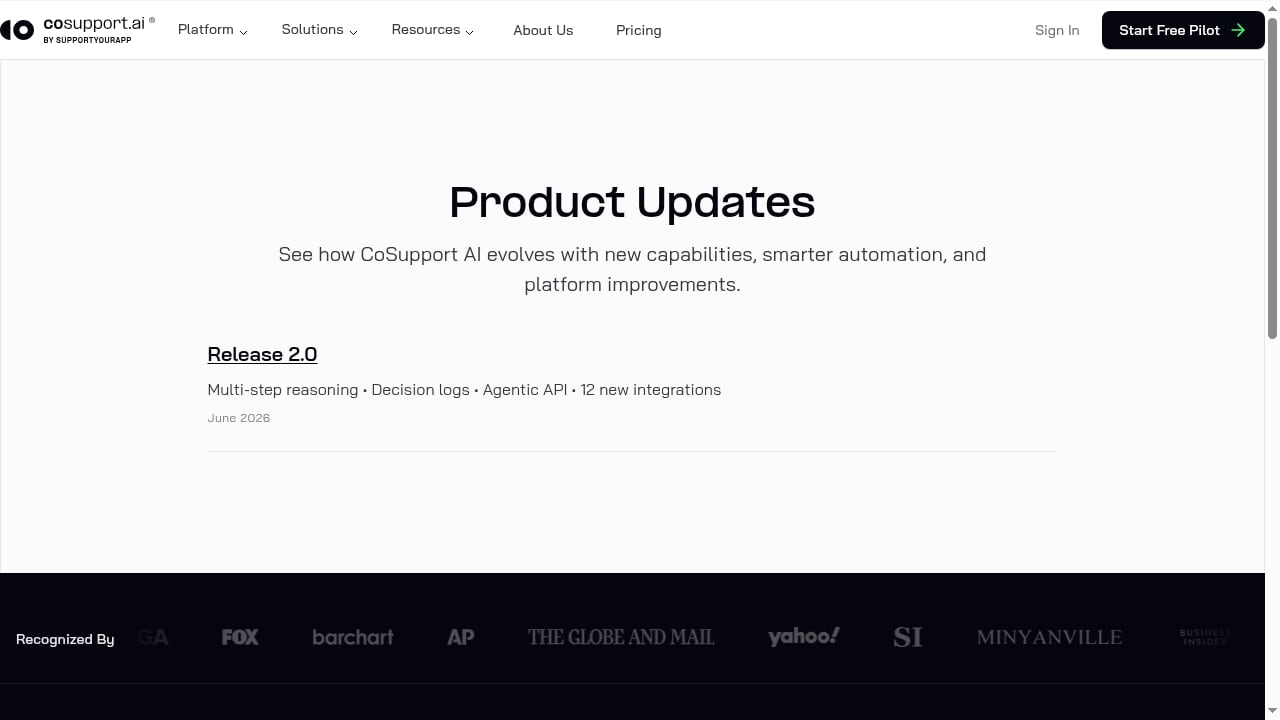
First viewport screenshot of cosupport.ai.
We scored each product on five weighted criteria:
- Resolution depth (30%): Does the AI complete end-to-end resolutions, or only draft replies for agents? We looked for published containment or automated-resolution figures.
- Action capability (20%): Can the agent cancel orders, issue refunds, update subscriptions, or trigger backend workflows, not just answer questions?
- Knowledge and learning (15%): How the platform ingests help centers, past tickets, and SOPs, and how it handles gaps and hallucinations.
- Pricing model and predictability (20%): Per resolution, per conversation, per seat, or custom enterprise contracts, and how each model aligns incentives.
- Time to value and fit (15%): Implementation effort, helpdesk compatibility, and the team size each product genuinely serves.
We excluded tools that are purely live-chat widgets without automation logic, and we did not rank general-purpose CRM suites unless their AI support layer stands on its own. Vendors' own claims are labeled as claims; independent pricing pages and case studies carry more weight.
Quick comparison: the top 10 at a glance
| Rank | Product | Best for | Pricing model |
|---|---|---|---|
| 1 | Ada | Large consumer brands across chat, email, and voice | Custom (sales-led) |
| 2 | Sierra | Enterprises wanting outcome-based AI agents | Custom, outcome-based |
| 3 | Decagon | AI-first, high-volume CX teams | Custom, per conversation or resolution |
| 4 | Zendesk AI | Teams already on Zendesk | Per agent + per automated resolution |
| 5 | Intercom (Fin) | Chat-first SaaS and ecommerce teams | Per resolution + seat fees |
| 6 | Gorgias | Shopify and ecommerce brands | Per ticket + per automated interaction |
| 7 | Salesforce Agentforce | Enterprises running on Salesforce CRM | Per conversation or Flex Credits |
| 8 | Freshdesk (Freddy AI) | Small and mid-sized teams on Freshworks | Per agent + per AI session |
| 9 | CoSupport AI | Teams that want to pay only for resolved tickets | $0.50 per AI-resolved ticket |
| 10 | Helpshift | High-volume in-app and mobile support | Tiered subscription |
1. Ada
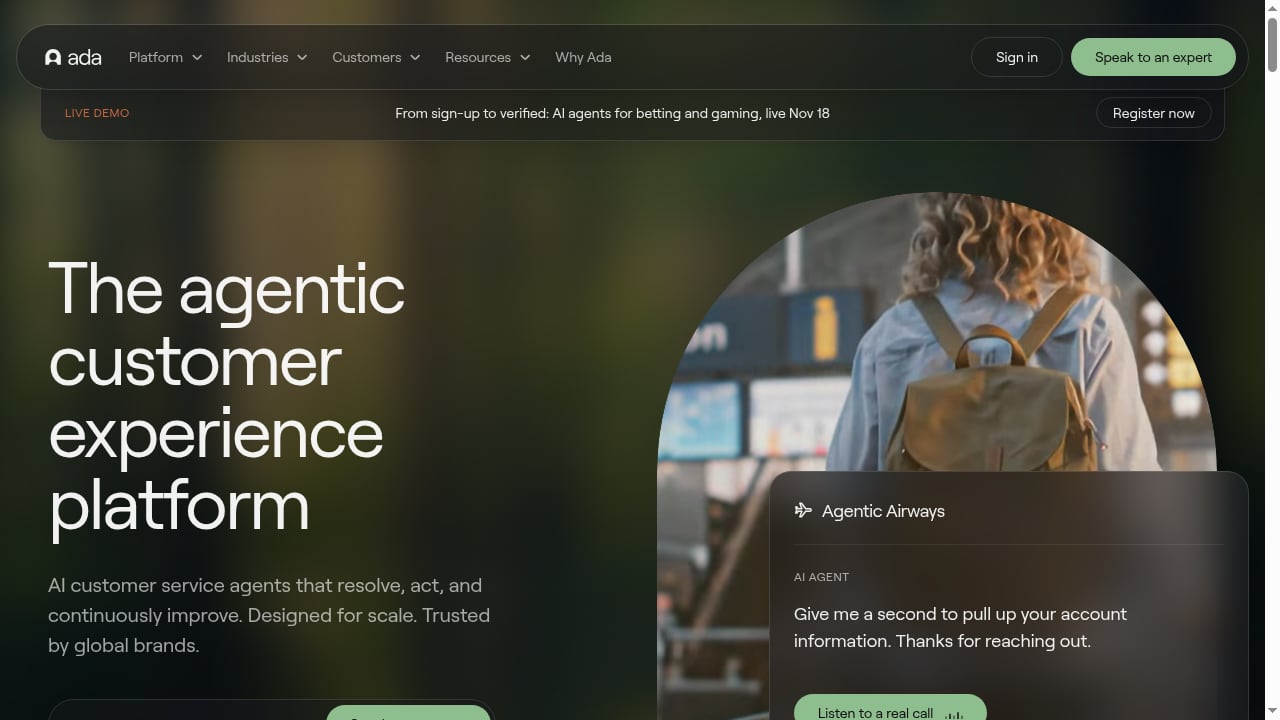
First viewport screenshot of www.ada.cx.
Best for: large consumer brands that want autonomous resolution across chat, email, and voice.
Ada deploys AI agents that handle multi-step tasks using reasoning and integrations rather than scripted flows. The company claims its agents autonomously resolve over 80% of support inquiries and serves more than 350 brands across ecommerce, financial services, gaming, media, telecom, and travel. Published proof points include TelevisaUnivision reaching 82% containment during the World Cup, GoFundMe reporting a 20% CSAT increase, and Deezer achieving roughly 30% automated resolution on day one with AI on 85% of contacts.
Ada also promotes the idea of an "Automated Customer Experience (ACX) department," a dedicated team of existing service professionals who run the AI strategy. Pricing is custom and sales-led, so smaller teams should expect a longer evaluation cycle. If you are comparing Ada against contact-center suites, our Genesys Cloud CX comparison covers the trade-offs in AI agent depth versus contact-center breadth.
2. Sierra
Best for: enterprises that want to pay for outcomes rather than seats.
Sierra builds AI agents from standard operating procedures and sells them on outcome-based contracts, which shifts risk toward the vendor: if the agent does not resolve, you do not pay the same way. The platform covers chat and voice and is aimed at large consumer brands. The trade-off is that outcome-based contracts require clear definitions of what counts as a resolution, so negotiate that definition before signing. Sierra is sales-led with no self-serve tier.
3. Decagon
Best for: AI-first CX teams with high conversation volume.
Decagon uses natural-language agent logic (often described as AOPs) to define how agents behave across channels, and it is sold per conversation or per resolution on custom contracts. It suits teams that want to move fast on AI without being locked into a legacy helpdesk's AI roadmap. As with Sierra, ask for a precise resolution definition and a pilot on your real ticket mix. For a head-to-head view against adjacent platforms, see our Decagon vs Issuetrak comparison.
4. Zendesk AI
Best for: mid-to-large teams already running Zendesk.
Zendesk bundles AI agents, Copilot, and intelligent triage directly into its helpdesk. Pricing combines a per-agent fee with a per-automated-resolution charge (commonly cited around $1.50 to $2.00 per resolution on top of the agent seat). The advantage is zero migration: your data, workflows, and reporting stay in one place. The limitation is that the AI is tied to Zendesk's roadmap and per-resolution costs can climb quickly at high volume. Teams weighing a standalone AI layer against a full helpdesk should read our Kayako and Genesys comparison for context on where AI add-ons fit.
5. Intercom (Fin)
Best for: chat-first SaaS and ecommerce teams already using Intercom.
Intercom's Fin agent is one of the most established conversational AI agents, billed per resolution plus seat fees. It excels at chat and messenger-style support and has improved steadily on actions and integrations. The main caution is total cost: seat fees plus per-resolution charges can add up for large teams, so model your volume before committing. Intercom is a strong fit if your support is already conversation-led rather than email-ticket-led.
6. Gorgias
Best for: Shopify and ecommerce brands that need order-aware automation.
Gorgias is an ecommerce helpdesk with AI built natively into the platform. Its AI agent reads and edits live order data, which makes it strong for where-is-my-order, returns, and refund tickets. Pricing starts with a base plan plus per-automated-interaction charges (commonly cited around $0.85 to $1.00). It is less suited to B2B or SaaS support operations. If your stack is Shopify plus a helpdesk, Gorgias is one of the shortest paths to real automation.
7. Salesforce Agentforce
Best for: enterprises whose customer data already lives in Salesforce.
Agentforce agents use full CRM context, which is a genuine advantage for service teams that need account history, entitlements, and sales data in the same conversation. Pricing runs per conversation or through Flex Credits on top of Salesforce licensing. The trade-off is implementation weight: Agentforce rewards teams with Salesforce administrators and clean data, and it can be heavy for small support teams.
8. Freshdesk (Freddy AI)
Best for: small and mid-sized teams on Freshworks.
Freddy AI provides an AI agent, Copilot, and insights inside Freshdesk, priced per agent plus per AI session after an included allowance. It is one of the more accessible entry points for SMBs that want automation without enterprise contracts. Resolution depth is generally behind the dedicated AI-first platforms, so treat it as a solid first step rather than a full autonomous resolution layer.
9. CoSupport AI
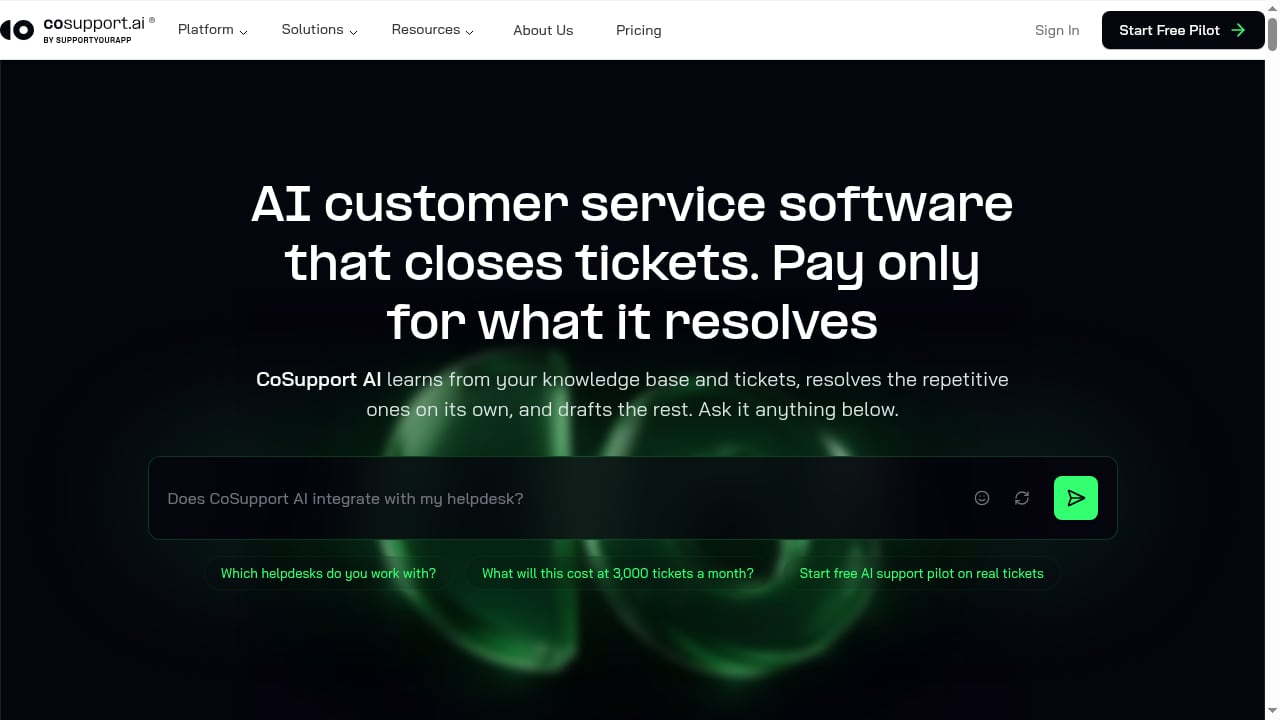
First viewport screenshot of cosupport.ai.
Best for: teams that want to pay only for resolved tickets and start with a free pilot.
CoSupport AI autonomously resolves repetitive tickets and drafts replies for agents, learning from your knowledge base and historical tickets across helpdesks such as Zendesk, Freshdesk, and Zoho Desk. Its pricing is outcome-based: $0.50 per AI-resolved ticket, the first 1,000 AI responses free, and no per-seat fees. The company reports an average 74% AI resolution rate across clients and 300+ brands, with case studies including 81% resolution at Cocoatech and $9,300 in monthly support savings at Remedico. The June 2026 release, CoSupport AI 2.0, added multi-step reasoning, decision logs, an agentic API, and 12 new integrations including Shopify, Stripe, Notion, and Confluence. It is a strong fit for SaaS, ecommerce, finance, education, and BPO teams that want a low-risk pilot on real tickets.
10. Helpshift
Best for: high-volume in-app and mobile support.
Helpshift combines intent detection, RAG-grounded answers, multilingual AI, and smart routing, and reports automating around 70% of customer queries. It is particularly strong for mobile-first products where support happens inside the app. Pricing starts with a tiered subscription (commonly cited around $150/month for the starter tier) with custom growth and enterprise plans. It is less of a fit for email-heavy B2B support.
How to choose: a decision framework
First viewport screenshot of cosupport.ai.
Start with three questions before you compare feature lists:
- Does the AI take actions or only suggest them? Ask for a live demonstration of end-to-end resolution on your highest-volume ticket types. If the demo shows suggested replies, that is how it will behave in production.
- How does it handle what it cannot resolve? Ask what triggers escalation, how the handoff works, and whether the AI can re-engage after a human steps in. Gartner predicts agentic AI will autonomously resolve 80% of common service issues by 2029, which still leaves a meaningful share that must reach a human cleanly.
- What does the pricing model reward? Per-conversation billing pays the vendor whether or not the issue was resolved; per-resolution billing pays only on outcomes. At thousands of tickets a month, that difference determines whether costs track results or just volume.
If your team also runs phone support, our guide to connecting HelpKnow AI with CloudTalk shows how an AI knowledge layer can sit alongside a voice platform. And if you are evaluating AI support agents more broadly, our Top 10 AI support agent software ranking scores products on resolution, knowledge reach, and time to value.
Where adjacent tools fit
Some teams need an AI layer that learns from existing knowledge bases and plugs into the helpdesk they already run, rather than replacing it. HelpKnow AI is one example of that adjacent approach: it builds AI agents from uploaded documents and FAQs, integrates with existing service systems, and adds action plugins such as express tracking and order processing. It is not part of this ranking because it is positioned as an enterprise AI agent layer rather than a full customer service automation suite, but it can complement platforms like Zendesk or Freshdesk when the priority is fast knowledge learning and practical task execution. Teams that want to see how that layer works inside a collaboration tool can read our HelpKnow AI with Slack setup guide.
Related reading
- HelpKnow AI vs RingCentral: AI Agent vs Voice Platform - Compare HelpKnow AI and RingCentral for AI customer service: knowledge learning, action plugins, voice and contact center depth, and which fits your team.
- Aisera Review 2026: Agentic AI for the Enterprise - An evidence-based Aisera review covering its agentic AI platform, ideal users, use cases, strengths, limitations, pricing signals, and setup considerations.
Frequently asked questions
What is the best AI customer service automation software in 2026?
There is no single best product. Ada and Sierra lead for large enterprises that need autonomous resolution across channels, while CoSupport AI and Gorgias offer clearer outcome-based or ecommerce-specific pricing for mid-market teams. The right choice depends on your helpdesk, ticket mix, and how you want to pay.
How much does AI customer service automation cost?
Pricing ranges from per-resolution models such as CoSupport AI at $0.50 per resolved ticket to custom enterprise contracts for Ada and Sierra. Helpdesk add-ons like Zendesk AI and Gorgias typically combine a per-agent or base fee with a per-resolution or per-interaction charge. Model your monthly volume before comparing sticker prices.
Can AI fully replace human customer service agents?
Not yet. Most platforms automate the repetitive majority and escalate complex or sensitive cases to humans. The quality of the escalation handoff matters as much as the automation rate, because a poor handoff creates downstream work for your team.
What should I ask vendors before buying?
Ask for a pilot on your real tickets, a precise definition of what counts as a resolution, details on escalation triggers and handoff, and a total-cost model at your actual volume. Also confirm data residency, security certifications, and how the AI handles knowledge gaps.
Conclusion
The 2026 market has split into two camps: AI-first platforms such as Ada, Sierra, and Decagon that sell autonomous resolution on custom contracts, and helpdesk-native AI such as Zendesk AI, Intercom, Gorgias, and Freshdesk that adds automation where your team already works. Outcome-based pricing from CoSupport AI shows the market moving toward paying for results rather than seats. Whichever shortlist you build, test on your own tickets, define resolution in writing, and check the handoff before you sign.
Sources: Yuma AI's customer service automation comparison, eesel AI's 2026 AI customer support tools guide, and Helpshift's AI customer service platform roundup.