
How to Use HelpKnow AI with Conversational AI and APIs for SMS, Email, Voice
Customer service teams often have strong AI for answering questions but weak plumbing for reaching customers where they actually are. HelpKnow AI handles the intelligence: it learns your knowledge base, recognizes intent, and can execute tasks like order lookups. Conversational AI and APIs for SMS, Email, Voice handle the delivery: they carry messages across channels and provide conversational AI for smarter engagement. Together they close the gap between "the AI knows the answer" and "the customer got the answer on the channel they chose."
This guide explains how the two products work together, how to set them up, and what practical problems the combination solves.
Why combine HelpKnow AI with Conversational AI and APIs?

Conversational AI and APIs for SMS, Email, Voice product interface.
HelpKnow AI is an enterprise AI agent platform for building and deploying AI agents in one click. It integrates with existing customer service systems and knowledge bases, and it claims a 95% automated resolution rate and up to 70% lower customer service costs across more than 1,000 enterprise customers.
Conversational AI and APIs for SMS, Email, Voice provide the channels. They let you build customer experiences on the Twilio platform with APIs for SMS, RCS, voice, and email, plus conversational AI for smarter engagement and identity verification for trust.
The split of responsibilities is clean:
- HelpKnow AI owns the answer. It ingests documents, FAQs, and product catalogs, recognizes intent, and runs super skill plugins such as express tracking or order processing.
- The communications platform owns the journey. It routes messages, manages phone numbers and senders, handles compliance, and keeps conversations coherent across channels.
Neither half is sufficient alone. An AI agent with no channel strategy cannot reach customers; a channel platform with no knowledge layer cannot resolve anything.
How the integration works end to end
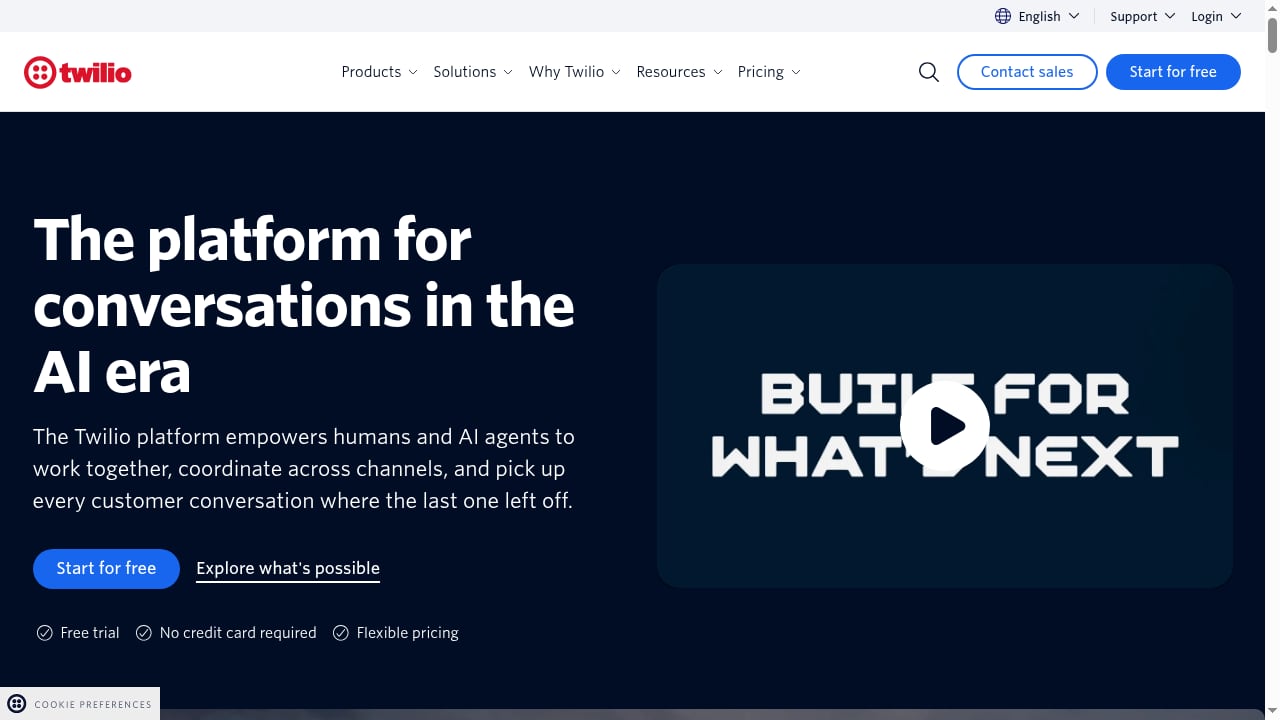
First viewport screenshot of Conversational AI and APIs for SMS, Email, Voice.
At a high level, a customer message arrives on a channel, the channel platform passes it to HelpKnow AI, HelpKnow AI resolves it or escalates it, and the response travels back out on the same channel.
The message flow
- A customer sends an SMS, email, or voice request.
- The communications platform receives it and forwards the content and context to HelpKnow AI.
- HelpKnow AI matches the intent against its learned knowledge and decides whether to answer directly, call a plugin, or hand off to a human.
- The response returns through the platform to the customer.
- If a human takes over, the platform keeps the conversation thread intact so the customer does not repeat themselves.
Where each product does the heavy lifting
| Task | HelpKnow AI | Conversational AI and APIs |
|---|---|---|
| Knowledge learning from docs and FAQs | Yes | No |
| Intent recognition and resolution | Yes | Supports conversational flows |
| Order processing, express tracking | Yes, via plugins | No |
| SMS, RCS, voice, email delivery | No | Yes |
| Phone numbers, senders, compliance | No | Yes |
| Identity verification | No | Yes |
Setup steps
First viewport screenshot of Twilio Product Changelog and Announcements.
Step 1: Prepare the knowledge layer in HelpKnow AI
Upload your documents, FAQs, and product catalogs so the agent can learn them. The quality of this step determines the quality of every downstream answer, so start with the content that covers your highest-volume questions.
Step 2: Enable the skills your workflows need
If customers ask about deliveries or orders, turn on the relevant super skill plugins. This is what separates an agent that explains a policy from one that actually checks a shipment.
Step 3: Connect the channels
On the communications side, provision the senders and phone numbers you need for SMS, voice, and email. Choose the sender type that matches your use case and geography, and confirm the regulatory requirements for each region before you start sending.
Step 4: Wire the two systems together
Connect HelpKnow AI to the channel platform so inbound messages reach the agent and outbound replies return to the customer. Keep the customer identifier consistent across channels so the agent recognizes returning customers.
Step 5: Define escalation rules
Decide which intents must go to a human, and make sure the handoff preserves context. HelpKnow AI is designed to integrate into third-party customer service systems for 24/7 second-level responses, so the handoff can be seamless rather than a reset.
Step 6: Test, then monitor
Run real scenarios across each channel before launch. After launch, track resolution rate, escalation rate, and response time per channel, because a workflow that works in SMS may behave differently in voice.
Practical examples

Conversational AI and APIs for SMS, Email, Voice product interface.
Example 1: Order status by SMS
A customer texts "where is my order?" The platform delivers the message to HelpKnow AI, which recognizes the intent, calls the express tracking plugin, and returns the current status. No agent touches the ticket.
Example 2: Voice inquiry with identity verification
A caller asks about their account. The voice channel captures the request, the platform verifies identity, and HelpKnow AI answers using the customer's actual account context rather than a generic script.
Example 3: Email follow-up after a failed self-service attempt
A customer abandons a web session. The platform triggers an email, HelpKnow AI drafts a resolution based on the same knowledge it would have used in chat, and the customer finishes the task without calling support.
Example 4: Escalation with full context
A complex billing dispute exceeds the agent's confidence threshold. The conversation routes to a human, who sees the full history across channels and the AI's attempted resolution.
Problems this combination solves
- Channel fragmentation. Customers move between SMS, email, and voice. A shared agent and shared context prevent the "start over" experience.
- Knowledge that never reaches the customer. Many teams have good documentation that never gets used in live conversations. HelpKnow AI turns that content into answers.
- Automation that cannot act. Answering is not resolving. Plugins let the agent complete tasks instead of describing how to complete them.
- Cost per contact. A high automated resolution rate reduces the volume of contacts that require a human, which is where the cost savings come from.
- Trust and compliance. Identity verification and proper sender management matter as much as answer quality in regulated industries.
Decision guidance: when this pairing fits
This combination fits best when you have high contact volume spread across multiple channels, a substantial knowledge base, and tasks that can be automated end to end. It fits less well if your support is almost entirely high-touch and low-volume, or if your knowledge content is not yet organized enough to feed an AI agent.
If you are still evaluating the AI layer itself, comparisons such as HelpKnow AI vs Intercom vs GPTBots and HelpKnow AI vs Zendesk AI can help you judge resolution rates, knowledge feeding, and cost before you commit to a channel architecture. For a broader view of channel coverage across vendors, see the Top 10 AI-Powered Omnichannel Customer Service Software 2026.
Related reading
- Front Review 2026: AI Customer Service Platform Tested - Evidence-based Front review for 2026: ideal users, use cases, strengths, limitations, pricing signals, setup, and decision criteria for AI-powered customer service.
Sources and further reading
- TEXAS EVIDENCE HANDBOOK Evidentiary Analysis - Mar 27, 2026 ... Speaker, Use and Abuse of Legal Assistants, Panhandle Family Law Bar Association November Luncheon, 2002. • Author/Speaker, Drafting Trial ...
FAQ
Do I need developers to connect HelpKnow AI to SMS, email, and voice?
It depends on the channel and the complexity of your flow. Simple messaging use cases can often be assembled from pre-built services, while advanced flows may need engineering help. Twilio's own guidance on getting the most out of a messaging project walks through when a developer is necessary and when a partner-built app is enough.
Can the AI agent handle voice as well as text?
Yes, provided the voice channel is set up to pass the request to the agent and return the response. Voice adds constraints that text does not, including turn-taking and recognition accuracy, so test voice separately from SMS and email.
What happens when the AI cannot resolve a request?
It escalates. The important detail is that escalation should carry context, so the human agent sees the conversation history and the AI's attempt. HelpKnow AI is built to integrate into existing customer service systems, which is what makes this handoff practical.
How do I know the integration is working?
Track resolution rate, escalation rate, and first-response time per channel. A healthy integration shows high automated resolution on routine intents and clean, contextual escalations on complex ones.
Does accessibility matter for voice channels?
It does, and it is easy to overlook. Speech recognition performs unevenly for people with non-standard speech, which is why specialized approaches such as Voiceitt's speech API exist to keep voice-based experiences inclusive. If your voice channel serves a broad population, plan for this rather than assuming generic recognition covers everyone.
Conclusion
HelpKnow AI and Conversational AI and APIs for SMS, Email, Voice solve different halves of the same problem. HelpKnow AI supplies the knowledge, intent recognition, and task execution; the communications platform supplies the channels, delivery, and trust layer. Connected properly, they turn scattered support conversations into a single automated resolution path across SMS, email, and voice.
Start with your highest-volume intents, feed the knowledge layer well, enable the plugins that let the agent act, and measure resolution per channel. That sequence is what turns an AI agent from a demo into a working part of your customer service operation.