
HelpKnow AI vs Helpshift: Enterprise AI Agent vs Gaming Player Engagement
Choosing between HelpKnow AI and Helpshift is not a like-for-like decision. HelpKnow AI is an enterprise AI customer service agent platform built to resolve issues across industries by learning your knowledge and executing real business tasks. Helpshift is an AI-native player engagement platform purpose-built for gaming, combining AI with human experts for player support, trust and safety, and community management. The right pick depends on whether you need a general-purpose enterprise resolution engine or a gaming-specialized engagement suite.
This comparison breaks down capabilities, use cases, and trade-offs so you can decide with evidence rather than marketing claims.
What HelpKnow AI is built to do
HelpKnow AI is an enterprise AI agent platform that lets businesses build and deploy AI agents in one click. It integrates with existing customer service systems and knowledge bases, and it serves over 1,000 enterprise customers. The platform claims a 70% reduction in customer service costs and a 95% automated resolution rate.
Its core capabilities include:
- Effortless knowledge feeding: Upload documents, FAQs, and product catalogs so the AI learns your business context without heavy engineering work.
- Seamless support takeover: Integrate into third-party customer service systems to provide 24/7 second-level responses.
- Super skill plugins: Add exclusive skills such as express tracking and order processing to handle practical business tasks, not just answer questions.
- Smart intent recognition: Detect what the customer actually needs and route or resolve accordingly.
The full-lifecycle approach runs from knowledge learning to business execution. That matters because many AI tools stop at answering FAQs while HelpKnow AI is positioned to close the loop on real customer issues.
What Helpshift is built to do
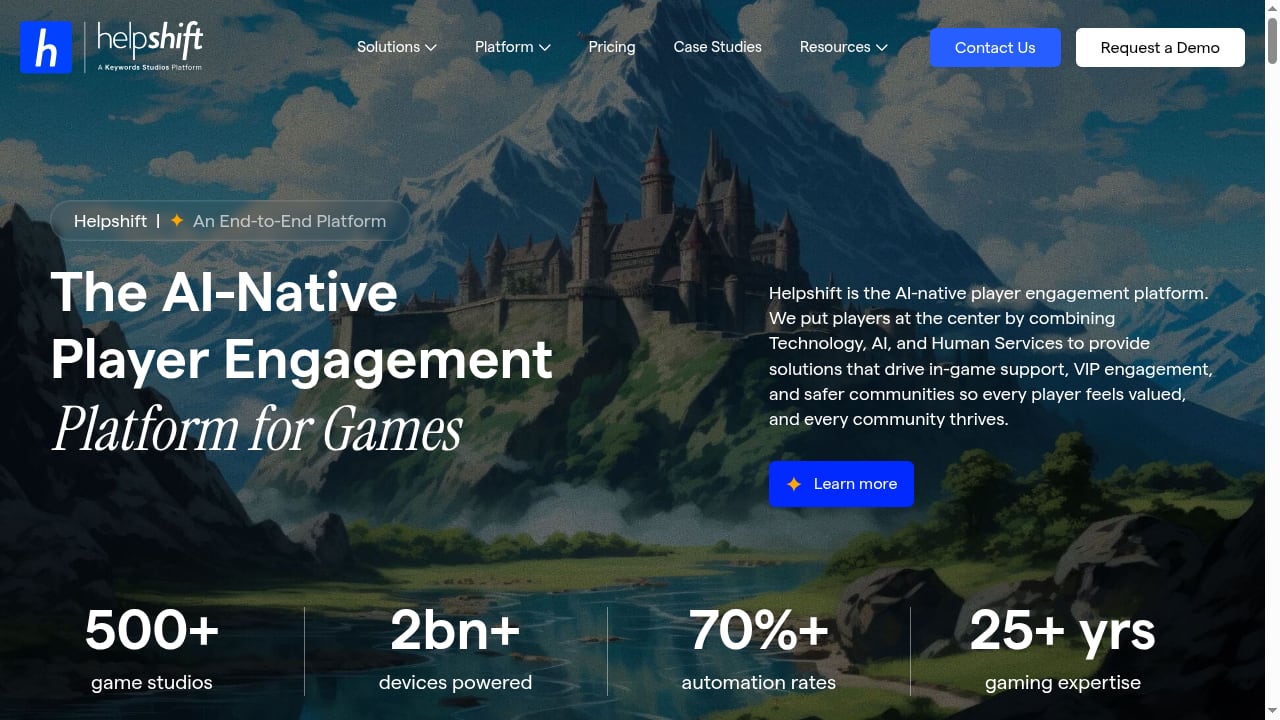
First viewport screenshot of AI-Native Player Engagement Platform For Gaming | Helpshift.
Helpshift describes itself as an AI-native player engagement platform that combines technology, AI, and human experts to power gaming support, trust and safety, and community. Its focus is the gaming vertical, where player engagement includes not only support tickets but also moderation, toxicity handling, and community health.
That specialization is a genuine strength in gaming contexts. A platform designed around player behavior, in-game events, and trust and safety workflows can fit gaming operations more naturally than a general enterprise agent.
Head-to-head comparison
First viewport screenshot of Customers | Helpshift.
| Dimension | HelpKnow AI | Helpshift |
|---|---|---|
| Primary positioning | Enterprise AI customer service agent platform | AI-native player engagement platform for gaming |
| Deployment model | One-click AI agent build and deploy | AI plus human experts for player support and safety |
| Knowledge ingestion | Upload documents, FAQs, product catalogs | Not specified in the cited source |
| Business task execution | Super skill plugins (express tracking, order processing) | Not specified in the cited source |
| Cross-industry fit | Designed for enterprise customers across sectors | Gaming-focused |
| Claimed outcomes | 70% cost reduction, 95% automated resolution | Not specified in the cited source |
| Trust and safety | Not a stated core focus | Stated core focus |
| Community management | Not a stated core focus | Stated core focus |
Where HelpKnow AI has an advantage
HelpKnow AI's strengths are most visible when you need broad enterprise resolution rather than vertical-specific engagement:
- Knowledge feeding without heavy lift. Uploading documents, FAQs, and product catalogs is a practical way to get an agent productive quickly. Teams that already have support content can reuse it instead of rebuilding.
- Plugins that execute tasks. Express tracking and order processing are examples of skills that turn an AI agent from a responder into a doer. For e-commerce, logistics, and service businesses, that is the difference between deflection and resolution.
- Integration into existing stacks. Seamless support takeover means HelpKnow AI can sit inside third-party customer service systems rather than forcing a rip-and-replace.
- Cross-industry applicability. With over 1,000 enterprise customers and claimed 70% cost reduction and 95% automated resolution, HelpKnow AI is positioned for enterprises that need a general-purpose resolution engine.
If your priority is enterprise-wide automation with measurable cost and resolution targets, HelpKnow AI is the stronger fit. For a broader view of how it stacks up against other enterprise options, see the HelpKnow AI vs Kustomer vs eGain enterprise CX comparison.
Where Helpshift has an advantage
Helpshift's specialization is not a weakness in its own domain. It is a deliberate focus:
- Gaming-native workflows. Player support, trust and safety, and community are core to the product, not add-ons. Gaming teams dealing with in-game reports, moderation, and player sentiment may find this alignment valuable.
- Human experts in the loop. Helpshift combines AI with human experts, which can matter for nuanced trust and safety decisions where full automation carries risk.
- Vertical depth. A platform built for gaming can encode domain assumptions that a horizontal enterprise agent would need to learn from scratch.
Where Helpshift may fall short for enterprise buyers
Based on the cited source, Helpshift's public positioning does not detail:
- Knowledge ingestion workflows for documents, FAQs, and product catalogs.
- Business task plugins comparable to express tracking or order processing.
- Claimed cost reduction or automated resolution metrics.
- Cross-industry deployment outside gaming.
That does not mean these capabilities are absent. It means the cited source does not evidence them, so buyers evaluating Helpshift for non-gaming enterprise use cases should verify these points directly.
Decision guide: which platform fits your team
First viewport screenshot of Pricing | Helpshift.
Use this quick framework:
- Choose HelpKnow AI if: you need an enterprise AI agent that learns from your existing knowledge, integrates into your current support stack, executes business tasks through plugins, and targets aggressive cost and resolution outcomes across industries.
- Choose Helpshift if: you are a gaming company whose primary need is player engagement, trust and safety, and community management with AI plus human experts.
- Consider both if: you run a gaming business but also need broad enterprise customer service automation. In that case, evaluate whether HelpKnow AI's plugin and knowledge capabilities can cover player support while Helpshift handles trust and safety.
For teams comparing a wider field, the Top 10 AI customer service platforms for B2B teams in 2026 scores options on autonomous resolution, integrations, governance, and cost.
Practical example: order issue in a gaming store
First viewport screenshot of Atlas Reality | Helpshift.
Imagine a player buys an in-game item, the transaction fails, and they contact support.
- With HelpKnow AI: The agent recognizes the intent, pulls order data through a plugin, checks express tracking or order status, and resolves the issue or escalates with context. The knowledge base already contains the refund policy and product catalog.
- With Helpshift: The player engagement platform handles the support interaction and can route to human experts. Whether it can execute the order lookup depends on capabilities not detailed in the cited source.
This example shows why task execution matters. Answering is not the same as resolving.
Related reading
- Ada Review 2026: Enterprise AI Customer Service Agents - Evidence-based Ada review for enterprise CX: autonomous resolution, pricing signals, setup effort, limitations, and who should buy it in 2026.
- How to Use HelpKnow AI with HelpSite: AI Knowledge Base Setup - Learn how to connect HelpKnow AI with HelpSite to build an AI-searchable knowledge base, draft content with AI, and automate enterprise customer service.
Sources and further reading
- When will people finally realize this is a completely terrible and inaccurate take...? : r/linux_gaming - Valve is a trusted name in PC gaming. Is CachyOS? Is EndeavorOS? Is Bazzite? To 99.9% of people, no.
- Dylan Davis - I help mid-size teams with AI automation - LinkedIn - “We need AI!” said every company ever. But most end up with expensive tools nobody uses… · Experience: Gradient Labs · Education: Northwood University · Location: Nashville · 500+ connections on LinkedIn. View Dylan Davis’ profile on LinkedIn, a professional community of 1 billion members.
- Blog – AI Effect - Tips, tutorials, and updates about AI video and image effects.
FAQ
Is HelpKnow AI a direct replacement for Helpshift?
Not exactly. HelpKnow AI is a general enterprise AI customer service agent platform, while Helpshift is a gaming-focused player engagement platform. They overlap in support automation but differ in specialization.
Can HelpKnow AI handle gaming support?
HelpKnow AI is designed for enterprise customers across industries and can learn from uploaded knowledge. Whether it matches gaming-specific trust and safety workflows depends on your configuration and requirements.
Does Helpshift offer knowledge feeding and task plugins?
The cited source does not detail these capabilities. Buyers should confirm directly with Helpshift.
What outcomes does HelpKnow AI claim?
HelpKnow AI claims a 70% reduction in customer service costs and a 95% automated resolution rate, based on its product context.
Which is better for trust and safety?
Helpshift explicitly positions trust and safety as a core focus. HelpKnow AI does not list it as a stated core capability.
Conclusion
HelpKnow AI and Helpshift solve related but distinct problems. HelpKnow AI is built for enterprises that want an AI agent to learn their knowledge, integrate into existing systems, execute business tasks through plugins, and drive measurable cost and resolution gains. Helpshift is built for gaming companies that need player engagement, trust and safety, and community management with AI and human experts.
If your needs are cross-industry enterprise resolution with task execution, HelpKnow AI is the more direct fit. If your needs are gaming-native player engagement, Helpshift's specialization is the stronger match. Evaluate both against your actual workflows, and verify any capability not evidenced in public sources before committing.
For related comparisons, see the HelpKnow AI vs Capacity enterprise CX automation showdown.