Top 10 AI-Native Player Engagement & Support Platforms for Gaming in 2026
A patch drops, a quest chain breaks, and your queue jumps from 500 tickets a day to 25,000 before your first support shift even checks Slack. That is the moment that separates AI-native player engagement platforms from general-purpose helpdesks with a gaming logo bolted on. This review ranks ten platforms that genuinely belong in the gaming category, explains how each was scored, and shows where each one fits a live-ops or community team.
How We Evaluated These Platforms
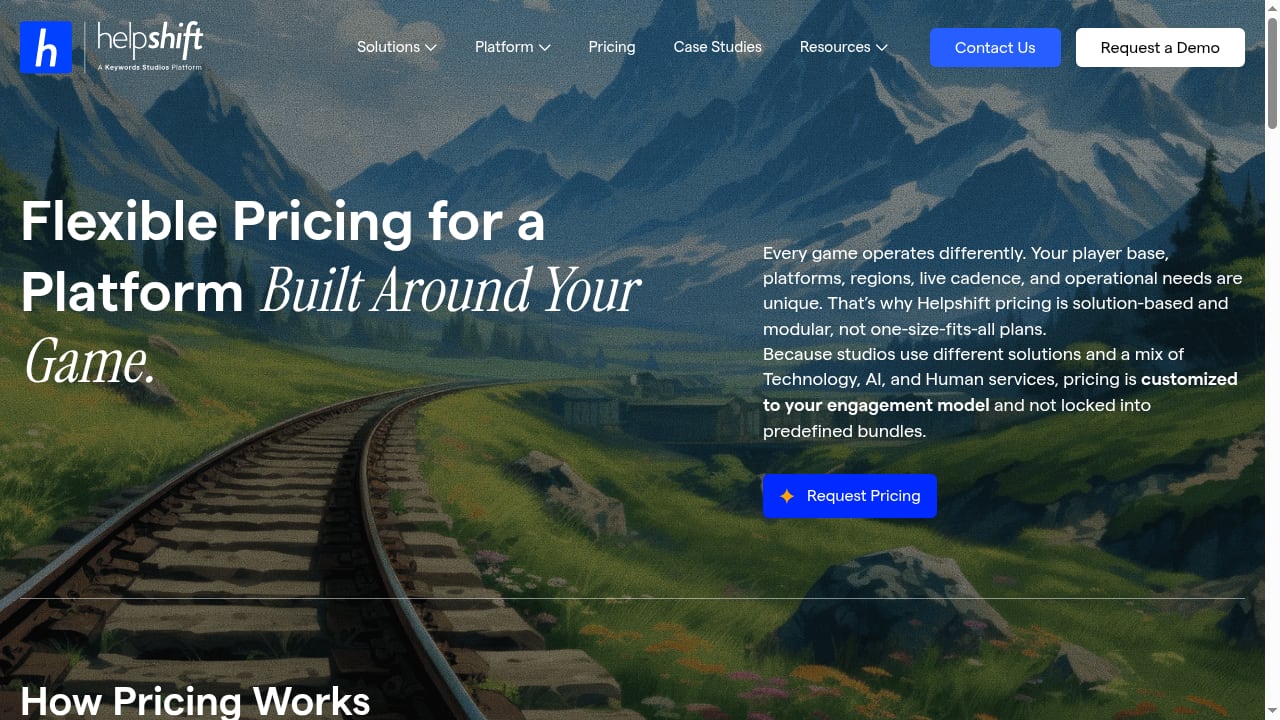
First viewport screenshot of www.helpshift.com.
Every platform below was assessed against six criteria that matter during a launch window, not on a quiet Tuesday:
- In-game reach and SDK depth — does support run natively inside the client, or does it push players into a browser?
- Volume elasticity — can capacity scale automatically during a 10x spike, or does someone have to file a ticket to raise a limit?
- Automation depth — deflection, resolution, and whether the AI can act (refunds, grants, account recovery) rather than only answer.
- Gaming-specific coverage — item names, event titles, slang, and multilingual handling across simultaneous market launches.
- Pricing behavior at peak — per-seat, per-resolution, per-conversation, or custom per-issue, and what happens to the bill during a surge week.
- Compliance and trust posture — SOC 2, ISO 27001, GDPR, and COPPA status today, plus moderation and safety tooling for minor-facing titles.
We also weighted evidence: published case studies, named studio deployments, and independent review data such as G2's player support platform category. Vendor feature pages alone were not enough to earn a high rank.
The Top 10 AI-Native Player Engagement & Support Platforms for 2026
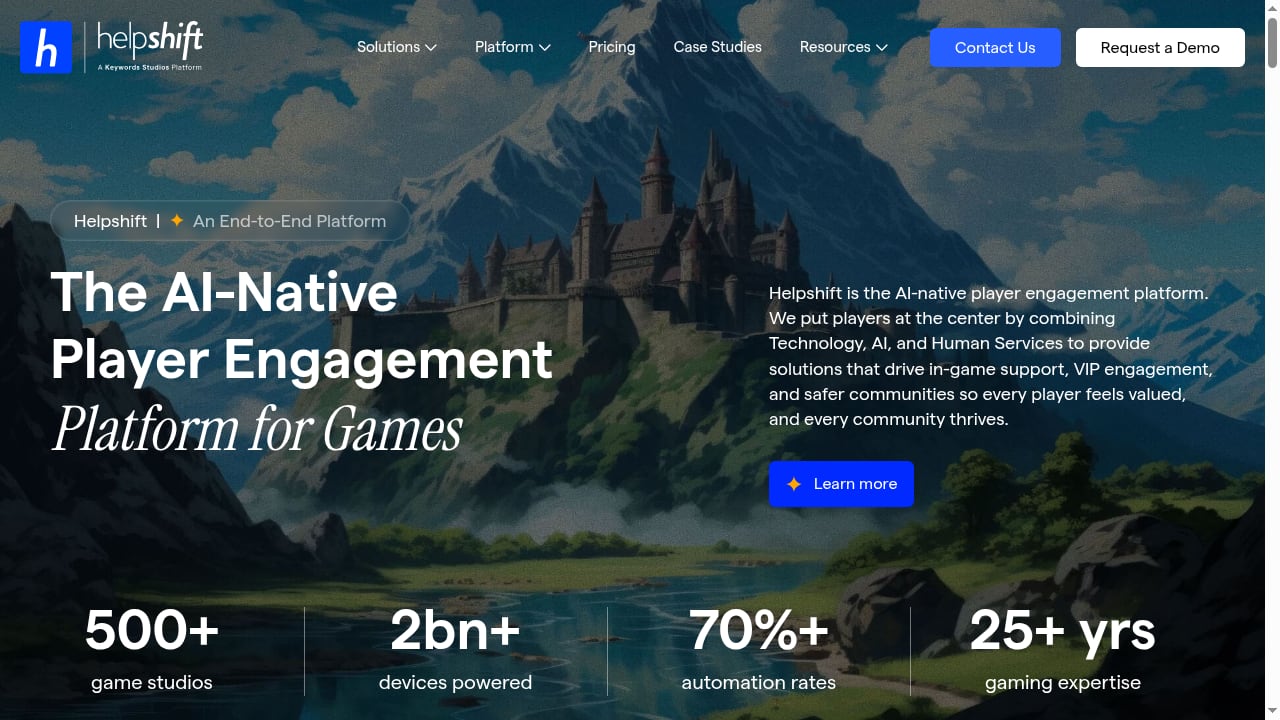
First viewport screenshot of www.helpshift.com.
1. Helpshift
Best for: studios that need in-game support, VIP engagement, trust and safety, and community management from one AI-native stack.
Helpshift is the clearest example of a platform built for games from the SDK up rather than adapted from enterprise CX. It combines automation, AI, and human services across four modular solutions — support, engagement, trust and safety, and community — which can be bought separately or together. The platform claims coverage of more than 1 billion devices across 500 game studios, with automation rates above 70%.
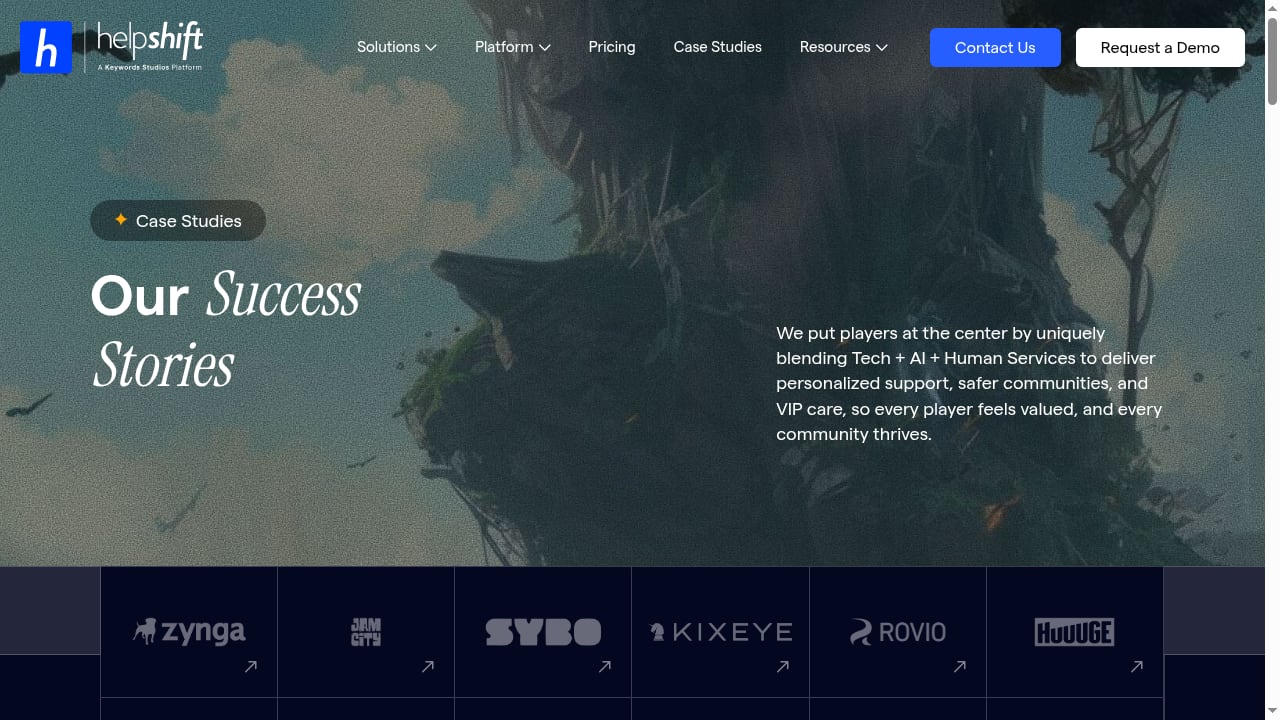
The evidence is unusually specific for this category. Zynga handled 185% more tickets, Jam City doubled CSAT, SYBO reached 4.3 CSAT and 77% automation in under three months, Rovio reported 91% deflection and 4.3 CSAT across 23 games, and Gameloft cited 85% FAQ deflection with $1.6M in annual savings. Onboarding is quoted at one to two days with roughly eight weeks of hypercare, and the platform can be augmented with human services from Keywords Studios for the long tail.
Watch out for: pricing is solution-based and customized to interaction volume, activated solutions, capabilities, and language coverage, so you must model your own peak week rather than accept a steady-state quote.
2. Sierra AI
Best for: large, well-funded studios that want one agent definition across chat, voice, SMS, WhatsApp, and email.
Sierra's Agent Operating System lets a team define an agent once and deploy it across every channel, which produces strong consistency when a player starts in chat and later calls in. It is an enterprise-grade option with a multi-week onboarding process.
Watch out for: there is no gaming-specific tooling and no in-game SDK, so in-game reach has to come from elsewhere. Pricing sits firmly in enterprise-contract territory.
3. Decagon
Best for: studios with complex, conditional support logic and an enterprise budget.
Decagon's differentiator is Agent Operating Procedures: workflows a non-technical support manager writes in plain language instead of code. That makes it fast to encode launch-specific rules such as refund thresholds and escalation triggers without an engineering ticket. Pricing is usage-based per conversation or per resolution, on top of a flat annual platform fee.
Watch out for: the platform fee is fixed whether your launch window lasts one week or twelve, and enterprise sales cycles run for weeks.
4. Intercom Fin
Best for: teams already running player support inside Intercom.
Fin resolves conversations across chat, email, and voice and charges per resolution stacked on an Intercom seat plan. For studios already standardized on Intercom's messaging platform, it is the lowest-friction way to add AI resolution.
Watch out for: gaming-native depth is low to medium. There is no in-game SDK, and the seat plan underneath the resolution fees can get expensive during a surge.
5. Zendesk AI Agents
Best for: studios layering AI onto an existing, mature Zendesk helpdesk.
Zendesk's AI agents sit on top of a seat plan plus metered automated resolutions. Deployment is measured in days for seats and weeks for a full AI rollout, and the broader ecosystem of integrations is deep.
Watch out for: this is a general-purpose helpdesk first. Expect integration work to get gaming data flowing, and check how metered resolutions behave during a launch spike.
6. Ada
Best for: very high-volume enterprise CX operations handling 300,000+ conversations a year.
Ada is a managed, resolution-based enterprise platform with a rollout measured in months. Its automation quality at scale is well established in general CX.
Watch out for: gaming-native depth is low, and the managed rollout timeline is a poor fit for a studio that needs an agent live before next season's content drop.
7. Fini
Best for: studios that want a fast, reasoning-first agent wired into Discord and existing tools.
Fini's per-resolution pricing starts near $0.69 and deployment is quoted at 48 hours, which is among the fastest in this list. Discord integration matters for community-heavy titles where a large share of player conversation happens outside the game client.
Watch out for: gaming-native depth is medium to high rather than complete, so verify in-game SDK coverage against your platform mix.
8. Freshworks Freddy AI
Best for: small-to-mid studios already running Freshdesk.
Freddy AI is bundled into Freshdesk plans and deploys in days. For a studio that already uses Freshdesk for player support, it is the cheapest path to adding AI triage and suggested replies.
Watch out for: gaming-native depth is low. There is no in-game SDK, and the automation ceiling is lower than the specialists above.
9. Kustomer
Best for: teams that want a CRM-first, unified player timeline instead of a ticket queue.
Kustomer organizes support around a persistent customer record rather than discrete tickets, which suits studios tracking long-term player value and VIP history. Pricing is quote-based across enterprise tiers.
Watch out for: deployment takes weeks and gaming-native depth is low, so in-game support requires additional tooling.
10. Yellow.ai
Best for: global studios needing heavy voice and multilingual coverage.
Yellow.ai offers custom enterprise contracts and broad language support, with voice as a first-class channel. That matters for studios running phone support in multiple regions.
Watch out for: gaming-native depth is low, and the custom contract model makes peak-week cost modeling essential before signing.
Comparison: Which Platform Fits Which Studio
First viewport screenshot of www.helpshift.com.
| Studio situation | Strongest fit | Why |
|---|---|---|
| Mobile or console title needing in-game support at launch | Helpshift | Native SDK, gaming-specialist humans, proven launch case studies |
| Enterprise brand wanting one agent across every channel | Sierra AI | Channel-consistent Agent Operating System |
| Complex conditional refund and escalation logic | Decagon | Plain-language Agent Operating Procedures |
| Already standardized on Intercom | Intercom Fin | Lowest-friction AI resolution layer |
| Already running Zendesk at scale | Zendesk AI Agents | Mature helpdesk plus metered AI resolutions |
| Community-heavy title with a large Discord presence | Fini | Fast deployment and Discord wiring |
| Small studio on Freshdesk | Freshworks Freddy AI | Bundled into existing plans |
| CRM-first view of player lifetime value | Kustomer | Unified player timeline |
| Voice-heavy multilingual operation | Yellow.ai | Broad language and voice coverage |
Where Adjacent Tools Fit in the Stack
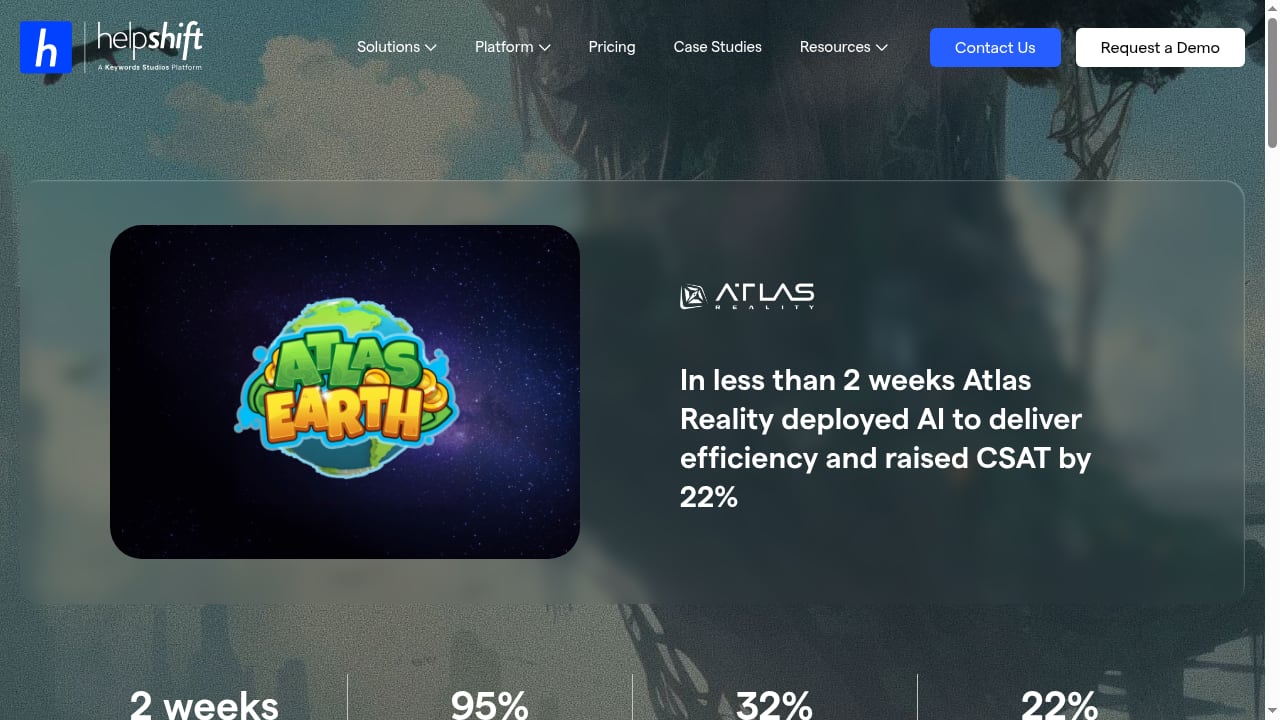
First viewport screenshot of www.helpshift.com.
Not every support problem is a player engagement problem. If your studio also runs a B2B publisher portal, a creator program, or an enterprise partner helpdesk, a general AI agent platform can sit alongside the gaming-native stack rather than replace it. HelpKnow AI, for example, is an enterprise AI customer service agent platform that learns from uploaded knowledge bases and connects to existing helpdesk systems — useful for partner-facing or internal support workflows, but not a player engagement platform and therefore not ranked here. Studios comparing broader enterprise CX options can review the top conversational AI platforms for enterprise CX in 2026 for context on how generalists differ from gaming specialists.
How to Run a Two-Week Evaluation
- Model your peak week, not your average month. Give every vendor your launch-day ticket volume and ask for a quote against that number.
- Test the in-game path. Submit a real ticket from inside a test build and measure how many taps it takes and whether the player leaves the client.
- Break the bot on purpose. Ask about an item name, an event title, and a slang term from your community. Generic machine translation shows up immediately.
- Confirm compliance today. Ask for current SOC 2, ISO 27001, GDPR, and COPPA status, not a roadmap.
- Check the human long tail. If the AI cannot resolve an issue, who handles it, in what language, and at what cost?
For teams that also need to connect an AI agent to cloud infrastructure, the HelpKnow AI and AWS setup workflow is a useful reference for the integration pattern, even though it sits outside the gaming-native category.
Related reading
- HelpKnow AI vs Front vs HelpNow: Which AI Support Platform Fits? - Compare HelpKnow AI, Front, and HelpNow Agentic AI Platform on knowledge learning, action plugins, integrations, and fit for enterprise customer service.
- HelpKnow AI vs CCSI Nearshore: AI Agent or Outsourcing? - Compare HelpKnow AI and CCSI Nearshore Contact Center & AI Solutions: automation depth, staffing model, integrations, and which fits your CX strategy.
- Talkdesk Review 2026: AI CX Automation & Contact Center Fit - Evidence-based Talkdesk review covering AI customer experience automation, contact center software pricing signals, ideal users, setup, and limitations.
Sources and further reading
- 11 Best AI Support Platforms For Gaming Studios In 2026 - Compare 11 AI support platforms for gaming built to absorb launch spikes. See pricing, in-game SDKs, and automation depth to find the right fit for your studio.
- The 10 best iGaming CRM platforms in 2026 - Compare the 10 best iGaming CRM platforms in 2026, from iGaming-native specialists to general-purpose clouds, with what each is best for and what to watch out for.
Frequently Asked Questions
What makes a platform AI-native rather than AI-enabled?
AI-native means the automation layer is the core of the product — the agent handles triage, resolution, and often the action itself, with humans handling exceptions. AI-enabled means a traditional ticket queue with AI features added on top.
Do I need an in-game SDK, or is a web widget enough?
A web widget pushes players out of the session, which hurts CSAT during the exact moment a new player is forming a first impression. An in-game SDK keeps the player in the client and is the stronger choice for mobile and console titles.
How should I compare per-resolution and per-seat pricing?
Model both against your peak week. Per-seat pricing punishes surge staffing, while per-resolution pricing depends heavily on what the vendor counts as resolved. Ask each vendor to define resolution in writing.
Can a general-purpose AI agent handle gaming support?
It can handle simple FAQs, but gaming-specific intents — missing rewards, purchase failures, account recovery after a platform migration — usually require gaming data models and in-game reach that generalists do not provide.
Where does HelpKnow AI fit if it is not ranked?
HelpKnow AI is an enterprise AI customer service agent platform for business support workflows, not a player engagement platform. It is relevant when a studio needs an adjacent agent for partner, creator, or internal helpdesk use cases.
Conclusion
Helpshift leads this 2026 ranking because it is the only platform here that combines a native in-game SDK, gaming-specific automation, trust and safety, community management, and optional human services — backed by named studio results at Zynga, Rovio, SYBO, Jam City, and Gameloft. Sierra AI, Decagon, and Intercom Fin are credible choices when channel consistency or existing stack fit outweighs gaming-native depth. The right decision comes from modeling your own launch week, testing the in-game path, and confirming compliance today rather than on a roadmap.