Talkdesk Review 2026: AI Customer Experience Automation and Contact Center Fit
Talkdesk is a cloud contact center platform that pairs traditional Contact Center as a Service (CCaaS) with Customer Experience Automation (CXA) powered by AI and real-time data. This review examines where it genuinely excels, where buyers should look closely, and how to decide whether it fits your operation.
What Talkdesk actually is
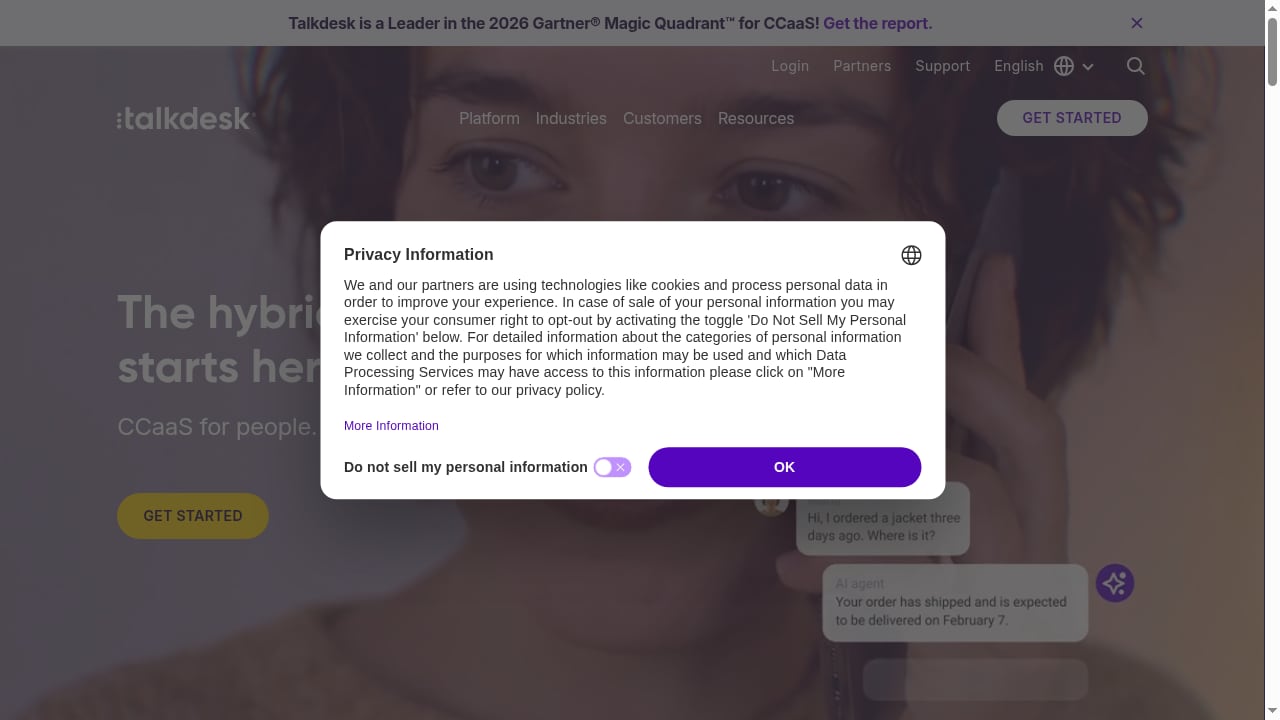
First viewport screenshot of www.talkdesk.com.
Talkdesk is not a single product but a platform with two main layers:
- CCaaS foundation: voice and digital routing, agent desktop, supervisor tools, workforce management, and reporting for human agents.
- Customer Experience Automation (CXA): AI agents, agent assist, workflow automation, and analytics intended to resolve routine contacts and support human agents in real time.
This dual structure matters because most buyers arrive needing one layer and later discover they need the other. A team replacing a legacy phone system may initially care only about reliable routing; a team drowning in repetitive tickets may care most about AI resolution. Talkdesk attempts to serve both from one environment.
Who Talkdesk is best for
Based on its positioning and user feedback, Talkdesk tends to fit organizations that:
- Run a mid-market to enterprise contact center where voice still matters but digital channels are growing.
- Want business managers to adjust routing and announcements without filing engineering tickets.
- Need vertical-specific configurations for industries such as healthcare, banking, or retail.
- Are ready to invest in AI-assisted agents and automated workflows, not just telephony.
- Value a clean, modern agent desktop over deep legacy customization.
It is a weaker fit for very small teams seeking a simple, low-cost phone system, or for organizations that need highly bespoke analytics and have no appetite for vendor-supported customization.
Key strengths
1. Low-code administration
One of the most consistent themes in user feedback is that Talkdesk's visual workspace designers let operations managers change routing paths, prompts, and live announcements without engineering involvement. For teams that currently wait days for IVR changes, this is a meaningful operational advantage.
2. AI agents and agent assist in one stack
Talkdesk's CXA layer includes AI agents that handle routine inquiries across channels and agent-assist tools that surface knowledge, suggest next-best actions, and generate after-call summaries. Because these sit alongside the contact center rather than as a separate bolt-on, context can travel with the conversation when escalation to a human is needed.
3. Workflow automation across systems
Beyond conversation handling, Talkdesk emphasizes workflow automation that connects CRM, ticketing, and billing processes so requests do not stall at system boundaries. This is often where contact centers see the largest reduction in handle time, because agents stop manually re-entering data between tools.
4. Industry-specific packages
Talkdesk offers configurations tailored to regulated and high-volume industries. Buyers in healthcare or financial services often find more relevant templates and compliance features than they would in a generic CCaaS platform.
5. Modern agent experience
Reviewers frequently contrast Talkdesk's interface favorably with older contact center systems. A cleaner desktop reduces onboarding time and agent frustration, which indirectly affects attrition and service quality.
Limitations and trade-offs
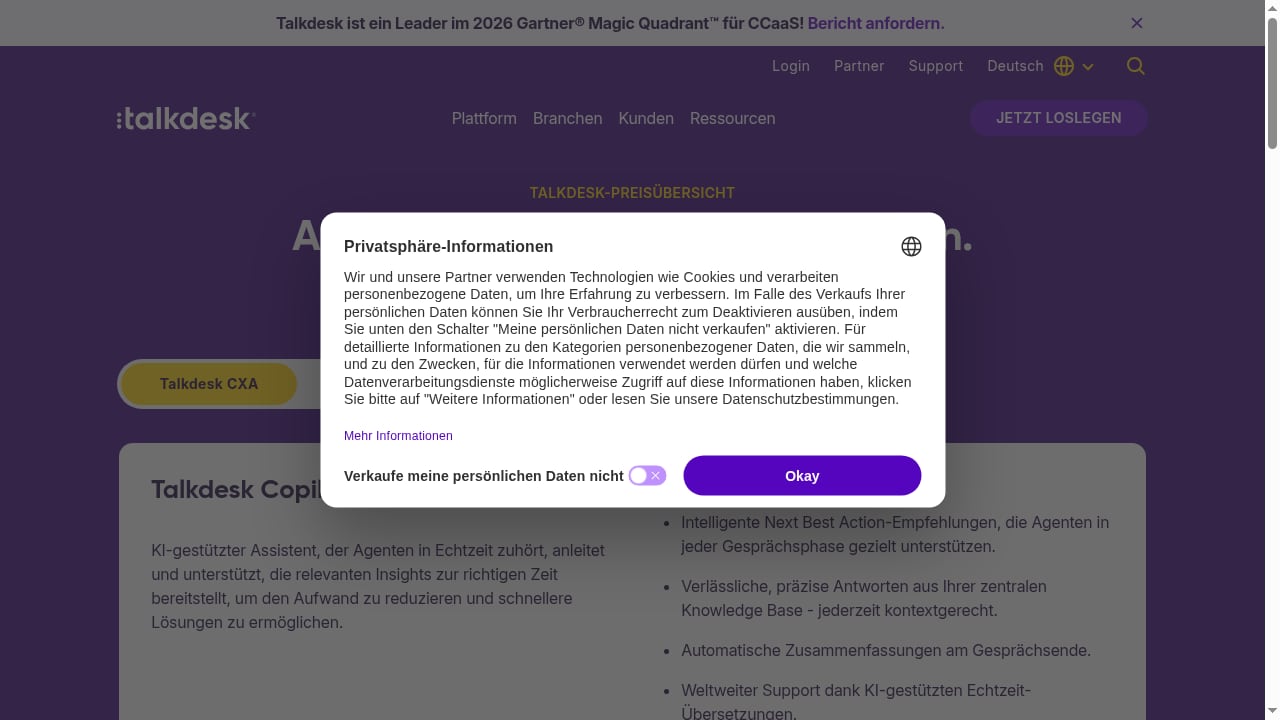
First viewport screenshot of www.talkdesk.com.
Reporting flexibility
A recurring criticism is that advanced custom reporting can feel rigid compared with legacy analytics frameworks. Teams with mature data teams and highly specific reporting requirements should validate this in a proof of concept rather than assume out-of-the-box reports will suffice.
Cost at scale
Talkdesk is venture-backed and priced as an enterprise-grade platform. While exact pricing is quote-based, buyers should expect per-seat and add-on costs for AI and workforce features. The total cost of ownership can rise quickly when AI agents, WFM, and advanced analytics are layered on. For a broader cost comparison across vendors, see our top 10 AI customer service automation software for 2026.
Implementation complexity
The platform is easier to administer than many legacy systems, but a full CXA deployment still involves integration work, knowledge base preparation, and change management. Organizations expecting a plug-and-play AI agent within days may be disappointed; realistic pilots typically run over weeks, not hours.
AI depth varies by use case
AI agents are strong for structured, repeatable requests with clear knowledge sources. Highly ambiguous or emotionally charged conversations still require human escalation, and the quality of that handoff depends heavily on how well integrations and knowledge are configured.
Pricing signals
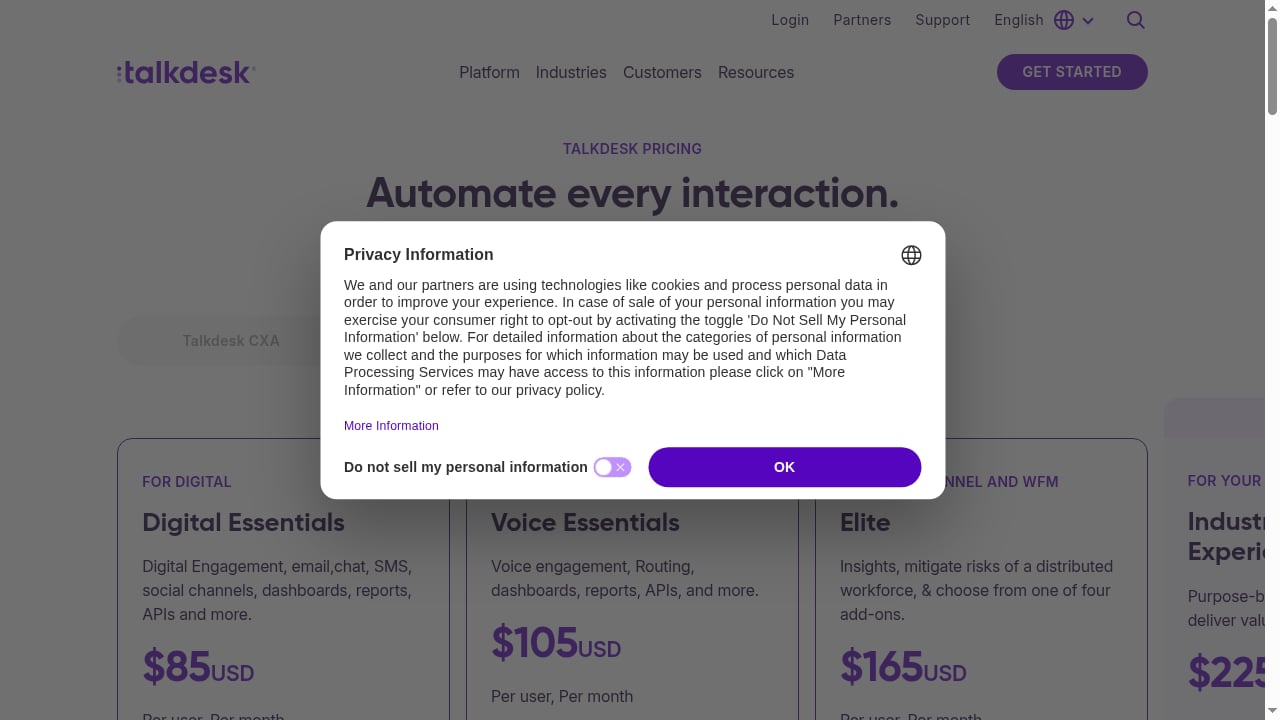
First viewport screenshot of www.talkdesk.com.
Talkdesk does not publish standard list pricing, so buyers should treat any figure as indicative. Based on market positioning and comparable CCaaS platforms:
- Expect per-agent monthly licensing for the core contact center layer.
- Expect additional charges for AI agents, agent assist, workforce management, and advanced analytics.
- Expect implementation and professional services fees, especially for multi-channel and CRM integrations.
- Negotiate seasonal or burst capacity terms if your volume fluctuates, since fixed licensing models can penalize peak periods.
A useful benchmark is to model cost per resolved contact, not just cost per seat. If AI automation reduces routine volume, the effective cost per human-handled contact may fall even as the platform fee rises.
Setup and time to value
A realistic Talkdesk rollout tends to follow these stages:
- Discovery and design: map current channels, routing logic, and the top contact reasons you want to automate.
- Core configuration: set up voice, digital channels, queues, and agent desktop; connect CRM and ticketing systems.
- Knowledge preparation: clean and structure the content your AI agents and agent-assist tools will rely on. Poor knowledge quality is the most common cause of weak AI performance.
- Pilot: run a limited AI agent or agent-assist deployment against a defined contact category and measure resolution rate, containment, and escalation quality.
- Scale and optimize: expand automation to additional intents, refine workflows, and train supervisors on new reporting.
Teams that treat knowledge management as a first-class workstream tend to reach value faster. For a practical walkthrough of connecting an AI assistant to a structured knowledge base, see how to use HelpKnow AI with KnowledgeBase.
How Talkdesk compares with alternatives
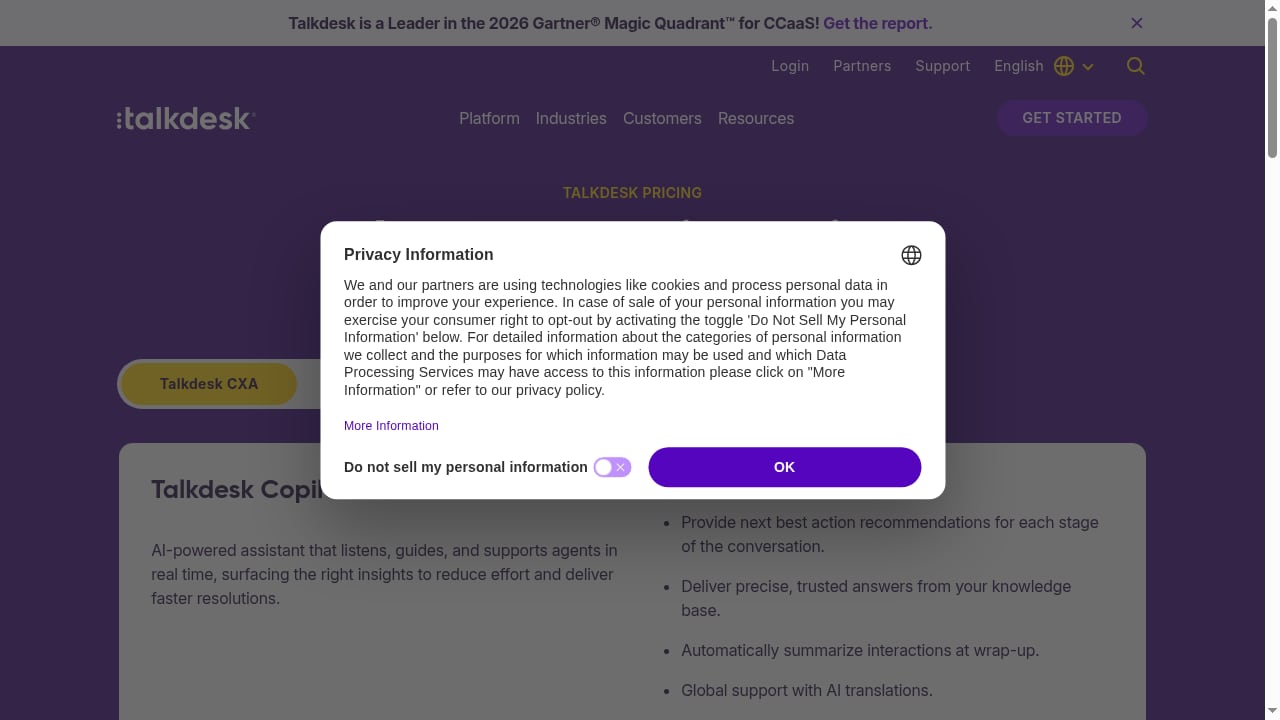
First viewport screenshot of www.talkdesk.com.
Talkdesk sits in a crowded field. The right choice depends on which layer you weight more heavily.
| Consideration | Talkdesk | Typical alternative |
|---|---|---|
| Low-code admin | Strong visual designers | Some platforms require engineering for routing changes |
| AI + CCaaS in one stack | Integrated CXA layer | Often AI is a separate add-on or third-party tool |
| Custom reporting depth | Can feel rigid | Legacy platforms offer deeper but harder-to-use analytics |
| Pricing transparency | Quote-based | Some competitors publish per-seat or consumption pricing |
| Setup effort | Moderate, with professional services | Varies from near-instant to heavy engineering |
If your priority is a broad enterprise CX comparison, our HelpKnow AI vs Ada vs Kayako comparison and top 10 conversational AI platforms for enterprise CX in 2026 provide additional decision context.
Decision criteria checklist
Before committing to Talkdesk, score your organization against these questions:
- Channel mix: Is voice still central, or are you primarily digital? Talkdesk is strongest in blended environments.
- Admin autonomy: Do you want business teams to manage routing without IT? This is a core strength.
- AI readiness: Do you have clean knowledge sources and defined intents for automation? Without them, AI value is limited.
- Reporting needs: Are your analytics requirements standard, or highly bespoke? Validate the latter in a pilot.
- Budget model: Can you absorb per-seat plus AI add-on pricing, and have you modeled cost per resolved contact?
- Integration landscape: Do your CRM and ticketing systems have supported connectors, or will you need custom work?
- Compliance: Does your industry require specific certifications or data residency? Confirm early.
Related reading
- HelpKnow AI vs HelpNow Agentic AI Platform - Compare HelpKnow AI and HelpNow Agentic AI Platform for enterprise customer service: knowledge learning, action plugins, voice, integrations, and fit.
Sources and further reading
- Talkdesk Reviews 2026: Details, Pricing, & Features - G2 - The platform includes enterprise-grade Contact Center as a Service (CCaaS) to support the human workforce and Customer Experience Automation (CXA) to build and ...
- 8 best customer experience automation tools in 2026 - Explore the top customer experience automation tools for 2026. Learn how AI, workflow automation, and analytics deliver faster, smarter support.
- 8 Best CCaaS Platforms Compared: 2026 Ultimate Buyer’s Guide - Compare the best contact center software on the market. Our unbiased comparison breaks down TCO, architecture, and features to help you find the right scale.
FAQ
Is Talkdesk a contact center or an AI platform?
It is both. Talkdesk provides CCaaS for human agents and a CXA layer for AI-driven automation, agent assist, and workflow automation. Most buyers use a combination of the two.
How much does Talkdesk cost?
Talkdesk does not publish standard list pricing. Expect per-agent licensing plus add-ons for AI, workforce management, and analytics, along with implementation fees. Request a detailed quote and model total cost of ownership against your contact volume.
How long does Talkdesk take to implement?
A core contact center deployment can take weeks, while AI automation pilots typically require additional time for knowledge preparation and testing. Timelines depend heavily on integration complexity and internal readiness.
What are the main limitations of Talkdesk?
Users most often cite rigid advanced reporting and rising costs at scale. AI performance also depends on knowledge quality and integration depth, so results vary by configuration.
Who should not choose Talkdesk?
Very small teams seeking a simple, low-cost phone system, or organizations needing highly customized analytics without vendor support, may find better fits elsewhere.
Conclusion
Talkdesk is a credible choice for mid-market and enterprise contact centers that want AI automation and human agent tooling in one platform, with administration that business teams can manage. Its strengths are low-code control, integrated CXA, and a modern agent experience. Its limitations are reporting flexibility and cost at scale. The deciding factor is rarely the feature list; it is whether your knowledge, integrations, and processes are ready for automation. Run a scoped pilot, measure cost per resolved contact, and let evidence rather than demos drive the decision.