Top 10 Conversational AI Platforms for Enterprise Customer Engagement in 2026
Enterprise buyers no longer shop for chatbots. They shop for platforms that can resolve customer issues end to end, across chat, voice, email, and messaging, without collapsing under peak load. The market has moved from scripted FAQ widgets to mission-critical infrastructure, and the gap between demo-ready tools and production-ready platforms has never been wider.
This review ranks ten platforms that genuinely belong in the conversational AI for enterprise customer engagement category. Each entry is scored against transparent criteria, backed by public evidence, and paired with guidance on where it fits. If you are also evaluating adjacent automation layers, such as knowledge-grounded AI agents that sit on top of an existing helpdesk, see our companion ranking of AI customer service automation software.
How We Evaluated These Platforms
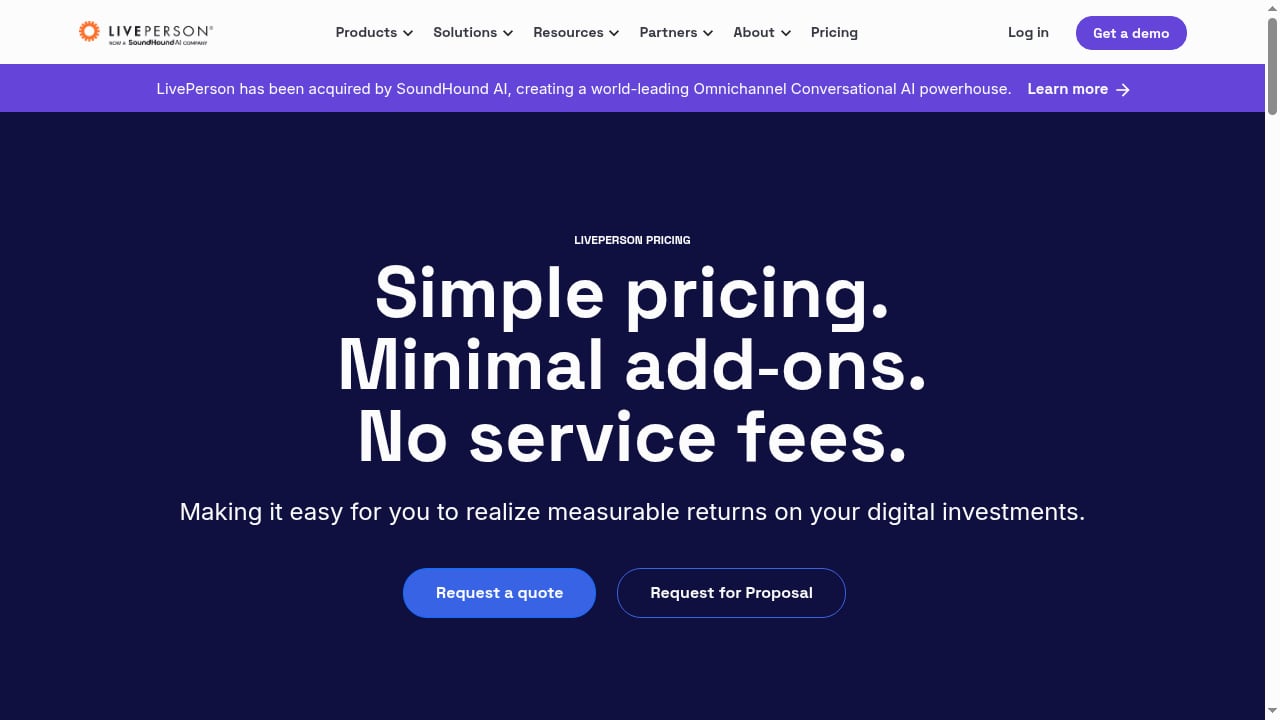
First viewport screenshot of www.liveperson.com.
We weighted six criteria, drawing on vendor documentation, analyst commentary, and verified customer outcomes reported in public case studies. No single score decides the ranking; fit depends on your operating model.
- Autonomous resolution depth (25%): Can the platform complete multi-step workflows such as refunds, order changes, and troubleshooting, or does it mainly deflect and route?
- Integration and action execution (20%): Native connectors to CRM, helpdesk, commerce, and telephony systems, plus the ability to take real actions through APIs.
- Enterprise governance and security (15%): Certifications such as SOC 2, ISO 27001, and PCI DSS, audit trails, role-based access, and data-residency options.
- Channel and language coverage (15%): Consistent reasoning across chat, voice, email, and messaging, with multilingual intent recognition.
- Production scale and reliability (15%): Proven deployments, conversation volumes, and stability during traffic surges.
- Time to value and pricing transparency (10%): Deployment architecture, implementation effort, and whether pricing is published or quote-only.
A note on scope: platforms that are primarily marketing engagement suites or CDPs were excluded unless they offer genuine conversational resolution. Products that are complementary layers rather than category members are mentioned only where they change a buying decision.
The Top 10 Conversational AI Platforms for 2026
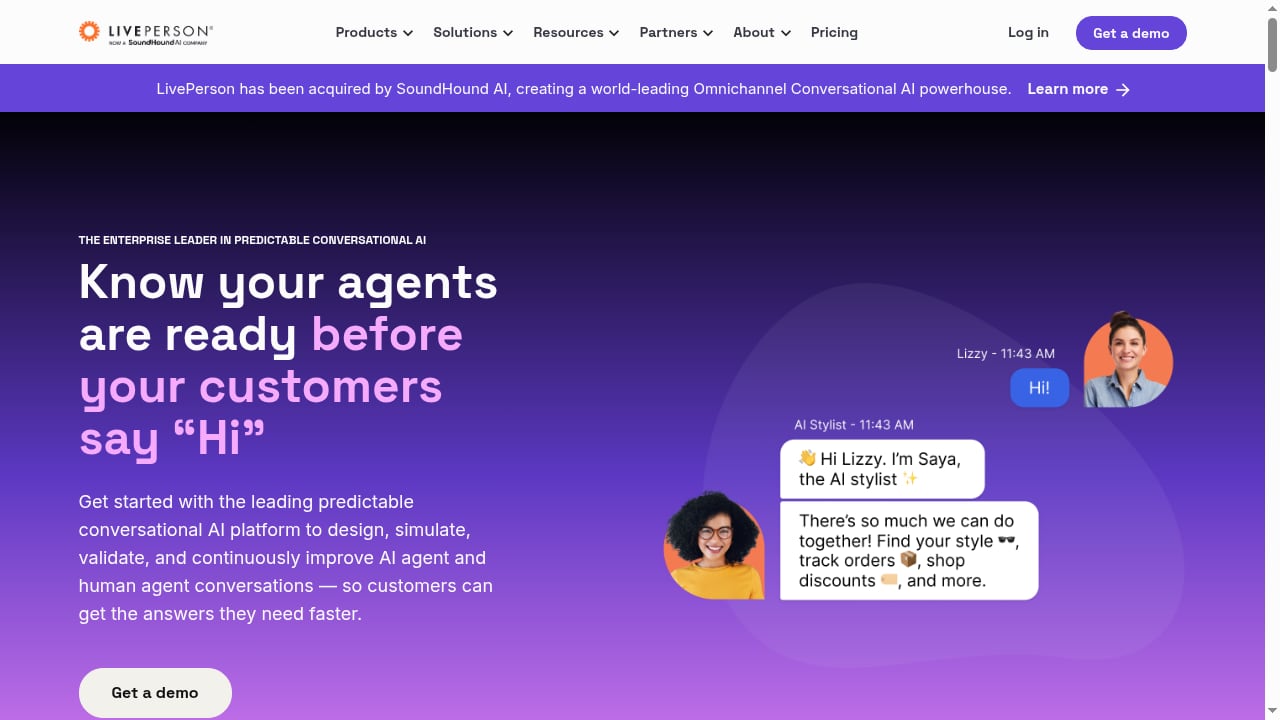
First viewport screenshot of www.liveperson.com.
1. LivePerson — Best for conversational commerce at enterprise scale
LivePerson has spent more than two decades building messaging-first customer engagement for large brands. Its Conversational AI platform combines intent recognition, generative AI, and human agent handoff across web, app, SMS, WhatsApp, and Apple Messages for Business. The platform's strength is personalization at scale: it connects browsing behavior, purchase history, and conversation context so that AI agents can recommend products and complete transactions inside the conversation.
Evidence: LivePerson reports deployments with global retail, telecom, and banking brands, and its messaging volume gives it one of the largest conversation datasets in the category. Its acquisition of VoiceBase added transcription and speech analytics, strengthening voice-adjacent workflows.
Best for: Consumer brands that want to turn service conversations into revenue and already run high-volume messaging programs.
Watch-outs: Pricing is quote-based, and the richest capabilities sit in higher tiers. Teams that mainly need a knowledge-grounded agent layered onto an existing helpdesk may find a lighter overlay approach faster to deploy; that is where a tool like HelpKnow AI can complement rather than replace a platform like LivePerson.
2. Kore.ai — Best for multi-agent orchestration across CX and EX
Kore.ai serves hundreds of Fortune 2000 companies and has been recognized as a Leader in Gartner's Magic Quadrant for Enterprise Conversational AI Platforms. Its XO platform coordinates specialized AI agents that hand off context, and its marketplace offers hundreds of prebuilt agents and integrations. The platform supports voice and digital channels from a shared reasoning layer, which matters for enterprises that want one governance model across contact center and employee-facing assistants.
Evidence: Kore.ai publishes 250+ plug-and-play enterprise integrations and a large agent marketplace, and its customer base spans banking, healthcare, and telecom.
Best for: Large organizations standardizing on one platform for both customer and employee assistants.
Watch-outs: The breadth of configuration options can slow initial rollout; plan for a dedicated implementation team.
3. Rasa — Best for regulated industries needing data sovereignty
Rasa is the platform of choice when customer data cannot leave the organization's environment. Its CALM framework separates LLM-based understanding from deterministic business logic, which reduces hallucination risk through architecture rather than prompt engineering. Full self-hosted deployment, native voice and chat from a single runtime, and connectors to Twilio, Genesys, and AudioCodes make it viable for banking, healthcare, and government.
Evidence: Rasa offers a free developer edition and enterprise licensing, and its architecture is specifically designed for organizations with strict data-residency requirements.
Best for: Enterprises with in-house AI engineering teams and hard compliance constraints.
Watch-outs: Requires Python development skills; it is not a no-code overlay.
4. Maven AGI — Best for fast autonomous resolution on top of existing helpdesks
Maven AGI's overlay architecture connects to Zendesk, Salesforce, Freshdesk, and Genesys without data migration, and its unified reasoning engine powers chat, voice, and email. Public case studies report high autonomous resolution rates, including 93% for Mastermind and 90% for Tripadvisor, with deployments reaching production in weeks rather than months.
Evidence: The company holds ISO 42001, ISO 27001:2022, PCI DSS 4.0 Level 1, and SOC 2 Type II certifications, and publishes named customer outcomes.
Best for: Support organizations that want to keep their current helpdesk and add autonomous resolution quickly.
Watch-outs: Pricing is custom; smaller teams may find the enterprise model heavy.
5. Ada — Best for AI-native customer service with strong brand controls
Ada positions its AI agent as a fully managed resolution layer that learns from past conversations and enforces brand and policy guardrails. The platform emphasizes automated resolution rates and easy configuration for CX teams without engineering support, with connectors to major CRMs and helpdesks.
Evidence: Ada publishes customer resolution benchmarks and is frequently cited in enterprise CX evaluations alongside Maven AGI and Forethought. For a direct comparison of strengths and trade-offs, see our HelpKnow AI vs Ada vs Kayako enterprise CX comparison.
Best for: CX teams that want a managed AI agent with strong guardrails and minimal engineering lift.
Watch-outs: Deep custom workflows may require professional services.
6. Forethought — Best for ticket triage and agent-assist automation
Forethought began with AI-powered ticket triage and has expanded into autonomous resolution and agent assistance. Its strength is understanding incoming support requests, routing them accurately, and drafting responses for human agents, which makes it a strong fit for teams with large backlogs and mixed complexity.
Evidence: Forethought publishes resolution and deflection metrics from named customers and integrates natively with Zendesk, Salesforce, and Intercom.
Best for: Support teams drowning in triage who want measurable deflection before full autonomy.
Watch-outs: Voice capabilities are less mature than its digital channels.
7. IBM watsonx Assistant — Best for hybrid cloud and governed AI deployment
IBM watsonx Assistant combines intent recognition, generative AI, and orchestration with IBM's enterprise governance stack. It supports deployment on IBM Cloud, on-premises, and hybrid environments, and integrates with watsonx.ai for model choice and watsonx.governance for auditability.
Evidence: IBM publishes enterprise deployments across banking, insurance, and public sector, and its governance tooling is a differentiator for regulated buyers.
Best for: Enterprises already standardized on IBM infrastructure or facing strict model-governance requirements.
Watch-outs: Configuration can be complex, and the platform's pace of innovation depends on the broader watsonx roadmap.
8. Genesys Cloud CX — Best for unified contact center and conversational AI
Genesys pairs its contact center infrastructure with AI-powered virtual agents, agent assist, and workforce engagement. For enterprises that want voice and digital channels governed in one place, the appeal is consolidation: routing, quality management, and AI resolution share the same platform.
Evidence: Genesys is a long-standing leader in contact center infrastructure, and its AI features are validated through large-scale deployments. For a deeper look at how it compares with AI helpdesk approaches, see our HelpKnow AI vs Kayako vs Genesys Cloud CX comparison.
Best for: Organizations replacing legacy contact center infrastructure and wanting AI built in.
Watch-outs: The platform is broad; conversational AI depth varies by tier and configuration.
9. Salesforce Agentforce — Best for CRM-native AI agents
Agentforce brings autonomous agents into the Salesforce ecosystem, using CRM data and Flow to execute actions such as case updates, order lookups, and escalation. For organizations already running Service Cloud, the advantage is that agents operate on the same customer record as human reps.
Evidence: Salesforce publishes Agentforce deployments across service, sales, and marketing use cases, with governance through the Einstein Trust Layer.
Best for: Salesforce-centric enterprises that want AI agents grounded in CRM data without a separate orchestration layer.
Watch-outs: Value depends heavily on CRM data quality and adoption of Salesforce workflows.
10. Zendesk AI agents — Best for helpdesk-native automation
Zendesk's AI agents work inside its helpdesk, using historical tickets and help center content to resolve common requests and assist human agents. The appeal is simplicity: teams already on Zendesk can turn on AI resolution without a new platform.
Evidence: Zendesk publishes automated resolution metrics and offers AI agents across its service tiers, with governance controls tied to its admin console.
Best for: Mid-market and enterprise teams standardized on Zendesk that want incremental automation.
Watch-outs: Cross-platform orchestration and voice depth are more limited than dedicated conversational AI platforms.
How to Choose Among These Platforms
First viewport screenshot of www.liveperson.com.
The right choice depends less on feature counts and more on your operating model. Use these decision paths:
- If your helpdesk is your system of record: Start with overlay or native options such as Maven AGI, Ada, Forethought, or Zendesk AI agents. They reduce time to value and avoid migration.
- If you need data sovereignty: Rasa and IBM watsonx Assistant are the strongest fits, with self-hosted and hybrid options.
- If you want one platform for CX and EX: Kore.ai's multi-agent orchestration and marketplace are designed for that consolidation.
- If conversational commerce is the goal: LivePerson's messaging-first personalization is built for revenue outcomes, not just deflection.
- If you are replacing contact center infrastructure: Genesys Cloud CX offers AI inside a proven telephony and routing stack.
- If you are Salesforce-centric: Agentforce keeps agents on the same CRM record as human reps.
For teams that need a knowledge-grounded agent to sit on top of an existing system and handle practical tasks such as order processing, a complementary layer like HelpKnow AI can be evaluated alongside these platforms; its KnowledgeBase setup workflow illustrates how overlay agents learn from documents and FAQs without replacing the underlying helpdesk.
Related reading
- HelpKnow AI vs HelpNow Agentic AI Platform - Compare HelpKnow AI and HelpNow Agentic AI Platform for enterprise customer service: knowledge learning, action plugins, voice, integrations, and fit.
- Severus AI Review 2026: AI Receptionist Cost & Fit - An evidence-based Severus AI review: pricing from $69/mo, 300 minutes, setup, strengths, limits, and who should choose it for AI call answering.
Frequently Asked Questions
What is the difference between a conversational AI platform and a chatbot?
A chatbot follows scripts or decision trees. A conversational AI platform uses natural language understanding, generative reasoning, and integrations to resolve multi-step requests, hand off context to humans, and apply business policies consistently across channels.
Which platform is best for voice and digital channels together?
Genesys Cloud CX, Kore.ai, and Maven AGI all coordinate voice and digital channels through a shared reasoning layer. Rasa supports native voice and chat from a single runtime for self-hosted deployments.
How long does enterprise deployment take?
Overlay architectures can reach production in one to six weeks, depending on integration depth and governance requirements. Full platform replacements or self-hosted deployments typically take months.
Do these platforms replace human agents?
The leading platforms automate high-volume, repeatable requests and escalate complex or sensitive cases with full context. Human agents remain central to judgment, empathy, and exception handling.
What should I ask vendors before signing?
Ask for named customer references at your scale, published resolution rates with methodology, security certifications, data-residency options, integration depth for your CRM and helpdesk, and a clear pricing model for conversation volume and seats.
Conclusion
The 2026 conversational AI market rewards platforms that resolve rather than deflect. LivePerson leads for conversational commerce, Kore.ai for multi-agent orchestration, Rasa for sovereignty, and Maven AGI for fast overlay resolution. The right shortlist depends on whether you are optimizing an existing helpdesk, replacing contact center infrastructure, or consolidating CX and EX on one platform. Evaluate against resolution depth, integration, and governance first, and treat feature lists as a distant second.
Sources: Insider One's enterprise conversational AI analysis, Maven AGI's 2026 platform comparison, and Gartner Peer Insights conversational AI reviews.