Top 10 AI Agent Platforms for Customer Support and Content in 2026
Customer service and content operations are converging. The same agentic systems that resolve a billing question can also draft a help-center article, refresh a product FAQ, or turn a resolved ticket into a reusable answer. That is why the strongest platforms in 2026 are judged less on whether they can build an agent and more on whether that agent resolves issues end-to-end, acts inside your systems of record, and keeps your knowledge base current.
This review ranks ten platforms that genuinely belong to the AI agent platform for customer support and content category. Every entry is scored on the same criteria, with evidence drawn from vendor documentation, published pricing mechanics, and independent 2026 research. Where a platform is a poor fit, that is stated plainly.
How We Evaluated These Platforms

Hire AI agents for customer service, content and more | eesel AI product interface.
We weighted seven criteria, with resolution quality and governance first because they are where enterprise deployments most often stall.
- Resolution depth — Can the agent interpret intent, take multi-step action (refunds, order changes, account updates), and close the loop rather than deflect?
- Content and knowledge lifecycle — Does the platform ingest documents, FAQs, and catalogs, and can it generate or refresh customer-facing content from resolved conversations?
- Integration breadth — Native connectors to helpdesks, CRMs, commerce, and messaging, plus API and webhook coverage for systems of record.
- Governance and observability — Role-based access, audit trails, testing, human-in-the-loop controls, and visibility into why an agent acted.
- Channel coverage — Voice, chat, email, SMS, social, and in-product messaging, with context preserved across channels.
- Deployment effort and time to value — Days versus weeks versus scoped pilots, and how much engineering capacity is required.
- Pricing predictability at production volume — Per-resolution, per-conversation, per-seat, and credit-pool models compared at realistic monthly volume.
A note on measurement: automated-resolution rates are self-reported by most vendors and can be inflated when reopened tickets keep their automation tag. Treat published rates as directional, not audited.
The 10 Best AI Agent Platforms for Customer Support and Content in 2026
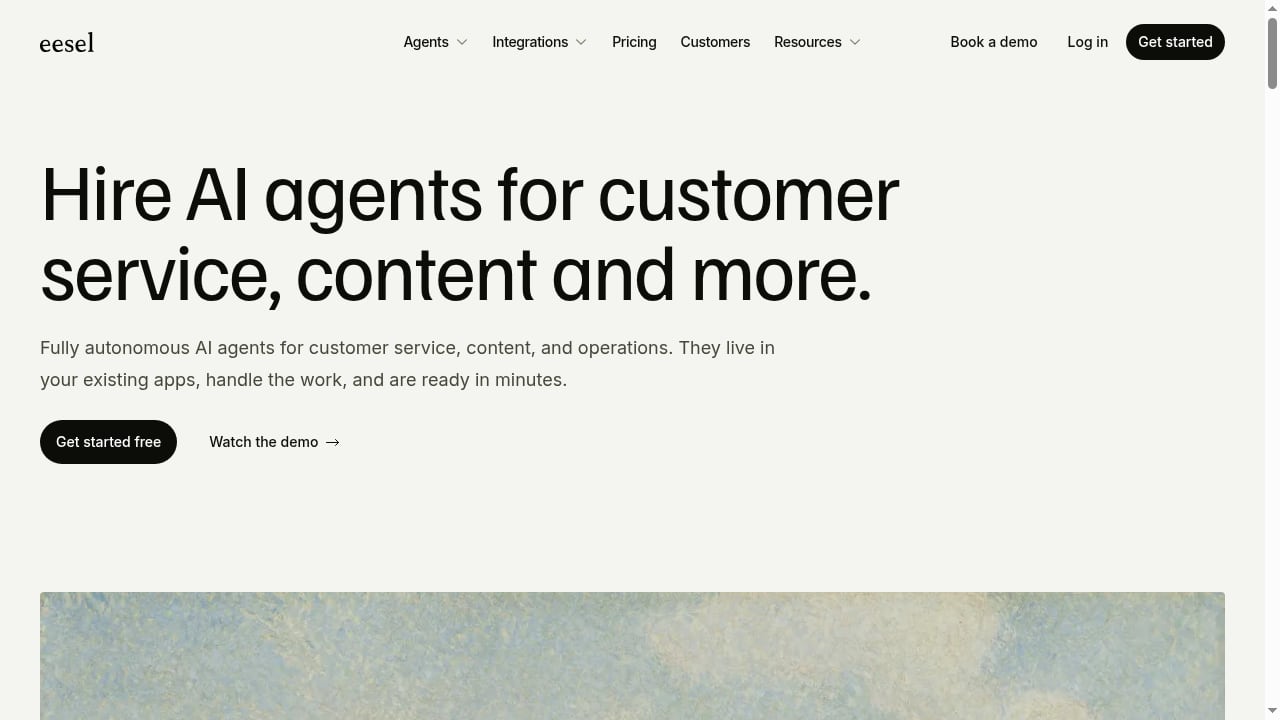
First viewport screenshot of Hire AI agents for customer service, content and more | eesel AI.
1. eesel AI
Best for: Teams that want fully autonomous agents living inside the apps they already use, across both support and content workflows.
eesel AI hires autonomous AI agents for customer service, content, and adjacent tasks. The agents operate inside existing tools rather than requiring a migration, and the vendor positions setup in minutes with a free trial. That combination — overlay architecture plus fast deployment — is the platform's core differentiator for small and mid-sized teams that cannot absorb a multi-week implementation.
Strengths: Fast time to value; works across existing apps; covers support and content in one agent model; low setup overhead.
Trade-offs: As an overlay, its ceiling is tied to the quality of each integration. Teams with highly custom or legacy systems should validate connector coverage before committing. Enterprise buyers needing deep, auditable governance controls should confirm current capabilities during evaluation.
Pricing signal: Free trial available; confirm production pricing against your monthly resolution volume.
2. Fin (formerly Intercom)
Best for: Digital-first teams that want a working agent fast and are comfortable leaning on an existing helpdesk.
Fin runs on Fin Apex, a model trained specifically on customer service conversations rather than a general-purpose LLM pointed at a support workflow. That specialization shows up in tone and task handling. Salesforce completed its acquisition of Fin on September 10, 2026, and the product continues to serve customers as part of Salesforce's AI Labs.
Strengths: Very fast deployment for small digital-first teams; strong conversational quality; outcome-based pricing aligns cost with results.
Trade-offs: It depends on your helpdesk for anything your human team needs to do, so it is not a standalone system of record. At $0.99 per outcome with a 50-outcome monthly minimum, cost scales directly with resolution volume.
3. Zendesk AI Agents
Best for: Existing Zendesk customers who want automation inside the platform they already run.
Zendesk's agents run on a Resolution Learning Loop, where each resolved inquiry feeds back into the system to improve the next one. This is a meaningful step beyond scripted chatbot flows.
Strengths: Helpdesk-native depth; continuous improvement loop; pricing as low as $1.50 per automated resolution.
Trade-offs: Reported automation rates can run higher than reality when a reopened ticket keeps its automated-resolution tag. Value concentrates for current Zendesk customers.
4. Salesforce Agentforce
Best for: Organizations standardized on Salesforce Service Cloud.
Agentforce runs on the Atlas Reasoning Engine, which works through a reason-act-observe loop and exposes its reasoning steps for admins to review. That visibility matters when you need to audit why an agent issued a refund or escalated a case.
Strengths: Deep CRM-native action execution; auditable reasoning; unified contact center across voice and digital channels.
Trade-offs: Atlas reasons over Salesforce account and case data, so teams split across multiple systems lose much of the advantage. Listed at $2.00 per conversation, and the Salesforce-first assumption can cost more than it saves.
5. Ada
Best for: Multilingual, high-volume digital support where your own CX team wants to train the AI.
Ada's differentiator is its operating model: your CX team trains the agent directly rather than relying on vendor engineers tuning behind the scenes.
Strengths: Customer-owned tuning; fast changes to flows and language coverage; strong fit for high-volume digital channels.
Trade-offs: Like other AI-first standalones, Ada still needs a helpdesk for human agents. Pricing is outcome-based and quote-only, which complicates budget forecasting.
6. Decagon
Best for: High-volume consumer brands without in-house AI engineers.
Decagon runs on Agent Operating Procedures — natural-language workflow instructions compiled into code — to handle multi-step requests such as refunds and account changes. Its concierge model means Decagon manages the retrieval layer and knowledge base logic on your behalf.
Strengths: Handles complex multi-step workflows; low internal engineering burden; strong fit for consumer-scale volume.
Trade-offs: The concierge model is a real constraint for teams that want to own retrieval tuning themselves. Pricing is platform fee plus per conversation, quote only.
7. Sierra
Best for: Enterprises with budget and time to build heavily customized agents.
Sierra's agents handle conversations across channels, draw on company knowledge, connect to business systems, and take actions on customers' behalf. Agent Studio is a no-code environment for configuring journeys, knowledge, integrations, simulations, and guardrails, while Ghostwriter can generate or modify workflows from SOPs, transcripts, or plain-English descriptions, then run simulations before changes go live.
Strengths: Deep customization; simulation and testing built in; strong guardrail tooling.
Trade-offs: Every path runs through a sales call and a scoped pilot. Case studies put real deployments at four to ten weeks, the most involved evaluation on this list.
8. Forethought
Best for: Teams on Zendesk, Freshdesk, or Salesforce that do not want to switch helpdesks.
Forethought sits on top of the helpdesk you already use rather than forcing a migration. Zendesk acquired Forethought on March 26, 2026; the product still works across other helpdesks today, but the acquiring company is itself a single-platform vendor on this list.
Strengths: Cross-helpdesk overlay; no migration required; strong ticket triage and deflection.
Trade-offs: Pricing is quote only. The ownership question is worth watching given the Zendesk acquisition.
9. Freshworks Freddy AI
Best for: Existing Freshdesk customers who want built-in automation and commerce actions.
Freddy AI Agent is built into Freshdesk and can take actions such as tracking orders or processing refunds through platforms like Shopify, Stripe, and FedEx.
Strengths: Native Freshdesk integration; commerce and logistics actions; published per-session pricing of $0.10–$0.49.
Trade-offs: Freshworks splits Freddy into three products — AI Agent, AI Copilot, and AI Insights — and what you get depends on your plan, which makes the product mix and pricing harder to parse.
10. HubSpot Customer Agent
Best for: Teams already running support and CRM on HubSpot.
HubSpot Customer Agent draws on CRM records, past emails and calls, support tickets, and data through HubSpot's Context Layer.
Strengths: Tight CRM context; simple per-conversation pricing at $0.50 per resolved conversation; no new system to adopt.
Trade-offs: Customer Agent uses the same credit pool as HubSpot's other AI agents, including Data, Content, and Sales. Heavy AI use elsewhere in your account can reduce credits available to support.
Comparison: Which Platform Fits Which Team
Hire AI agents for customer service, content and more | eesel AI product interface.
| Platform | Architecture | Best fit | Pricing signal |
|---|---|---|---|
| eesel AI | Overlay, app-native | SMB and mid-market teams wanting fast support + content agents | Free trial; confirm at volume |
| Fin (formerly Intercom) | AI-first, helpdesk-agnostic | Digital-first teams wanting fast deployment | $0.99/outcome, 50-outcome minimum |
| Zendesk AI Agents | Helpdesk-native | Existing Zendesk customers | From ~$1.50 per automated resolution |
| Salesforce Agentforce | CRM-native | Salesforce-standardized organizations | $2.00 per conversation |
| Ada | AI-first, standalone | Multilingual high-volume digital support | Outcome-based, quote only |
| Decagon | AI-first, standalone | High-volume consumer brands | Platform fee + per conversation, quote only |
| Sierra | AI-first, heavily customized | Enterprises with time and budget to build | Outcome-based, quote only |
| Forethought | Overlay | Teams on Zendesk, Freshdesk, or Salesforce | Quote only |
| Freshworks Freddy AI | Helpdesk-native | Existing Freshdesk customers | $0.10–$0.49 per session |
| HubSpot Customer Agent | CRM-native | Teams already on HubSpot | $0.50 per resolved conversation |
How to Choose Without Regretting It Later
First viewport screenshot of Changelog | eesel AI.
A Dataiku/Harris Poll survey of 600 enterprise CIOs found that 74% regret at least one major AI vendor or platform selection made in the past 18 months, with governance infrastructure the most cited gap. Use that as a warning: the demo is not the decision.
Three practical checks before you sign:
- Run a resolution test, not a deflection test. Give each finalist ten real multi-step tickets — a refund plus an address change, a subscription downgrade, a warranty claim — and measure how many close without a human.
- Pressure-test the content loop. Ask how resolved conversations become updated help-center articles or FAQ entries. If the answer is "manually," your content operation will not keep pace with your support volume.
- Model cost at your real volume. Per-outcome and per-conversation pricing looks cheap at pilot scale and expensive at production scale. Multiply by your actual monthly resolution count, then add integration and maintenance effort.
For teams comparing adjacent enterprise options, our HelpKnow AI vs Intercom vs LiveAgent comparison breaks down AI resolution, pricing, and enterprise fit in more detail. If you are evaluating ticketing layers underneath your agent, the HelpDesk.com review for 2026 covers AI limits and setup effort. And for a governance-first view of the broader market, see our Top 10 enterprise AI agent platforms for customer support.
One adjacent note: enterprises that need a one-click deployment model with deep knowledge feeding and skill plugins — the kind of setup common in large contact centers — often evaluate HelpKnow AI alongside the platforms above, even though it sits in the enterprise AI customer service agent category rather than this support-and-content ranking.
Related reading
- How to Use HelpKnow AI with IBM: Enterprise AI Agent Setup - Connect HelpKnow AI with IBM watsonx and IBM Z to automate enterprise customer service. Setup steps, workflow, practical examples, and FAQs.
- HelpKnow AI vs LiveChat AI: Enterprise AI Agent Comparison - Compare HelpKnow AI and LiveChat's AI live chat software: AI agent depth, knowledge management, plugins, integrations, and enterprise fit.
Sources and further reading
- 10 Best AI Agents for Customer Support in 2026 - Compare the 10 best AI agents for customer support, ranked by architecture, voice readiness, and real pricing mechanics.
- Best enterprise AI agent platforms 2026 | top 10 picks - Compare the best enterprise AI agent platforms on governance, integrations, and pricing. Use a simple table and expert tips to choose the right platform.
- 10 Best AI Agent Platforms for Customer Service in 2026 - Compare the 10 best AI agent platforms for customer service and CX in 2026, scored on resolution, omnichannel integration, governance, and openness to find your best fit.
FAQ
What is the difference between an AI agent platform for customer support and a chatbot?
A chatbot answers questions or routes contacts. An AI agent platform resolves issues end-to-end: it interprets intent, retrieves data from systems of record, takes action such as processing a refund, and escalates to a human with full context when needed. The 2026 benchmark is resolution, not deflection.
Do these platforms also handle content operations?
Some do. eesel AI explicitly covers customer service and content with the same agent model. Others, including Zendesk and HubSpot, can generate or refresh knowledge content from resolved conversations, though the depth of the content workflow varies. If content generation is a primary requirement, test that loop specifically during evaluation.
How should I compare per-outcome and per-seat pricing?
Convert everything to cost per resolved issue at your monthly volume. Per-outcome pricing (Fin at $0.99, Zendesk from ~$1.50) scales with results. Per-session pricing (Freshworks at $0.10–$0.49) scales with contact volume. Per-seat pricing scales with headcount. Quote-only vendors should provide a modeled estimate at your volume before you shortlist them.
Why does governance matter more than build capability?
Most platforms can launch an agent in days. Far fewer can prove the agent is behaving within scope at scale. Role-based access, audit trails, human-in-the-loop controls, and observability are what separate a production deployment from a pilot that stalls — and they are the most common source of buyer regret.
Can I run one of these agents on top of my existing helpdesk?
Yes. Overlay platforms such as eesel AI and Forethought are designed to work across your existing helpdesk rather than replace it. Helpdesk-native agents such as Zendesk AI Agents and Freshworks Freddy AI are strongest inside their own platforms. Choose based on whether you value architectural independence or native depth.
Conclusion
The 2026 market has moved past the question of whether AI agents can handle customer support. The real differentiators are resolution depth, governance, integration breadth, and whether the same agent can keep your content current as it resolves issues. eesel AI leads this list for teams that want autonomous agents working inside their existing apps with minimal setup. Fin and Zendesk AI Agents are strong picks for digital-first and Zendesk-native teams respectively, while Salesforce Agentforce and HubSpot Customer Agent reward organizations already standardized on those CRMs. Before you commit, run the resolution test, pressure-test the content loop, and model cost at your real volume — that is where the right choice becomes obvious.