Talkdesk Review 2026: Features, Pricing, and Verdict
Talkdesk has moved well beyond the traditional cloud contact center label. The platform now positions itself as a customer experience automation (CXA) provider, combining omnichannel routing, workforce tools, and agentic AI into a single stack. This review examines what Talkdesk actually delivers, where it excels, where it falls short, and which organizations should shortlist it.
What Is Talkdesk?
First viewport screenshot of Precios del Software para Centro de Contacto | Talkdesk.
Talkdesk is a cloud-based contact center platform founded in 2011 and headquartered in Palo Alto. It serves organizations that need voice, email, chat, SMS, and social messaging in one workspace, with a growing emphasis on AI agents that can resolve customer issues without human intervention.
The platform is built around three AI pillars:
- Talkdesk Copilot: an in-the-moment assistant for human agents that suggests next best actions, surfaces knowledge base answers, and generates automatic call summaries.
- Talkdesk Autopilot: agentic virtual assistants for voice and digital channels designed to autonomously resolve routine issues.
- Talkdesk Navigator: AI-powered routing that interprets natural conversation and context to send customers to the right destination.
Underneath these sits the Talkdesk Data Cloud, which feeds real-time context to AI models and supports interaction and quality analytics. The vendor also offers Industry Experience Clouds tailored to banking, healthcare, retail, and other regulated or specialized sectors.
Who Is Talkdesk Best For?
Talkdesk Review 2026: Features, Pricing, and Verdict - Key Limitations.
Talkdesk is not a lightweight helpdesk tool. It is built for organizations that treat customer service as a strategic function and need to orchestrate complex journeys across channels.
Strong fits include:
- Mid-market and enterprise contact centers managing 50 to several thousand agents.
- Financial services, healthcare, and insurance teams that need compliance controls, secure integrations, and industry-specific workflows.
- Organizations consolidating multiple point solutions — telephony, IVR, chat, workforce management, analytics — into one platform.
- Teams ready to automate a meaningful share of routine interactions with AI agents rather than simply deflecting tickets.
Weaker fits include:
- Very small teams that only need a shared inbox and basic ticketing. Talkdesk's depth can feel like overhead.
- Companies with minimal voice volume that primarily need asynchronous digital support.
- Buyers seeking a low-cost, self-serve tool with transparent per-seat pricing and no sales process.
Core Strengths
1. Unified Platform Architecture
One of the most consistent themes in verified user reviews is consolidation. A banking VP on Gartner Peer Insights described replacing more than 10 disconnected systems with Talkdesk's Financial Services Experience Cloud, creating a single pane of glass for voice, chat, SMS, and core banking self-service actions.
For operations leaders, this matters because it reduces context switching, simplifies reporting, and removes the integration tax that comes with stitching together separate telephony, CRM, and workforce tools.
2. Conversational AI and IVR
Traditional numeric-menu IVRs are a common source of customer friction. Talkdesk's natural language IVR lets callers state their intent in plain speech, and Navigator routes based on that intent plus historical context.
The same banking review reported a 13-point increase in customer satisfaction scores after implementing the conversational IVR, with scores consistently above 95%. A separate SMS survey program achieved a 40% response rate, significantly higher than the legacy IVR survey it replaced.
3. Agentic AI Beyond Deflection
Many contact center platforms bolt a chatbot onto existing flows. Talkdesk's Autopilot is designed to execute end-to-end tasks: authenticate a caller, retrieve account data, complete a transaction, and only escalate when judgment or empathy is required.
This shifts the value proposition from "contain the easy calls" to "resolve the easy calls completely." For high-volume operations such as balance inquiries, order status checks, or appointment rescheduling, that distinction has direct cost implications.
4. Low-Code Journey Building
Talkdesk allows operations teams to iterate on call flows, messaging sequences, and routing logic without heavy vendor dependency. Reviewers specifically called out the ability to adjust journeys quickly as a reason they could continuously optimize rather than waiting on professional services.
5. Analytics and Quality Management
Interaction and quality analytics are native to the platform. Supervisors can review transcripts, monitor sentiment, and score interactions without exporting data to a separate tool. The automatic summaries generated by Copilot also reduce after-call work, which is a meaningful time savings in high-volume environments.
Key Limitations
First viewport screenshot of Preise der Contact Center-Software | Talkdesk.
1. Journey Debugging Can Be Fragmented
A critical review from a healthcare engineering manager noted that debugging end-to-end customer journeys requires reviewing multiple reports and piecing together the story manually. There is no single unified view that reconstructs every step of a call or digital interaction in one timeline.
This is a real operational pain point. When something breaks in a complex flow, the time spent diagnosing it can erode the efficiency gains the platform is supposed to deliver.
2. Proactive Monitoring Gaps
The same review flagged a lack of proactive monitoring signals. Teams may not learn about degraded flows or failed interactions until customers complain or metrics dip. For organizations running mission-critical service operations, this is a meaningful gap compared to platforms with stronger observability features.
3. Pricing Transparency
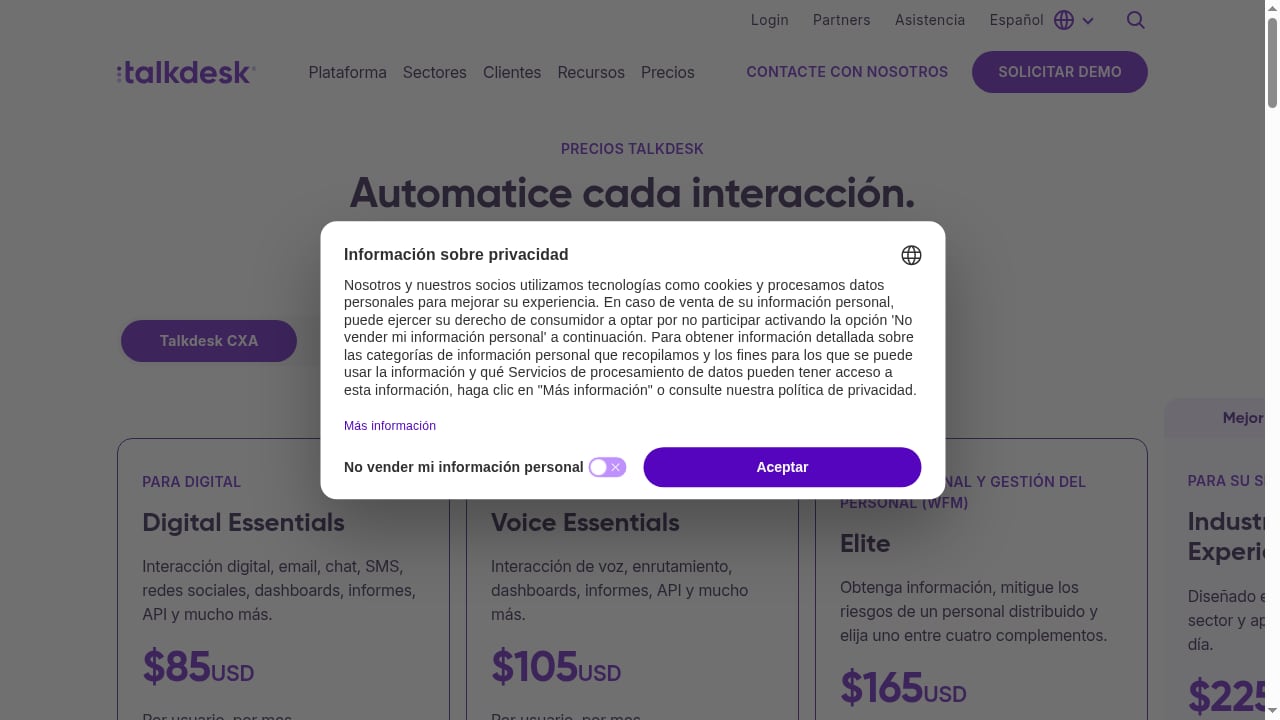
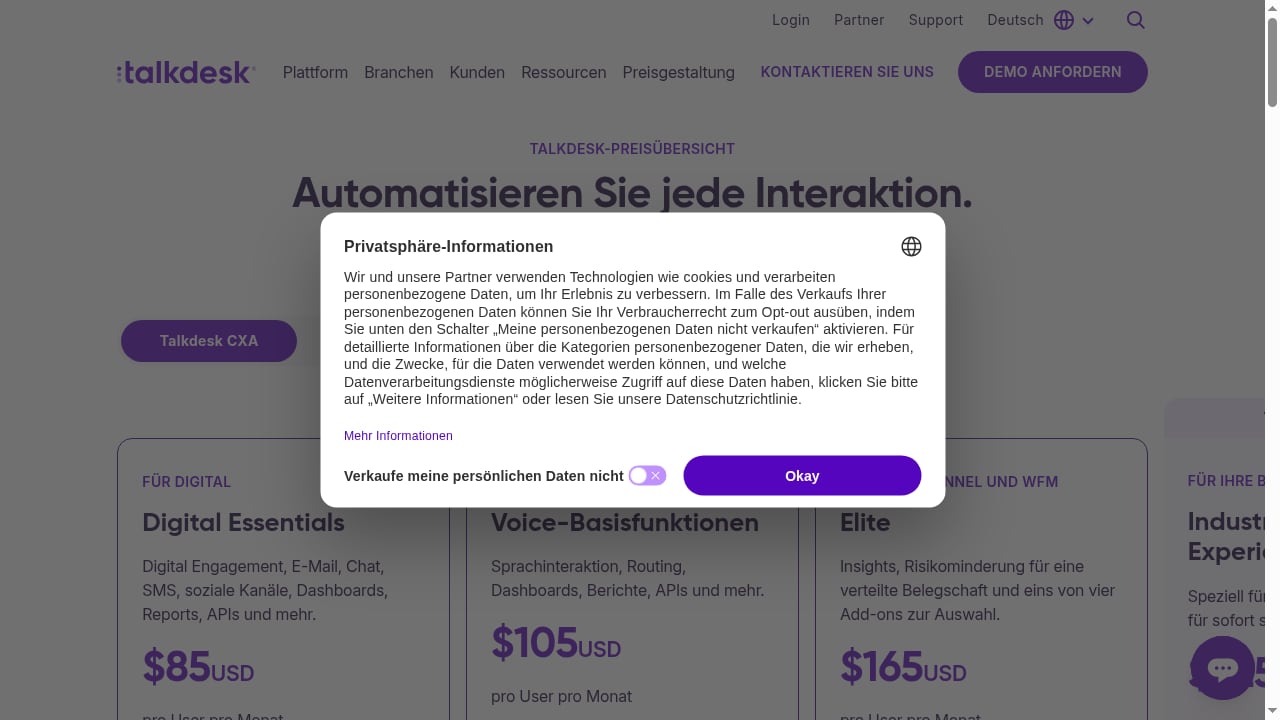
Talkdesk publishes a starting price of $85 per user per month for digital essentials, but actual quotes vary significantly based on channels, AI usage, industry clouds, and contract length. Voice, Autopilot, and advanced analytics typically require custom pricing.
This is common in the CCaaS space, but it makes comparison shopping harder than with tools that publish full rate cards.
4. Implementation Complexity
Talkdesk is powerful, but it is not plug-and-play. Migrating from legacy telephony, configuring AI agents, and integrating with core systems such as banking platforms or EHRs requires planning and often professional services. Smaller teams without dedicated contact center operations staff may find the setup burden disproportionate to their needs.
Pricing Signals
Talkdesk's public pricing starts at $85 per user per month for the digital essentials tier. However, that number is best understood as an entry point rather than a complete picture.
What typically influences final pricing:
- Channels: voice, SMS, and social messaging often sit in higher tiers than digital-only chat and email.
- AI usage: Autopilot interactions, Copilot seats, and Navigator routing may be priced as add-ons or bundled into enterprise agreements.
- Industry Experience Clouds: financial services, healthcare, and retail packages include pre-built workflows and compliance features that affect cost.
- Volume commitments: per-minute voice pricing and concurrent agent licensing can shift the effective per-seat cost.
For accurate budgeting, expect to go through a sales discovery process. Ask specifically about AI consumption pricing, because that is where post-launch surprise costs most often appear in CCaaS platforms.
Setup and Onboarding
Implementation typically follows this sequence:
- Discovery and journey mapping: identify existing channels, systems, and the customer journeys to migrate or redesign.
- Integration work: connect CRM, workforce management, and any industry-specific systems such as core banking or EHR platforms.
- IVR and routing configuration: build natural language flows and test routing logic.
- AI agent deployment: train Autopilot on knowledge sources, define escalation rules, and run supervised pilots.
- Agent enablement: configure Copilot, train teams, and establish quality scoring criteria.
Talkdesk markets a "white glove" support reputation, and enterprise reviews generally describe the vendor as a strategic partner rather than a transactional software provider. That level of engagement is valuable during complex migrations, but it also means the relationship is more involved than a self-serve SaaS purchase.
How Talkdesk Compares to Alternatives
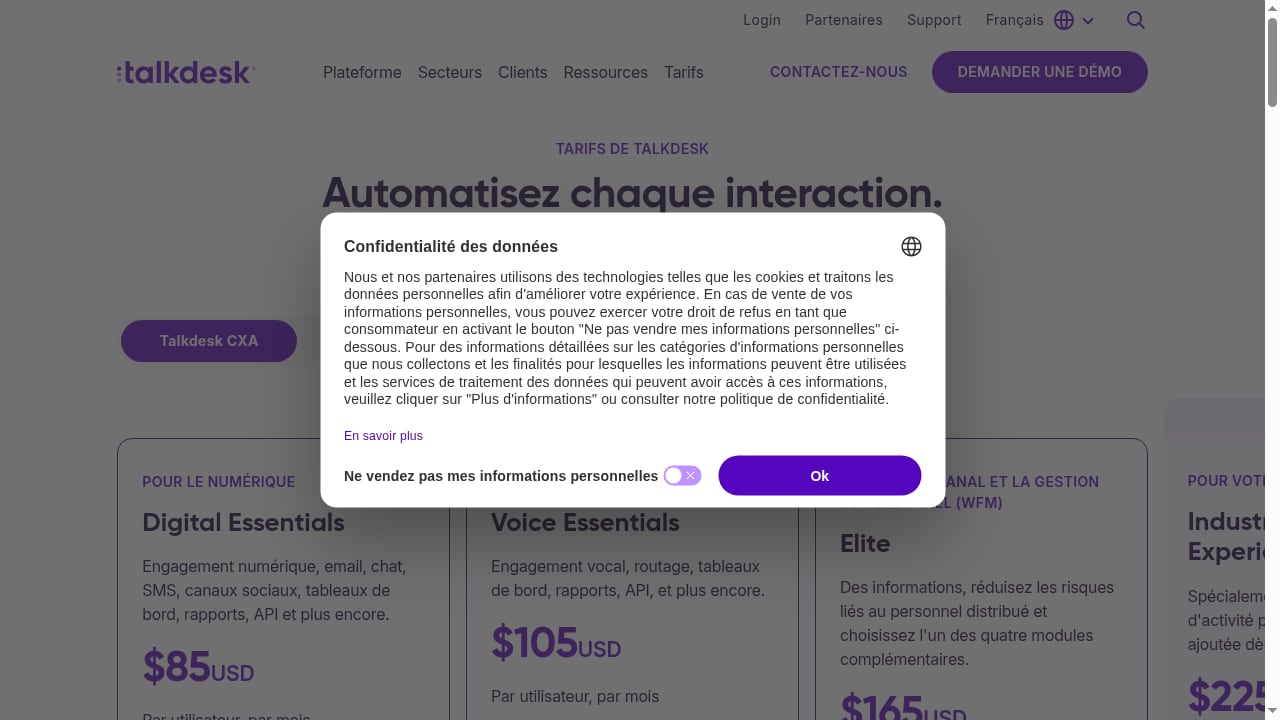
First viewport screenshot of Tarifs des solutions de centre de contact | Talkdesk.
If you are evaluating Talkdesk, you are likely also considering other CCaaS and AI support platforms. The right choice depends on what you are optimizing for.
Choose Talkdesk if:
- You need deep voice capabilities plus omnichannel digital support in one platform.
- You want to automate complete customer journeys, not just deflect tickets.
- You operate in a regulated industry and need tailored compliance workflows.
- You are consolidating multiple legacy tools and value a unified architecture.
Consider alternatives if:
- Your primary need is AI-powered ticket resolution on digital channels. Tools like Ada or HelpDesk focus more narrowly on AI ticketing and asynchronous support, often with simpler pricing.
- You want a lightweight AI support layer on top of existing tools. A comparison like HelpKnow AI vs Dialpad can clarify the difference between AI agent platforms and full CCaaS suites.
- You are a small team that needs to launch quickly without a sales process or professional services engagement.
For teams specifically focused on AI resolution rates and agent productivity rather than full contact center infrastructure, CoSupport AI and EasyAgent represent different points on the complexity spectrum.
What Verified Users Say
Across Gartner Peer Insights, TrustRadius, and G2, Talkdesk maintains strong aggregate ratings. The vendor reports an 8 out of 10 average across 700+ reviews on call center software comparison reports and positions itself as a G2 leader in contact center software.
Recurring praise:
- Platform consolidation and reduced tool sprawl.
- Measurable CSAT improvements after conversational IVR deployment.
- Responsive support and strategic partnership during implementation.
- Continuous AI roadmap investment.
Recurring criticism:
- Fragmented debugging and reporting for complex journeys.
- Limited proactive monitoring and alerting.
- Pricing opacity and add-on costs that emerge after launch.
- Learning curve for non-technical operations teams.
For independent sentiment, Trustpilot reviews and Gartner Peer Insights provide useful counterpoints to vendor-published case studies.
Related reading
- HelpKnow AI vs Help Scout vs Fin: Which Support Tool Wins? - Compare HelpKnow AI, Help Scout, and Fin on AI resolution rates, human workflows, integrations, analytics, and pricing to choose the right support platform.
- HelpKnow AI vs Enjo vs My AskAI: Which AI Support Tool Wins? - Compare HelpKnow AI, Enjo, and My AskAI on AI resolution, integrations, channels, analytics, pricing, and ideal users to choose the right AI support platform.
FAQ
Is Talkdesk only for large enterprises?
No. Talkdesk serves mid-market organizations as well, but its depth is most valuable when you have meaningful interaction volume and multiple channels to manage. Very small teams may find simpler tools more cost-effective.
What does Talkdesk actually cost?
Published pricing starts at $85 per user per month for digital essentials. Voice, AI agents, and industry-specific packages typically require custom quotes. Always ask about AI consumption pricing before signing.
How long does Talkdesk implementation take?
Simple digital deployments can go live in weeks. Full voice migrations with CRM integrations, AI agent training, and industry cloud configuration often take months, especially in regulated environments.
Can Talkdesk fully replace human agents?
No platform can replace every human interaction. Talkdesk's Autopilot is designed to resolve routine, high-volume tasks autonomously while escalating complex or emotionally sensitive cases to human agents supported by Copilot.
Does Talkdesk integrate with Salesforce and other CRMs?
Yes. Talkdesk offers integrations with major CRM, workforce management, and industry systems. The depth of integration varies by package and may require professional services for complex or custom systems.
Is Talkdesk HIPAA compliant?
Talkdesk offers healthcare-specific experience clouds and supports compliance requirements for regulated industries. Organizations should verify specific certifications and sign appropriate agreements during procurement.
Final Verdict
Talkdesk is a strong choice for mid-market and enterprise organizations that want to consolidate their contact center stack and automate meaningful portions of customer journeys. Its conversational IVR, agentic AI, and industry-specific clouds deliver measurable results when implemented well, and verified reviews support claims of improved CSAT and operational efficiency.
The platform is less compelling for small teams, digital-only support operations, or buyers who prioritize pricing transparency and rapid self-serve onboarding. The fragmented journey debugging and limited proactive monitoring are also worth weighing carefully if you run mission-critical service flows.
If your roadmap includes voice, omnichannel orchestration, and AI agents that resolve rather than deflect, Talkdesk deserves a place on your shortlist. If your needs are narrower, a focused AI support platform may deliver faster value at lower complexity.
Explore Talkdesk's customer reviews to see how organizations in your industry rate the platform.