
CoSupport AI Review 2026: Features, Pricing, and Verdict
Customer support teams face a familiar tension: response volumes keep climbing while headcount stays flat. CoSupport AI positions itself as the bridge between those realities—an AI customer service platform trained on your historical solved tickets to deliver accurate, multilingual responses across chat, email, social, and helpdesk channels. But does the platform live up to its promise of a 60% AI resolution rate? This review examines the evidence, use cases, strengths, limitations, pricing signals, and setup experience to help you decide if CoSupport AI belongs in your support stack.
What Is CoSupport AI?

CoSupport AI Review 2026: Features, Pricing, and Verdict - Real-World Performance Evidence.
CoSupport AI is an AI-powered customer service platform that automates support interactions across multiple channels. Unlike generic chatbots that rely on scripted flows, CoSupport AI learns from a company's own resolved ticket history. That means the AI doesn't just answer questions—it answers them the way your best agents already do, in the languages your customers actually use.
The platform combines three core functions:
- Auto-replies that resolve repetitive tickets without human intervention
- Agent assistance that drafts suggested responses for human review
- Business intelligence that surfaces recurring issues, customer sentiment, and resolution patterns
Version 2.0 added multi-step reasoning, decision logs, an agentic API, and 12 new integrations including Shopify, Stripe, Notion, and Confluence. These updates push CoSupport AI beyond simple deflection toward more complex, multi-turn problem solving.
Who Is CoSupport AI For?
CoSupport AI targets support teams that meet several criteria. The platform works best when:
- Ticket volume is high and repetitive. If your team answers the same 20 questions daily, AI deflection creates immediate value.
- Historical ticket data is available. The AI needs solved tickets to learn from. Teams with years of helpdesk history get the fastest time-to-value.
- Multilingual support is required. CoSupport AI responds in the customer's language without separate bot configurations.
- Helpdesk infrastructure already exists. The platform integrates with popular tools like Zendesk, Freshdesk, and others rather than replacing them.
Industries served include SaaS, e-commerce, finance, education, and BPO. Each vertical gets workflow adaptations—for example, e-commerce teams can connect Shopify order data, while finance teams benefit from compliance-aware response handling.
Key Features and Capabilities
Ticket-History Training
The foundation of CoSupport AI is its ability to learn from your resolved tickets. During setup, the platform ingests historical conversations, identifies successful resolution patterns, and builds a response model specific to your products, policies, and tone. This is fundamentally different from rule-based bots that require manual flow mapping.
Omnichannel Automation
CoSupport AI operates across chat, email, social media, and helpdesk channels from a single training source. A customer who emails about a billing question and later chats about the same issue receives consistent answers because both channels draw from the same learned knowledge.
Agent Assistance Mode
Not every ticket should be fully automated. CoSupport AI offers an assist mode where the AI drafts responses that agents review, edit, and send. This hybrid approach works well for edge cases, sensitive issues, or teams that want to build confidence in AI suggestions before enabling full automation.
Business Intelligence Layer
Beyond answering tickets, CoSupport AI analyzes conversation patterns to surface product issues, common friction points, and customer sentiment trends. One case study showed Label Your Data using these insights to close 17% more deals—the intelligence layer can inform product and sales decisions, not just support operations.
Enterprise Security and Compliance
CoSupport AI emphasizes enterprise-grade data security. For finance, healthcare-adjacent, and BPO use cases, this matters. The platform's compliance posture supports industries where data handling requirements are strict.
No-Code Setup and Fast Integration
Setup requires no engineering resources. The platform connects to existing helpdesks through pre-built integrations, and training begins once historical data is connected. User reviews on G2 consistently highlight fast integration as a standout benefit.
Real-World Performance Evidence
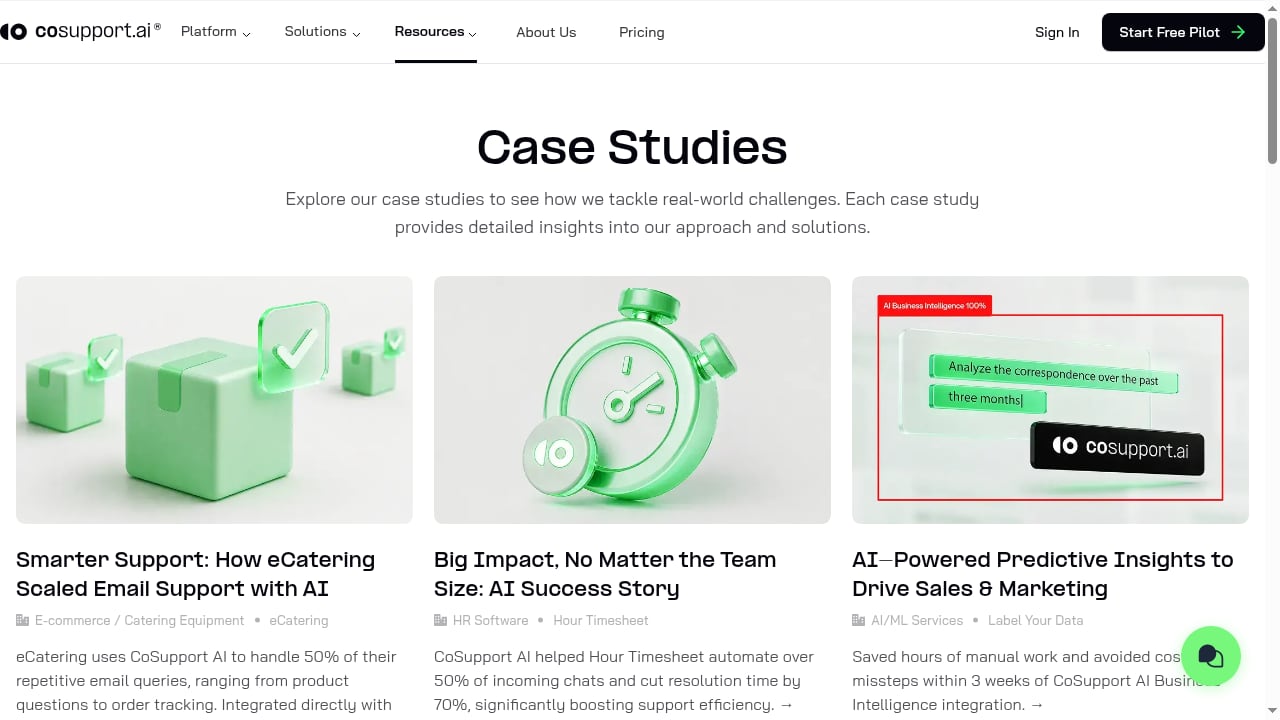
First viewport screenshot of CoSupport AI Case Studies - Real Customer Results.
CoSupport AI publishes case studies with specific metrics. Here's what the evidence shows:
| Company | Industry | Result |
|---|---|---|
| E-commerce marketplace | E-commerce | $7,000/month saved, 75% auto-resolution |
| Cocoatech | SaaS | 82% of tickets automated on Zendesk |
| eCatering | Food service | 50% of email tickets deflected on Freshdesk |
| Hour Timesheet | SaaS | 82% of chats automated, 70% faster resolution |
| Label Your Data | Data services | 17% more deals closed via BI insights |
These numbers are vendor-reported, so treat them as directional rather than guaranteed. However, the consistency across industries—SaaS, e-commerce, food service, data services—suggests the platform's core mechanism works across different ticket types.
The 60-day guarantee to achieve a 60% AI resolution rate is notable. It shifts risk from the buyer to the vendor and signals confidence in the training methodology. Teams that don't hit the threshold within 60 days have a clear exit path.
Pricing Signals
CoSupport AI offers three pricing models:
- Per resolved ticket — Pay only when the AI actually resolves a ticket without human intervention. This aligns cost directly with value delivered.
- Flat monthly fee — Predictable pricing for teams that prefer fixed budgets regardless of volume fluctuations.
- Per response — Pay based on total AI responses, including those that agents later edit or override.
The per-resolved-ticket model is the most interesting. It means you don't pay for AI attempts that fail or require human takeover—only for genuinely resolved conversations. For teams evaluating ROI, this model makes the business case straightforward.
Exact pricing isn't published publicly. Expect to engage with sales for a quote based on ticket volume, channels, and integration requirements. The platform serves over 300 brands, suggesting pricing scales from mid-market to enterprise.
Setup and Onboarding
Setup follows a clear sequence:
- Connect your helpdesk — Integrations with Zendesk, Freshdesk, and other platforms take minutes, not days.
- Import historical tickets — The AI ingests solved tickets to learn your response patterns.
- Configure channels and rules — Decide which channels get full automation, which get assist mode, and which stay human-only.
- Test and calibrate — Run the AI in shadow mode or assist mode before enabling full auto-replies.
- Go live and monitor — Track resolution rates, customer satisfaction, and agent workload through the analytics dashboard.
No-code setup means support managers can handle implementation without developer involvement. The 60-day guarantee window starts once training is complete, giving teams a defined evaluation period.
Strengths and Limitations
Strengths
- Resolution-based pricing reduces financial risk and aligns vendor incentives with customer outcomes
- Ticket-history training produces responses that match your brand voice and policies
- Omnichannel consistency from a single knowledge source
- Fast integration with popular helpdesks, confirmed by user reviews
- 60-day guarantee with a specific, measurable success metric
- Agent assist mode provides a low-risk adoption path
Limitations
- Historical data dependency — Teams without substantial solved-ticket history will see slower initial performance
- Vendor-reported metrics — Case study numbers aren't independently verified
- Opaque pricing — No public pricing page means budget planning requires a sales conversation
- Limited public reviews — Trustpilot shows very few independent reviews, and G2/Capterra listings are relatively new
- Complex edge cases — Multi-step reasoning improved in 2.0, but highly nuanced or emotional conversations may still require human handling
- Helpdesk dependency — The platform augments existing helpdesks rather than replacing them, which may not suit teams seeking an all-in-one solution
How CoSupport AI Compares to Alternatives
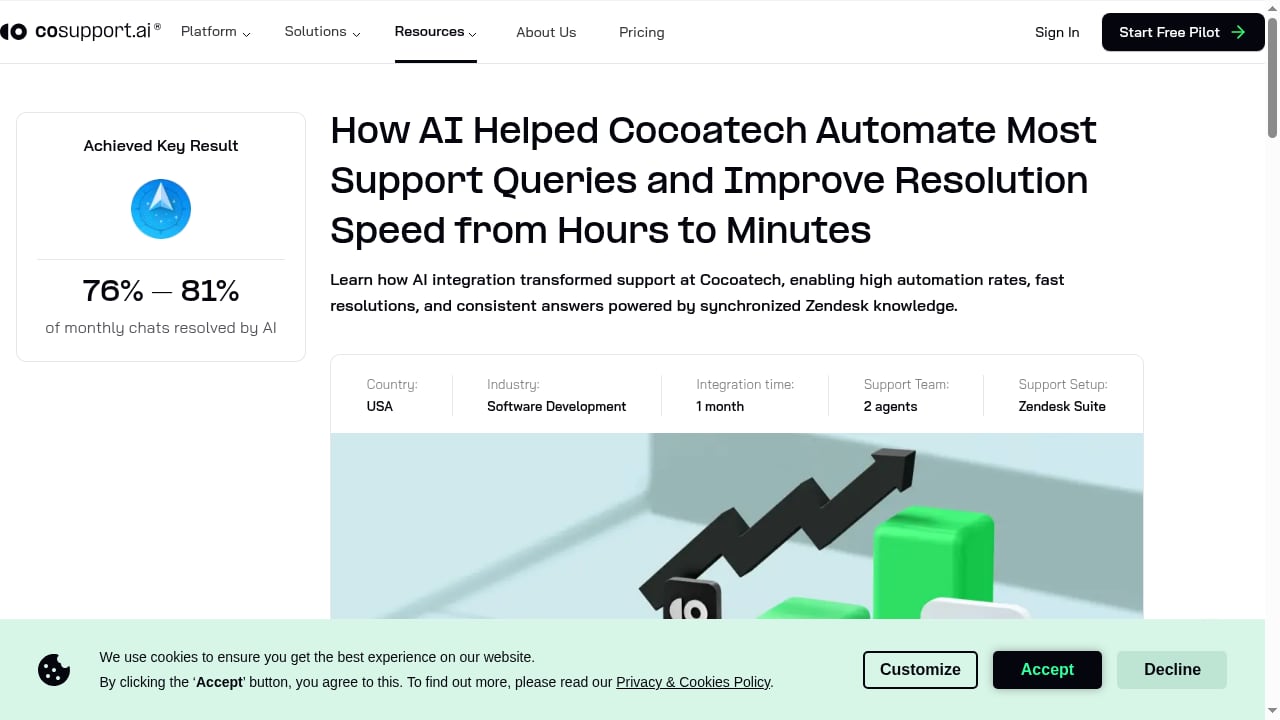
First viewport screenshot of Cocoatech Case Study - 82% Ticket Automation on Zendesk.
If you're evaluating AI support platforms, CoSupport AI sits in a competitive field. Here's how to think about the comparison:
- CoSupport AI vs Ada — Ada focuses on enterprise-grade AI agents with strong no-code bot building. CoSupport AI differentiates through ticket-history training and resolution-based pricing. For a deeper comparison, see HelpKnow AI vs Ada: Which AI Support Platform Wins?.
- CoSupport AI vs HelpDesk — HelpDesk offers AI ticketing and multichannel support with its own automation layer. Teams wanting a full helpdesk replacement should read the HelpDesk Review 2026 before deciding.
- CoSupport AI vs EasyAgent — EasyAgent emphasizes no-code AI agents with a different setup philosophy. The EasyAgent Review 2026 covers where each approach fits best.
The key differentiator for CoSupport AI remains its training methodology: it learns from your resolved tickets rather than relying on pre-built intent libraries. For teams with rich ticket history, this produces more accurate, brand-aligned responses.
Decision Criteria: Should You Choose CoSupport AI?
Choose CoSupport AI if:
- You have at least 6–12 months of resolved ticket history in a supported helpdesk
- Repetitive tickets consume more than 40% of agent time
- You need multilingual support without building separate bot flows
- You want pricing tied to actual AI resolution rather than response volume
- Your team prefers a gradual adoption path through assist mode
Look elsewhere if:
- Your ticket history is thin or poorly organized
- You need a full helpdesk replacement rather than an automation layer
- Your support volume is too low to justify AI automation
- You require published, self-serve pricing before evaluation
Related reading
- HelpKnow AI vs Dialpad: Which AI Support Platform Wins? - Compare HelpKnow AI and Dialpad on AI resolution rates, omnichannel support, integrations, analytics, compliance, and pricing to pick the right enterprise AI platform.
Sources and further reading
- Read Customer Service Reviews of cosupport.ai - Trustpilot - Apr 26, 2025 ... 1 person has already reviewed CoSupport AI. Read about their experiences and share your own!
Frequently Asked Questions
What is CoSupport AI's resolution rate guarantee?
CoSupport AI offers a 60-day guarantee to achieve a 60% AI resolution rate. If the platform doesn't hit that threshold within 60 days of going live, the guarantee provides an exit path. The specific terms should be confirmed during the sales process.
How does CoSupport AI pricing work?
CoSupport AI offers three pricing models: per resolved ticket, flat monthly fee, or per response. The per-resolved-ticket model means you only pay when the AI successfully resolves a ticket without human intervention. Exact pricing requires a quote based on your ticket volume and requirements.
Which helpdesks does CoSupport AI integrate with?
CoSupport AI integrates with popular helpdesks including Zendesk and Freshdesk. Version 2.0 added 12 new integrations, including Shopify, Stripe, Notion, and Confluence. Check with the vendor for your specific helpdesk.
How long does CoSupport AI setup take?
Setup is no-code and typically takes days rather than weeks. The process involves connecting your helpdesk, importing historical tickets, configuring channel rules, and testing before full deployment. User reviews on G2 consistently mention fast integration.
Does CoSupport AI replace human agents?
No. CoSupport AI automates repetitive tickets and assists agents with suggested responses, but human agents remain essential for complex, sensitive, or emotionally nuanced conversations. The platform's assist mode explicitly supports human-AI collaboration.
Is CoSupport AI suitable for small businesses?
CoSupport AI serves over 300 brands across SaaS, e-commerce, finance, education, and BPO. Small businesses with meaningful ticket volume and historical data can benefit, but very low-volume teams may not see sufficient ROI to justify implementation.
Final Verdict
CoSupport AI delivers on its core promise: an AI support layer that learns from your actual ticket history and resolves repetitive conversations across channels. The resolution-based pricing model is a genuine differentiator that aligns vendor incentives with customer outcomes. The 60-day, 60% resolution guarantee reduces adoption risk in a way few competitors match.
The platform isn't for everyone. Teams without historical ticket data, those seeking a full helpdesk replacement, or organizations with very low support volume should evaluate alternatives. Independent review volume is still building, so vendor-reported metrics should be validated during a trial.
For support teams drowning in repetitive tickets across multiple channels—and with the ticket history to train an AI properly—CoSupport AI is a strong candidate worth piloting. The HelpKnow AI vs Enjo vs My AskAI comparison offers additional context if you're evaluating multiple AI support tools. You can also explore user perspectives on G2 and Capterra as you build your shortlist.