Salesforce Agentic CRM Review: Strengths, Gaps, and Verdict
Salesforce has repositioned its CRM platform around a bold claim: becoming the #1 Agentic AI CRM, where humans and AI agents collaborate across sales, service, and marketing. The practical question for buyers is whether that vision translates into measurable value or adds another layer of complexity to an already sprawling platform. This review breaks down how Salesforce Agentic CRM works, where it delivers, where it struggles, and who should consider it.
What Is Salesforce Agentic CRM?
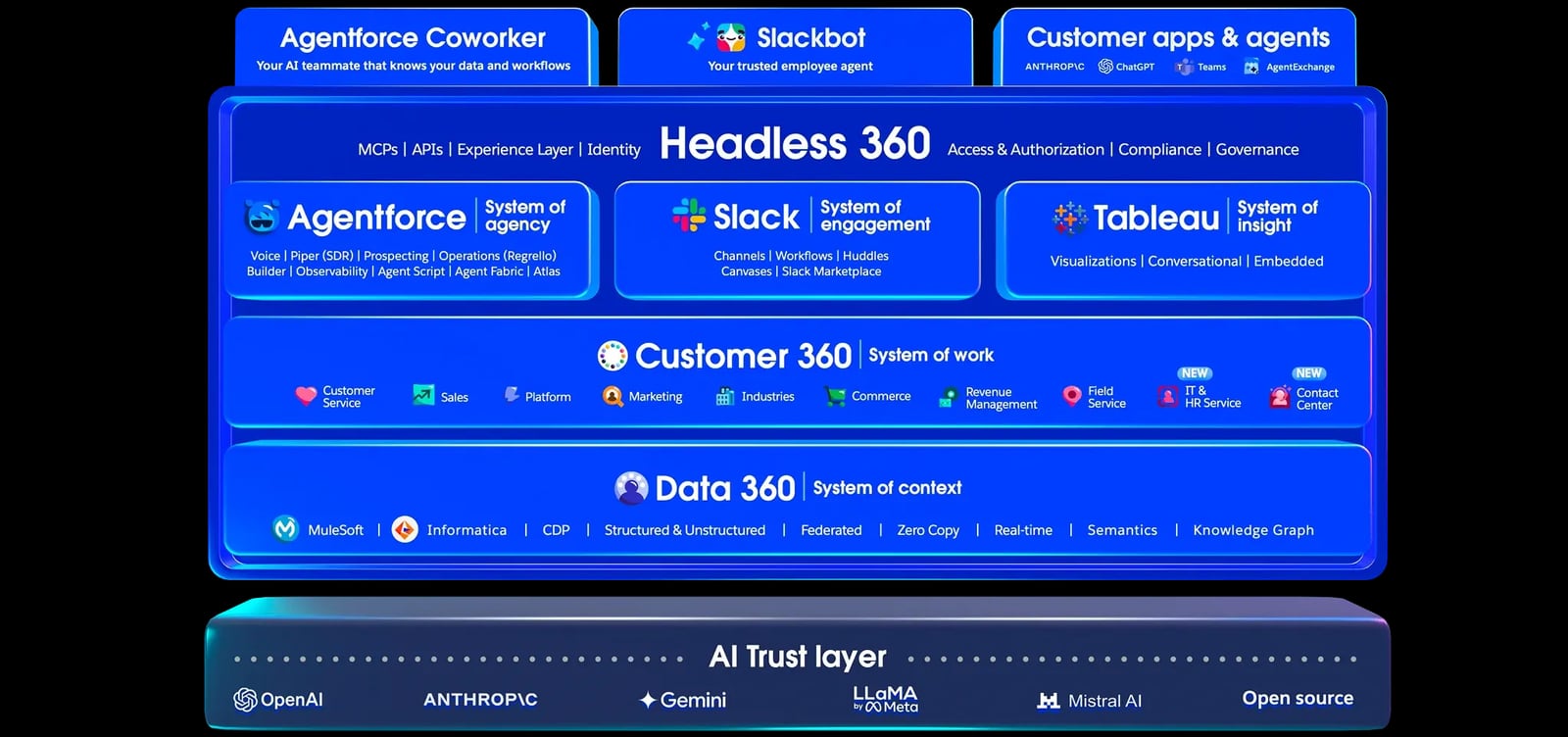
Salesforce Agentic CRM product interface.
Salesforce Agentic CRM is not a separate product. It is the evolution of the Salesforce platform — Customer 360, Data Cloud, Einstein AI, and Agentforce — into an environment where autonomous AI agents perform work inside the same customer records, workflows, and trust controls that human teams already use.
The core idea is that AI should not sit in a separate chatbot tool. Instead, agents operate directly within the CRM object model: they qualify leads, schedule meetings, update cases, route requests, and trigger follow-ups while respecting the permissions and data governance rules configured by the organization.
This architecture matters. Traditional AI support tools often require copying data into an external system. Salesforce's approach keeps the AI working against the same unified customer record that sales, service, and marketing teams see. The result is less fragmentation and more consistent context across interactions.
How the Platform Works
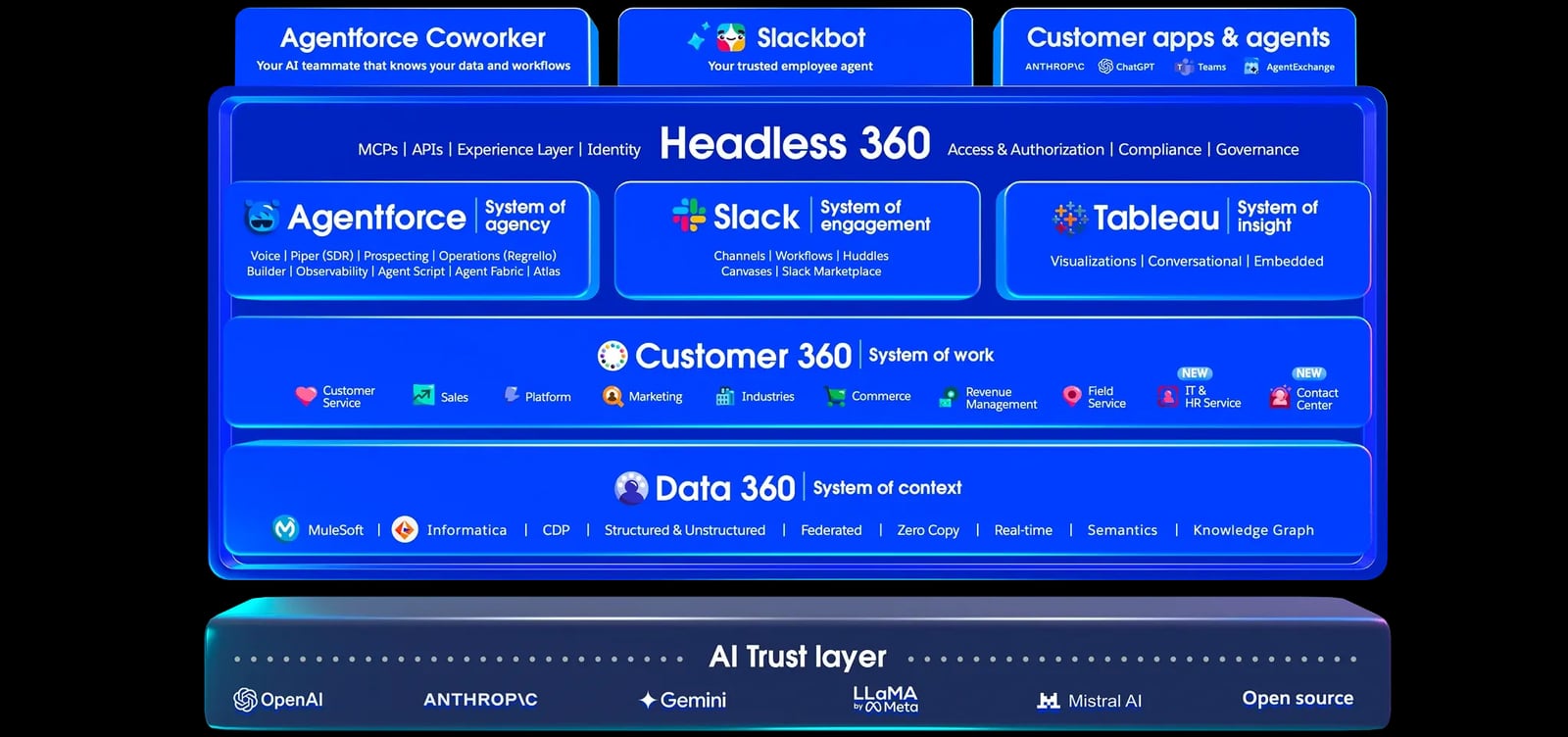
Salesforce Agentic CRM product interface.
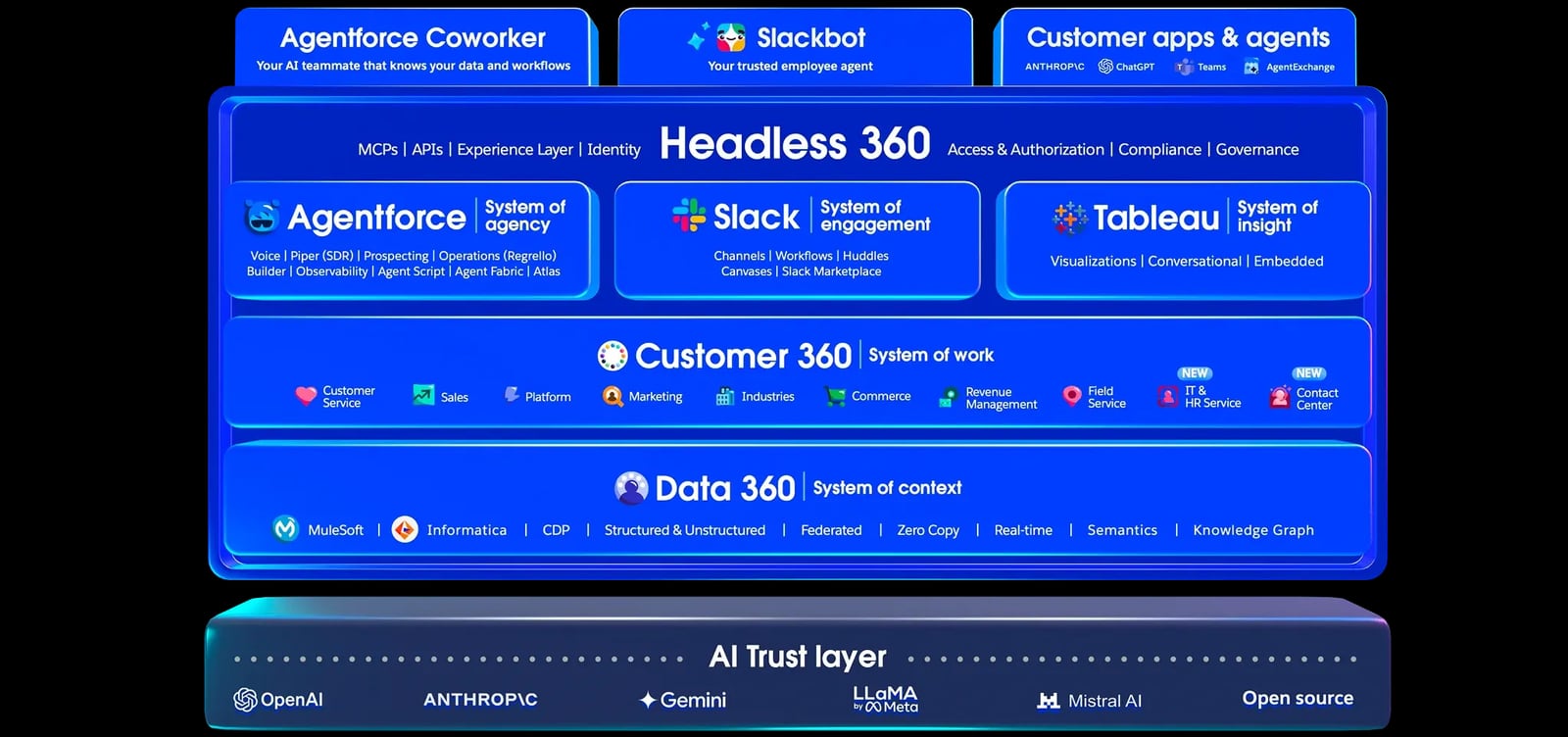
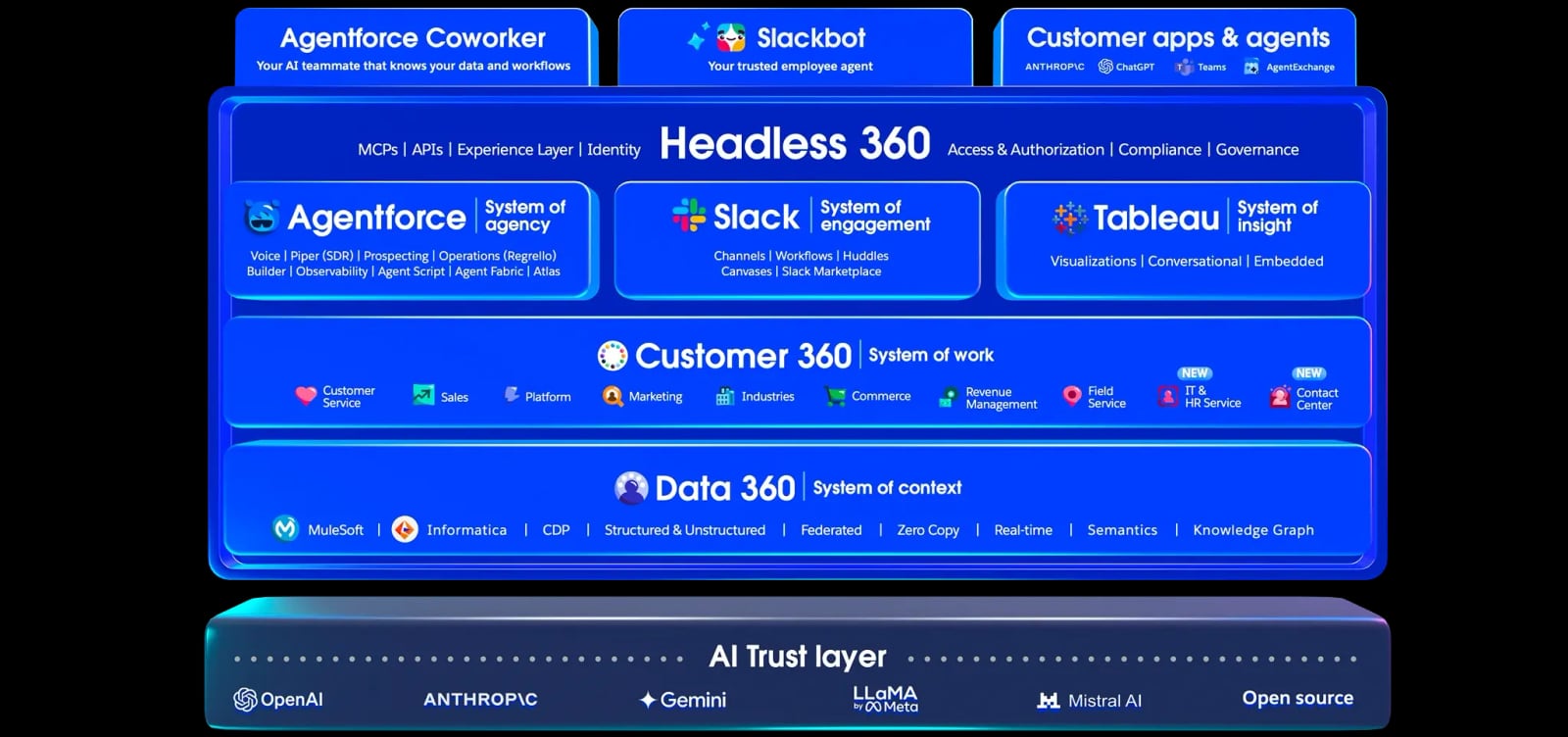
Salesforce Agentic CRM combines several layers:
- Customer 360 and Data Cloud unify customer data from transactions, interactions, and behavioral signals into a shared record.
- Einstein AI provides real-time summaries, suggested responses, and next-best-action recommendations inside agent workflows.
- Agentforce extends Einstein from assistive suggestions into autonomous execution, allowing agents to trigger workflows, update records, and initiate follow-ups within defined guardrails.
- Slack integration lets AI agents surface actions and requests in team channels, reducing the need to open a separate console.
- Agent Builder provides a low-code environment for creating custom agents without deep developer resources.
- AgentExchange offers a marketplace for pre-built agent skills and templates.
The platform also formalized a shift it calls Headless 360, which exposes data, workflows, business logic, and trust controls as APIs, MCP tools, and CLI commands. In practice, this means AI agents can retrieve customer context, trigger case updates, and surface decisions across Slack, voice, WhatsApp, or any MCP-compatible surface without a human navigating the UI.
Ideal Users and Use Cases
Salesforce Agentic CRM is best suited to organizations that already run significant portions of their operations on Salesforce and have invested in clean, connected data.
Strong fits
- Mid-market and enterprise sales teams that want always-on lead engagement and automated meeting scheduling.
- Customer service operations handling high volumes of repeatable requests across phone, chat, email, and social channels.
- Companies with mature Salesforce data governance that can feed accurate context into AI agents.
- Organizations using Slack as a primary collaboration surface, where agents can act without forcing users into another console.
Use cases with proven traction
Salesforce reports that Vercel saved more than 70,000 meeting hours using Slack agents, and Signature Success Plan customers achieved an 83% ROI. Those proof points reflect the platform's sweet spot: automating structured, repeatable work inside an existing Salesforce environment.
Common deployments include:
- AI-qualified inbound leads routed to the right sales rep with full context
- Automated case triage and suggested resolution steps for service agents
- Post-interaction summaries and follow-up scheduling without manual data entry
- Self-service portals where customers resolve routine issues without human involvement
Key Strengths
Unified data foundation
The biggest structural advantage is the CRM-first architecture. Because AI agents operate on the same customer record as human teams, there is no synchronization gap between what the AI knows and what the rep sees. This is a meaningful difference from standalone AI support tools that require data replication.
Deep workflow integration
Agentforce does not just answer questions. It can update records, trigger workflows, and initiate follow-ups within the Salesforce object model. That makes it possible to automate outcomes, not just conversations.
Low-code customization
Agent Builder reduces the burden on development teams. Administrators can create custom agents and workflows without extensive coding, which accelerates rollout for organizations without large engineering resources.
Ecosystem and marketplace
AgentExchange, the Trailblazer Community, and IdeaExchange provide templates, expert guidance, and peer resources. For companies already invested in Salesforce, this ecosystem reduces the cost of learning and implementation.
Trust and governance controls
Sandboxes, permission sets, and Success Plans provide a structured path for testing and deploying agents safely. For regulated industries, this governance layer is a meaningful advantage over less mature AI platforms.
Limitations and Gaps
Complexity and data maturity requirements
The most consistent criticism from users is the learning curve. Gartner Peer Insights reviews describe the platform as powerful but demanding, with one finance-sector reviewer noting a "steep learning curve" and another citing "integration process and training demands" as key concerns. AI automation only performs as well as the underlying data. Organizations with fragmented or poorly governed data will see limited value.
Cost
Per-license costs are frequently cited as high. The full value of Agentforce typically requires Salesforce Enterprise or Unlimited editions, Data Cloud, and often additional Success Plan investment. For smaller teams, the total cost of ownership can be difficult to justify compared to point solutions.
Configuration overhead
Unlike more self-contained contact center platforms, Salesforce requires significant configuration and data strategy work before AI agents deliver consistent results. Traditional CCaaS platforms such as Genesys, NICE, and Five9 are often more turnkey for telephony and routing, even if they lack Salesforce's cross-functional data depth.
Troubleshooting friction
User reviews mention that resolving integration issues can require extensive troubleshooting, and data integrations can be finicky to configure correctly. Teams without dedicated Salesforce administrators may find ongoing maintenance burdensome.
Pricing Signals
Salesforce does not publish transparent list pricing for Agentforce. Based on available signals:
- Agentforce conversations are typically priced per conversation or per resolution, on top of existing Salesforce edition costs.
- Platform editions start with Enterprise or Unlimited, which already carry significant per-user costs.
- Data Cloud credits add another consumption-based cost layer.
- Success Plans are optional but recommended for complex deployments, adding further expense.
Organizations should budget for platform licensing, AI consumption, data infrastructure, and implementation services. A realistic pilot should include administrator time and data cleanup as explicit line items.
Setup and Implementation
Setup follows a phased path:
- Data foundation: Unify customer data in Data Cloud and resolve identity, permissions, and quality issues.
- Use case selection: Start with one high-volume, structured workflow rather than attempting broad automation.
- Agent configuration: Use Agent Builder or pre-built templates from AgentExchange to define scope, guardrails, and escalation paths.
- Sandbox testing: Run agents in a secure development environment before production deployment.
- Human-in-the-loop design: Define when agents escalate to humans and how context transfers.
- Measurement: Track resolution rates, deflection, rep time saved, and customer satisfaction against a baseline.
Salesforce emphasizes quick setup and pre-built agents, but the practical timeline depends heavily on data readiness. Teams with clean Salesforce data can deploy a pilot in weeks. Teams with fragmented data should expect a multi-month data strategy project first.
How Salesforce Agentic CRM Compares to Alternatives
Salesforce Agentic CRM product interface.
| Capability | Salesforce Agentic CRM | Traditional CCaaS | Standalone AI support tools |
|---|---|---|---|
| Platform foundation | CRM and unified customer data | Telephony and interaction management | External AI layer |
| Data model | Single customer record across functions | Often fragmented, requires integration | Requires data sync |
| AI role | Orchestration across workflows | Primarily assistive or chatbot-driven | Conversation automation |
| Channel management | Unified with shared context | Multi-channel but often siloed | Limited to configured channels |
| Complexity | High | Moderate | Low to moderate |
| Best for | Salesforce-centric enterprises | Voice-heavy contact centers | Focused support automation |
For organizations evaluating AI support platforms beyond Salesforce, comparisons such as HelpKnow AI vs Retell AI or HelpKnow AI vs Dialpad can clarify how standalone tools differ from a CRM-embedded approach. If your primary need is contact center automation rather than cross-functional CRM orchestration, a review like Talkdesk Review 2026 offers a useful contrast.
Decision Criteria: Should You Choose Salesforce Agentic CRM?
Salesforce Agentic CRM product interface.
Choose Salesforce Agentic CRM if:
- You already run sales, service, or marketing on Salesforce and want AI embedded in those same workflows.
- You have clean, governed customer data or are willing to invest in getting there.
- You need automation that updates records and triggers workflows, not just answers questions.
- You operate in a regulated industry where trust controls and sandboxes matter.
Look elsewhere if:
- You need a turnkey contact center solution without significant configuration.
- Your budget is constrained and per-license costs are a primary concern.
- Your data lives primarily outside Salesforce and you have no near-term plan to consolidate it.
- You need a focused AI support tool rather than a full CRM platform. In that case, reviews like CoSupport AI Review 2026 or HelpDesk Review 2026 may be more relevant.
Sources and further reading
- Salesforce Agentforce Contact Center Review: Strengths, Gaps and How It Compares to Rivals - Salesforce Agentforce Contact Center unifies CRM, AI and workflows — but is the complexity worth it? A deep dive with analyst and expert perspective.
- How Effective Is Salesforce Agentforce for AI-Powered Customer ... - Aug 12, 2025 ... I'm curious to hear from professionals who have implemented Salesforce Agentforce. How has it impacted your customer support operations?
FAQ
What is Salesforce Agentic CRM?
Salesforce Agentic CRM is the integration of autonomous AI agents into the Salesforce platform, where they operate within the same customer records, workflows, and trust controls used by human sales, service, and marketing teams.
Is Salesforce Agentforce the same as Agentic CRM?
Agentforce is the AI agent layer within Salesforce's broader agentic CRM vision. The agentic CRM includes Customer 360, Data Cloud, Einstein AI, Agentforce, and Slack integration working together.
How much does Salesforce Agentic CRM cost?
Salesforce does not publish transparent pricing. Costs typically include platform edition licenses, per-conversation or per-resolution AI consumption, Data Cloud credits, and optional Success Plans. Total cost varies widely by deployment size.
Does Salesforce Agentic CRM replace human agents?
No. The current model is hybrid. AI agents handle structured, repeatable tasks within guardrails, while humans manage exceptions, complex cases, and relationship-sensitive interactions.
How long does implementation take?
Teams with clean Salesforce data can pilot a use case in weeks. Organizations with fragmented data should expect a longer data strategy and cleanup phase before agents deliver consistent value.
What are the main limitations?
The most common limitations are complexity, high per-license costs, data maturity requirements, and configuration overhead. User reviews also cite training demands and occasional integration troubleshooting friction.
Conclusion
Salesforce Agentic CRM is a credible and ambitious attempt to make AI a native part of customer operations rather than a bolted-on chatbot. Its CRM-first architecture, workflow integration, and governance controls are genuine differentiators for organizations already invested in Salesforce.
The trade-off is clear: the platform demands clean data, skilled administrators, and meaningful budget. For enterprises that can meet those requirements, the payoff can be substantial. For smaller teams or those seeking a focused, lower-complexity AI tool, the total cost and configuration burden may outweigh the benefits.
As with any major platform decision, start with one structured, high-volume use case, measure against a baseline, and expand only when the data proves the value. For broader context on how Salesforce's approach compares to dedicated AI support platforms, see HelpKnow AI vs Help Scout vs Fin and the Gartner Peer Insights reviews for Agentforce Service.