
How to Use HelpKnow AI with Dataiku
HelpKnow AI and Dataiku solve different halves of the same problem. HelpKnow AI is the customer-facing agent: it learns your knowledge base, greets customers, resolves questions around the clock, and runs action plugins like order processing. Dataiku is the enterprise AI and data science platform behind the scenes: it prepares data, builds and governs models, manages LLM connections, and turns AI work into measurable outcomes.
Put them together and customer service stops being a black box. Every conversation becomes a data asset you can analyze, every answer becomes something you can audit, and every improvement to the knowledge base can be tested before it reaches a customer. This article explains the workflow, the setup steps, practical examples, and the problems the combination actually solves.
Why combine HelpKnow AI and Dataiku?
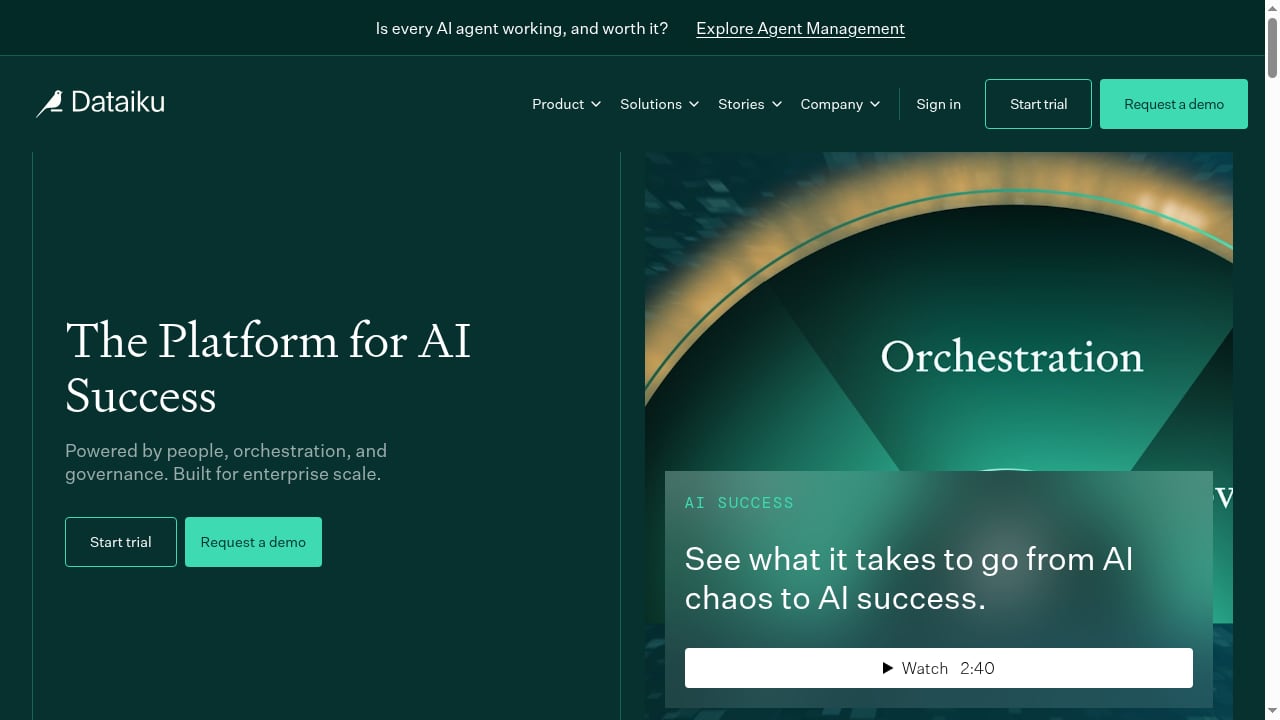
First viewport screenshot of www.dataiku.com.
Most teams deploy an AI customer service agent and then struggle with three questions: Is it answering correctly? Are the answers improving? Can we prove any of this to compliance? HelpKnow AI handles the conversation layer well, but the evidence layer lives in your data platform.
Dataiku is positioned as a platform for AI success, uniting people, orchestration, and governance. It supports the full AI lifecycle, including data preparation, machine learning, generative AI, LLM Mesh, RAG chatbots, and agent management, all under governed systems. That is exactly the layer HelpKnow AI customers need when they want to move from "the bot works" to "we can measure, explain, and improve the bot."
| Capability | HelpKnow AI | Dataiku |
|---|---|---|
| Customer conversation | Yes — AI agent greets, answers, resolves | No — not a customer-facing channel |
| Knowledge learning | Yes — documents, FAQs, product catalogs | Indirect — via RAG pipelines and LLM Mesh |
| Action execution | Yes — plugins for order processing, express tracking | No — analytics and model execution |
| Data preparation and modeling | Limited | Yes — full lifecycle |
| Governance and explainability | Platform-level | Yes — governed, explainable, scalable systems |
| Measurable business outcomes | Cost reduction, resolution rate | Prototypes in under 2 days, hours saved, cost avoidance |
The two products are complementary, not competitive. HelpKnow AI owns the customer moment; Dataiku owns the evidence and the improvement loop.
The combined workflow at a glance
First viewport screenshot of www.dataiku.com.
A practical integration follows five stages:
- Ingest — HelpKnow AI captures conversations, intents, and resolution outcomes.
- Prepare — Dataiku cleans and joins that data with CRM, order, and product data.
- Model — Dataiku builds classification, sentiment, and quality models, and manages LLM connections through LLM Mesh.
- Feed back — Insights become knowledge base updates, new intents, and revised action plugins in HelpKnow AI.
- Govern — Dataiku documents lineage, model versions, and evaluation results so the loop is auditable.
Each stage is described below with concrete steps.
Stage 1: Ingest conversation and outcome data
HelpKnow AI already produces the raw material: smart intent recognition output, conversation transcripts, resolution status, and plugin execution records. Export these on a schedule (daily is typical) to a storage layer Dataiku can reach — cloud object storage, a warehouse table, or a database connection.
Keep the export schema stable. At minimum capture: conversation ID, timestamp, detected intent, confidence, resolution outcome, escalation flag, plugin invoked, and plugin result. Stable schemas make downstream Dataiku recipes reusable.
Stage 2: Prepare and enrich in Dataiku
In Dataiku, build a preparation flow that joins conversation data with business context:
- Customer segment and account tier from the CRM
- Order status and delivery events from fulfillment systems
- Product catalog attributes so intent labels map to real SKUs
- Agent handoff records so you can compare AI-resolved and human-resolved cases
Dataiku's visual recipes let business analysts contribute here without waiting on engineering. That matters because the people who know which intents are mislabeled are usually on the support operations team, not in the data team.
Stage 3: Model quality, sentiment, and demand
With prepared data, Dataiku can support several models that directly improve HelpKnow AI performance:
- Intent drift detection — flag intents whose volume or phrasing is changing so the knowledge base can be updated before resolution rates fall.
- Resolution quality scoring — classify conversations by whether the customer's issue was truly resolved, not just whether the chat ended.
- Sentiment and escalation prediction — identify patterns that precede escalation and feed those signals back as new agent behaviors.
- Demand forecasting — predict contact volume by product or region so staffing and knowledge updates are proactive.
Dataiku's LLM Mesh is useful here if you want to route evaluation prompts to different models under one governed connection layer, rather than hard-coding a single provider into your analysis scripts.
Stage 4: Feed insights back into HelpKnow AI
The loop only closes when Dataiku output changes something in HelpKnow AI. Common feedback paths:
- Knowledge base updates — new FAQ entries or corrected product documentation for intents with low resolution rates.
- Intent configuration — refine smart intent recognition categories based on observed phrasing.
- Plugin tuning — adjust order processing or express tracking logic when plugin failures cluster around specific order states.
- Escalation rules — route conversations to humans earlier when the model predicts escalation.
Treat each feedback change as a versioned update. Record what changed, why, and which Dataiku analysis justified it.
Stage 5: Govern and report
Dataiku's governance layer is where the combination earns trust with compliance and finance. Document model versions, data lineage, and evaluation results alongside the HelpKnow AI configuration changes they produced. When an executive asks why the automated resolution rate moved, you can trace the answer from conversation data through a Dataiku model to a specific knowledge base edit.
Setup steps
Step 1: Define the integration scope
Start narrow. Pick one product line or one support queue. Trying to pipe every conversation into Dataiku on day one creates a data swamp and delays value. A single queue with clear intents is enough to prove the loop.
Step 2: Confirm access and connections
- Confirm HelpKnow AI's export or API access for conversation and plugin data.
- Confirm Dataiku can reach your storage or warehouse where that data lands.
- Agree on refresh cadence and data retention with security and legal.
Step 3: Build the ingestion pipeline
Create a scheduled job that pulls HelpKnow AI data into your landing zone. Validate row counts and schema on every run. Alert on missing partitions — silent pipeline failures are the most common reason these integrations stall.
Step 4: Build the first analysis in Dataiku
Choose one high-value question, such as: which intents have the lowest resolution rate, and what do those conversations have in common? Build the preparation flow and a simple model or dashboard to answer it. Ship this within the first two weeks; Dataiku's templates and pre-built solutions are designed to shorten time to value.
Step 5: Close the loop with a change
Pick the top finding and make one concrete change in HelpKnow AI — a new FAQ entry, a revised intent, or a plugin adjustment. Measure the effect over the next two to four weeks. This first closed loop is the proof of concept that justifies expanding scope.
Step 6: Operationalize and expand
Once the loop works, add queues, automate the reporting, and set thresholds that trigger review when resolution rates or sentiment shift. Document the operating model so support operations, data science, and compliance each know their role.
Practical examples
First viewport screenshot of www.dataiku.com.
Example 1: Reducing repeat contacts on order status
A retailer notices customers asking about order status repeatedly. HelpKnow AI's express tracking plugin handles many of these, but some fail. Exporting plugin results to Dataiku reveals that failures cluster around orders in a specific fulfillment state. The team updates the plugin logic and adds a knowledge base entry explaining the delay. Repeat contacts on that intent drop in the following weeks.
Example 2: Catching knowledge gaps before they hurt
A SaaS company uses Dataiku to cluster unresolved conversations by topic. A cluster of questions about a newly released feature has no matching knowledge base content. Support operations uploads documentation before the next release, and the AI agent handles the questions from launch day instead of escalating them.
Example 3: Proving ROI to finance
Finance wants evidence behind the claimed cost reduction. Dataiku joins conversation outcomes with handling-time data to show hours deflected from human agents, broken down by intent and product line. The result is a defensible model rather than a single headline percentage.
Example 4: Governing LLM usage
A regulated enterprise needs to know which models touched customer data. Dataiku's LLM Mesh provides a governed connection layer for model access, while HelpKnow AI handles the customer interaction. Together they give compliance a clear picture of where data flows and which model versions were in use.
Where each product stops
First viewport screenshot of www.dataiku.com.
Be clear about boundaries to avoid over-engineering:
- HelpKnow AI does not replace your data platform. It is not built for large-scale data preparation or model training across the enterprise.
- Dataiku does not talk to your customers. It has no customer-facing channel, greeting, or action plugin for order processing.
- Neither product alone gives you the full loop. The value comes from the handoff between them.
If your priority is purely conversation quality with no analytics ambition, HelpKnow AI alone may be sufficient. If your priority is enterprise-wide AI governance with no customer service use case, Dataiku alone fits. The combination is for teams that want both.
If you are still evaluating the customer service layer, comparisons such as HelpKnow AI vs Quidget vs Korra and HelpKnow AI vs Kayako can help you choose the right agent platform before adding a data platform. For teams already on cloud infrastructure, How to Use HelpKnow AI with AWS covers the storage and scaling side of the same architecture.
Best practices
- Start with one closed loop. A single finding that changes a single HelpKnow AI configuration is worth more than a dozen dashboards nobody acts on.
- Version every change. Tie each knowledge base or intent update to the Dataiku analysis that justified it.
- Keep schemas stable. Reusable preparation flows depend on predictable export formats.
- Involve support operations early. They know which intents are mislabeled and which answers are wrong.
- Test awkward conversations deliberately. Include scenarios where the customer changes their request mid-conversation, interrupts, or asks for a human, and verify both the conversation and the final system state.
- Review governance quarterly. Model versions, data retention, and access controls drift if nobody owns them.
Related reading
- LiveAgent Review 2026: AI Help Desk Fit, Pricing & Limits - Evidence-based LiveAgent review: AI chatbot, ticketing, live chat and call center strengths, pricing signals, setup effort, and who should choose it in 2026.
- Top 10 AI-Native Player Engagement & Support Platforms 2026 - Ranked review of the top 10 AI-native player engagement and support platforms for gaming in 2026, scored on in-game SDKs, launch elasticity, automation depth, and pricing.
Sources and further reading
- Self Healing Code - “We need AI!” said every company ever. But most end up with expensive tools nobody uses… · Experience: Gradient Labs · Education: Northwood University · Location: Nashville · 500+ connections on LinkedIn. View Dylan Davis’ profile on LinkedIn, a professional community of 1 billion members.
- Atlassian Cloud Data Protection: Security, Privacy & Migration - Check what you need to know about Atlassian cloud data residency, cloud migration & security and how Smart Checklist on Forge fits in
- Your pilot needs a few deliberately awkward conversations. A caller ... - 3 likes, 0 comments - induslabs.io on October 12, 2026: "Your pilot needs a few deliberately awkward conversations.
A caller changes the date halfway through. Someone interrupts the agent. A product name is pronounced unexpectedly. The booking system times out. The customer asks for a person.
Write down the expected behaviour for each scenario before the test begins.
Then check the conversation, the final system state and the handoff. A smooth-sounding answer can still leave the wrong booking behind.
Keep a short failure log with an owner and a retest decision for every issue.
Which difficult call would you add to this list?
#AIQuality #VoiceAgents #IndusLabs".
FAQ
Is HelpKnow AI a replacement for Dataiku?
No. HelpKnow AI is an enterprise AI customer service agent platform focused on conversations and business actions. Dataiku is an enterprise AI and data science platform focused on data preparation, modeling, and governance. They serve different layers and work best together.
Do I need a data team to run this integration?
A data engineer or analyst is helpful for the initial pipeline, but Dataiku's visual interface lets business users contribute to preparation and analysis. Many teams run the ongoing loop with a small cross-functional group from support operations and data.
How long does setup take?
A first closed loop — ingestion, one analysis, one HelpKnow AI change — is typically achievable in a few weeks. Dataiku reports working generative AI prototypes in less than two days, which shortens the analysis side considerably.
What data should I export from HelpKnow AI?
At minimum: conversation ID, timestamp, detected intent, confidence, resolution outcome, escalation flag, plugin invoked, and plugin result. Add customer segment and product identifiers if your privacy review allows it.
Can this help with compliance and audit requirements?
Yes. Dataiku's governance capabilities let you document model versions, data lineage, and evaluation results, which supports audit conversations about how AI answers are produced and improved.
Does the integration replace human agents?
No. HelpKnow AI automates high-volume, well-understood questions and escalates the rest. The Dataiku loop helps you identify which questions can be safely automated and which should stay with humans.
Conclusion
HelpKnow AI and Dataiku are strongest when treated as two halves of one system: the agent that talks to customers and the platform that proves and improves the conversation. The workflow is straightforward — ingest, prepare, model, feed back, govern — but the discipline of closing the loop is what turns a customer service deployment into a measurable business asset. Start with one queue, one question, and one change, then expand once the evidence supports it.
For broader context on how AI agent platforms compare, see HelpKnow AI vs Front vs HelpNow. For platform-level background, the Dataiku platform overview and HelpKnow AI are the primary references.