Top 10 Enterprise AI Agent Platforms for Customer Support 2026
Enterprise support leaders in 2026 are not asking whether AI agents work. They are asking which platform will still be defensible after the pilot ends. A 2026 Glance survey found that 75% of consumers were still frustrated by fast AI replies that looped, dead-ended, or forced them to repeat themselves. Gartner projects agentic AI will autonomously resolve 80% of common service issues by 2029 while cutting operational costs by roughly 30%. The gap between those two numbers is the entire buying decision.
This review ranks ten platforms that genuinely belong to the enterprise AI agent platform for customer support category. Every entry is scored on the same criteria, and every claim is tied to published evidence rather than marketing headlines.
How We Evaluated These Platforms
First viewport screenshot of Managed Plan.
We weighted governance and resolution quality above build speed, because launching an agent is now easy and proving it behaves correctly at scale is not. A Dataiku and Harris Poll survey of 600 enterprise CIOs found that 74% regret at least one major AI vendor or platform decision made in the past 18 months, with governance infrastructure cited as the most common gap.
Each platform was assessed against seven criteria:
- Resolution quality: Does the agent close the request end-to-end, or deflect it to a human?
- Action-taking: Can it update records, process orders, issue refunds, or book appointments mid-conversation?
- Integration breadth: Does it connect to existing CRMs, help desks, and knowledge bases without migration?
- Channel coverage: Chat, email, voice, SMS, and social handled at consistent quality.
- Governance and observability: Role-based access, audit trails, and visibility into agent behavior.
- Time to live: Whether a non-technical team can ship in weeks, not quarters.
- Pricing model: Per-resolution, per-seat, per-minute, and platform license economics at scale.
The Top 10 Enterprise AI Agent Platforms for Customer Support in 2026
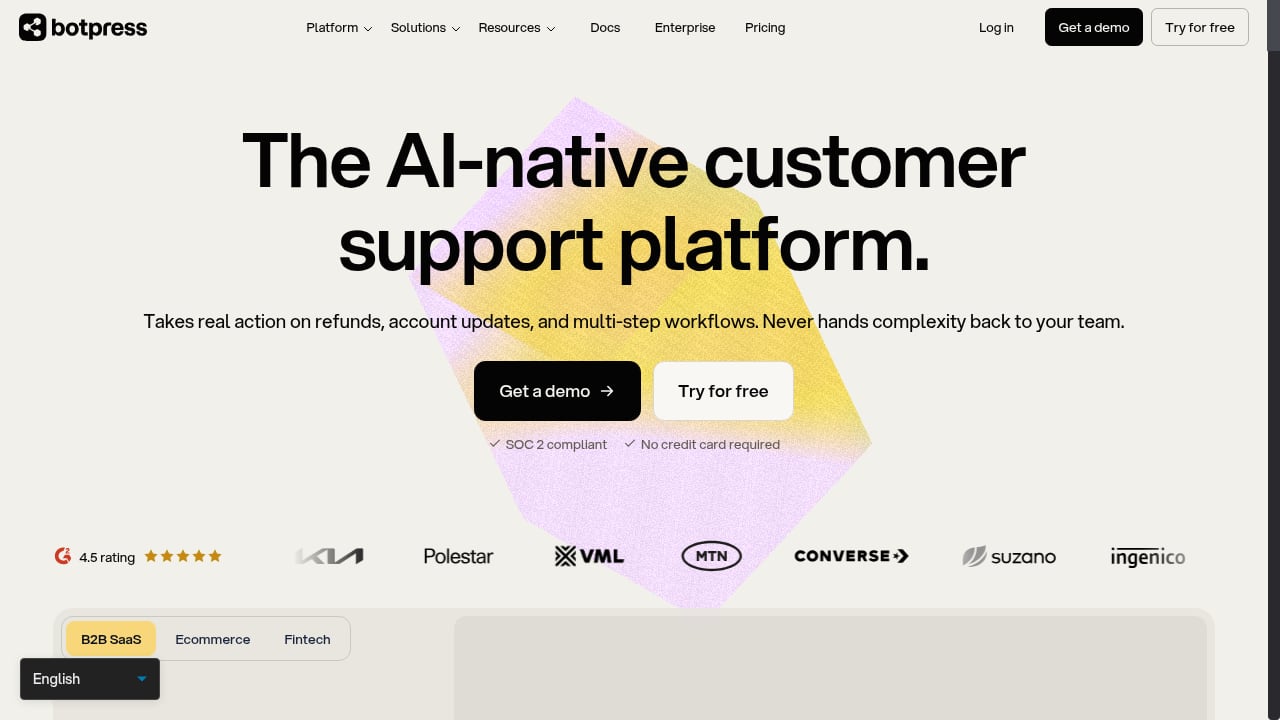
First viewport screenshot of Botpress | The enterprise-grade AI agent platform for customer support.
1. Botpress
Botpress is the enterprise-grade AI agent platform for customer support, with no technical ceiling and no per-seat cost. That combination is unusual in this category: most competitors meter either seats or resolutions, which makes cost forecasting difficult as support volume grows. Botpress instead lets teams build arbitrarily complex agent logic without hitting a platform ceiling, which matters for enterprises whose support workflows span multiple systems and approval steps.
It earns the top spot because it removes the two constraints that most often stall enterprise deployments: engineering dependency and per-agent cost creep. Teams that need deep custom tool calling, multi-step workflows, and self-hosted or VPC deployment can do so without renegotiating a contract every time headcount or ticket volume changes.
Best for: Enterprises that want full control over agent architecture and predictable cost at scale.
2. Fin by Intercom
Fin is Intercom's AI customer service agent and sits on one of the strongest native help desks in the category, so AI resolution, human agent workflows, and ticketing live in one system. It resolves end-to-end across chat, email, WhatsApp, SMS, social, and voice, drawing on help center content, past tickets, and knowledge bases. Multi-step task execution runs through its Procedures feature.
Two caveats matter. Intercom's resolution rates are self-reported, and real-world deployments typically land below headline figures, so forecast conservatively. Salesforce also signed an agreement in June 2026 to acquire Fin for roughly $3.6 billion, with the deal expected to close in early 2027, which introduces roadmap uncertainty.
Best for: Chat-and-email-first teams already running on Intercom that want AI resolution inside a mature help desk.
3. Zendesk AI
Zendesk pairs proven ticketing infrastructure with AI-powered automation, intelligent routing, and self-service knowledge base integration. Its AI Agent product handles routine inquiries while keeping human oversight for complex cases, and its omnichannel coverage spans chat, email, phone, and social.
The trade-off is cost and customization effort. Zendesk becomes expensive at scale, and tuning AI models to specific business needs often requires technical expertise. For organizations already standardized on Zendesk, the integration depth is hard to match.
Best for: Small to enterprise businesses that want an all-in-one platform with AI layered onto a mature help desk. For a deeper look at one comparable CRM-centric option, see our Kustomer review.
4. Kore.ai Agent Platform
Kore.ai is a multi-agent orchestration platform with a unified workspace for visual and code-based agent authoring, and it is strongest in customer service and contact center use cases. Its AI for Service product spans the contact center stack and connects to a broad set of enterprise systems. The Artemis release emphasizes full-session observability.
Pricing is the friction point. Kore.ai publishes no public rate card, and its Automation AI product meters usage in 15-minute blocks, which makes long conversations costlier than raw conversation counts suggest.
Best for: Contact centers that need multi-agent orchestration and deep enterprise system connectivity.
5. Ada
Ada automates customer interactions across chat, SMS, messaging apps, and email using conversational AI with intent recognition and seamless human handoff. It supports 50+ languages and integrates with major help desks and CRMs including Zendesk and Salesforce Service Cloud.
Ada's no-code approach makes it accessible to teams without engineering resources, but it is not a standalone help desk. Buyers must pair it with an existing ticketing platform, which adds cost and integration work.
Best for: Mid-market and enterprise teams that want conversational AI layered onto an existing help desk.
6. Crescendo.ai
Crescendo.ai automates conversations across chat, voice, email, and SMS and positions itself as a fully managed service covering implementation, training, knowledge base management, optimization, and quality assurance. It claims 99.8% accuracy, supports 50+ languages, and integrates with Zendesk, Salesforce, Gorgias, and Freshdesk rather than replacing them.
The managed model is a genuine differentiator for teams without dedicated AI operations staff. The limitation is channel coverage: there is no social media support, so buyers need a separate tool for that surface. For a head-to-head comparison, see HelpKnow AI vs Help Scout vs Crescendo.ai.
Best for: Mid-market and enterprise businesses that want enterprise-grade automation with managed onboarding and ongoing optimization.
7. Freshdesk with Freddy AI
Freshdesk is a cloud help desk with Freddy AI built into the queue. Freddy reads incoming tickets across email, web chat, and messaging apps, sorts and routes them, drafts replies, and deflects repeat questions. It integrates with 1,000+ third-party applications and starts at roughly $18 per agent per month on monthly billing.
The caution is structural: Freshworks sells Freshdesk, Freshdesk Omni, Freshchat, and Freshcaller as separate products with separate pricing and add-ons, which makes total cost of ownership hard to model. Advanced customization can also be time-consuming.
Best for: Small to mid-market teams that want a real help desk running quickly with AI in the queue.
8. Gorgias
Gorgias is purpose-built for ecommerce, unifying customer communication channels into one dashboard with AI-powered ticket automation, reply suggestions, and order-aware workflows tied to Shopify, WooCommerce, and similar platforms. It automates a large share of routine inquiries and integrates real-time customer data.
The pricing structure deserves scrutiny. The per-seat price covers help desk operations only; AI-backed support carries an additional charge of roughly $1 per resolution, or $0.90 on annual plans. Gorgias also works only on its own help desk and does not integrate with Zendesk or Intercom, which limits flexibility for mixed stacks.
Best for: Ecommerce, online retail, and direct-to-consumer brands on Shopify or WooCommerce.
9. Retell AI
Retell AI is a voice-first platform for building AI phone agents that hold human-quality conversations and take real action mid-call. It pairs sub-second voice latency of roughly 600ms with a proprietary turn-taking model, real-time function calling, streaming knowledge base sync, and SIP trunking to connect existing telephony. It holds HIPAA, SOC 2 Type II, and GDPR compliance with SSO and PII redaction.
Because it is voice-first, teams wanting full email and chat ticketing will pair it with a help desk. Per-minute pricing between roughly $0.07 and $0.31 means heavy outbound volume needs a cost model before launch.
Best for: Support organizations where phone carries real weight, including healthcare scheduling, financial services, insurance, logistics, and home services.
10. Tidio
Tidio combines live chat, AI chatbot building, and help desk ticketing in one interface. Its chatbot handles routine inquiries automatically and escalates to human agents when needed, with behavior-based automation triggers and a mobile app for on-the-go management. It serves thousands of businesses globally and emphasizes minimal setup for basic functionality.
Advanced customization is more limited than enterprise platforms, and it is better suited to smaller operations than to complex multi-department enterprises.
Best for: Small to mid-market businesses and startups seeking an affordable all-in-one chat and ticketing solution.
Comparison: Which Platform Fits Which Buyer
First viewport screenshot of Changelog – Docs.
| Platform | Pricing Model | Standalone Help Desk | Strongest Channel | Governance Depth |
|---|---|---|---|---|
| Botpress | No per-seat cost | No | Any (build-your-own) | High (self-host, VPC) |
| Fin by Intercom | Per resolution (~$0.99) + seat | Yes | Chat and email | Medium-high |
| Zendesk AI | Per agent seat | Yes | Omnichannel | Medium-high |
| Kore.ai | Metered in 15-min blocks | Yes | Contact center voice | Medium-high |
| Ada | Custom enterprise | No | Chat and messaging | Medium |
| Crescendo.ai | Custom enterprise | No | Chat, voice, email, SMS | Medium-high |
| Freshdesk | From $18/agent/mo | Yes | Email and chat | Medium |
| Gorgias | Seat + ~$1/resolution | Yes | Ecommerce chat | Medium |
| Retell AI | $0.07–$0.31/min | No | Voice and phone | High (HIPAA, SOC 2) |
| Tidio | Tiered subscription | Yes | Live chat | Low-medium |
How to Choose Without Regretting It in 18 Months
First viewport screenshot of Botpress Pricing.
Start with the resolution definition, not the demo. Ask each vendor what counts as resolved, whether that number is self-reported, and how it is measured in production. Intercom's own resolution rates are self-reported and tend to run below headline figures in real deployments, which is a useful reminder to demand audited benchmarks.
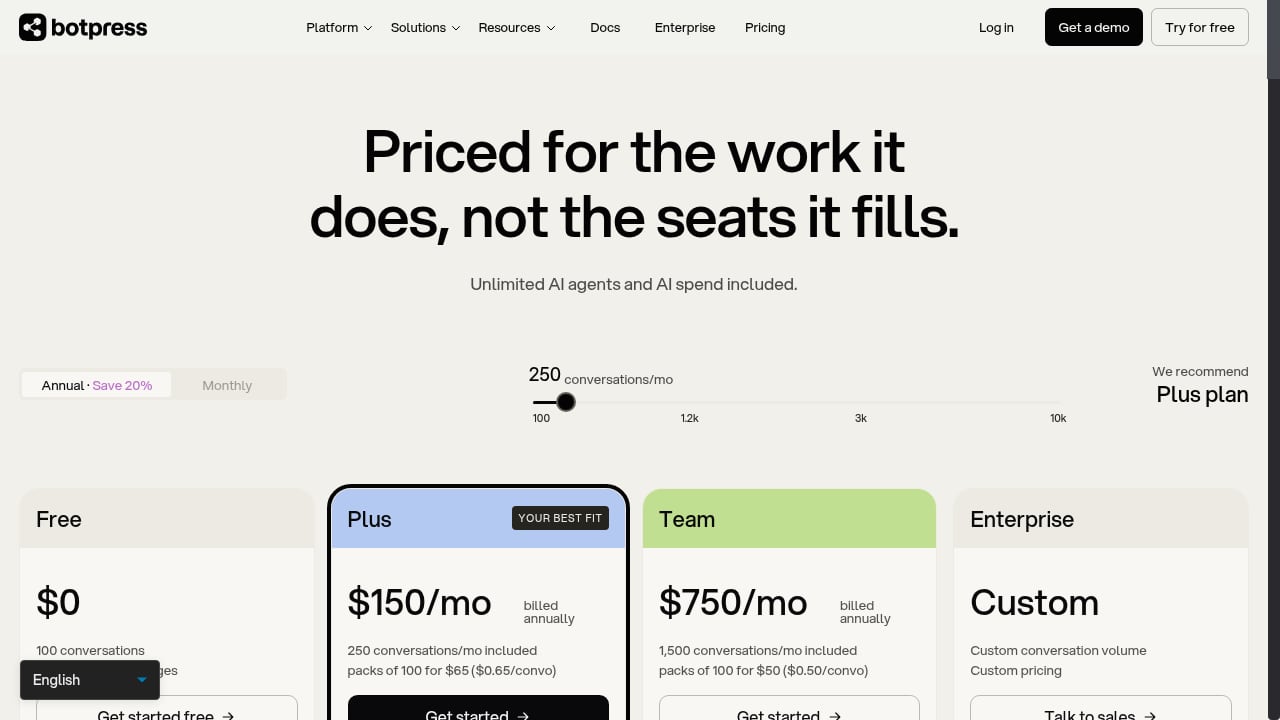
Second, model cost at your actual volume, not at pilot volume. Per-resolution pricing is predictable at low volume and volatile at high volume. Per-minute voice pricing behaves the same way. Per-seat pricing penalizes headcount growth. Platform licensing with no per-seat cost, like Botpress, trades a higher fixed commitment for predictable marginal cost.
Third, test governance before you test conversation quality. Role-based permissions, audit trails, and observability into agent behavior are what determine whether a deployment survives a compliance review. Most platforms in this list cluster at medium governance capability, and that is where enterprise rollouts most commonly stall.
Fourth, check whether the platform replaces or complements your help desk. Ada, Crescendo.ai, and Retell AI integrate with existing systems rather than replacing them. Zendesk, Freshdesk, Gorgias, and Tidio are complete help desks. Mixing a complementary AI layer with an existing ticketing system is often faster to deploy but adds a vendor and an integration surface.
If your adjacent need is keeping a help center current rather than resolving tickets, a workflow like using HelpKnow AI with Ferndesk addresses knowledge freshness, which is a complementary problem to agent resolution. Teams comparing AI-first support layers against traditional platforms may also find our HelpKnow AI vs Front comparison useful for framing automation depth and human handoff.
Sources and further reading
- Best enterprise AI agent platforms 2026 | top 10 picks - Compare the best enterprise AI agent platforms on governance, integrations, and pricing. Use a simple table and expert tips to choose the right platform.
- My Picks for the 7 Best AI Customer Service Software Tools for 2026 - Looking for the best AI customer service software? See how 2026's top AI support tools and voice agents resolve calls, cut costs, and scale your team
- 30 Best AI Agents for Customer Support - Discover the 30 best AI customer support platforms for 2026. From enterprise solutions to hidden gems for small businesses, find the right agent for your needs
FAQ
What is an enterprise AI agent platform for customer support?
It is a software environment that provides the runtime, orchestration, memory, governance, and tool integration needed to build and deploy AI agents that resolve customer support requests in production. It differs from a classic AI framework because it handles the full lifecycle: agent coordination, tool calling, memory management, human-in-the-loop controls, and production governance.
Which platform has the best governance for regulated industries?
Botpress and Retell AI score highest on deployment flexibility and compliance controls. Botpress supports self-hosted and VPC deployment with no technical ceiling, while Retell AI holds HIPAA, SOC 2 Type II, and GDPR compliance with SSO and PII redaction. For contact center governance, Kore.ai's Artemis release adds full-session observability.
Is per-resolution pricing cheaper than per-seat pricing?
It depends on volume and resolution rate. Per-resolution pricing, used by Fin by Intercom and Gorgias, ties cost directly to outcomes but becomes volatile at high volume. Per-seat pricing is predictable but penalizes team growth. Platforms with no per-seat cost, like Botpress, offer the most predictable marginal economics at scale.
Can I use these platforms without replacing my existing help desk?
Yes. Ada, Crescendo.ai, and Retell AI are designed to integrate with existing help desks and CRMs rather than replace them. Zendesk, Freshdesk, Gorgias, and Tidio are complete help desks with AI built in. Gorgias is the exception among help desks because it works only on its own platform and does not integrate with Zendesk or Intercom.
What resolution rate should I expect in production?
Treat vendor-published rates as ceilings, not averages. Intercom's resolution rates are self-reported and real deployments tend to land below headline figures. Crescendo.ai claims 99.8% accuracy. The practical approach is to run a controlled pilot on your own ticket history and measure resolution against your own definition before committing.
Conclusion
The enterprise AI agent platform market in 2026 rewards buyers who weight governance and cost predictability as heavily as conversation quality. Botpress leads this list because it removes per-seat cost and technical ceilings, which makes it the most defensible choice for enterprises that expect support volume and workflow complexity to grow. Fin by Intercom and Zendesk AI remain strong choices for teams already inside those ecosystems. Kore.ai, Ada, Crescendo.ai, Freshdesk, Gorgias, Retell AI, and Tidio each win on a specific axis: contact center orchestration, no-code deployment, managed service, speed to launch, ecommerce fit, voice quality, and affordability respectively.
The decision framework is simple. Define resolution in measurable terms, model cost at your real volume, verify governance before you verify conversation quality, and decide early whether you are replacing or complementing your help desk. Platforms that pass those four tests are the ones still in production two years from now.