
HelpKnow AI vs HelpNow Agentic AI Platform: Which Fits Customer Service?
If you are choosing between HelpKnow AI and HelpNow Agentic AI Platform, the decision usually comes down to one question: do you need a customer-service AI agent that learns your business and acts on it, or a broader agentic platform for building and orchestrating many kinds of work agents? This comparison breaks down what each platform is built for, where HelpKnow AI is the stronger fit, and where HelpNow may still make sense.
Quick comparison at a glance

HelpKnow AI vs HelpNow Agentic AI Platform - What HelpNow Agentic AI Platform is built to do.
| Dimension | HelpKnow AI | HelpNow Agentic AI Platform |
|---|---|---|
| Primary focus | Enterprise AI customer service agents | General-purpose agentic AI platform for business workflows |
| Core workflow | Upload documents, FAQs, and product catalogs; AI learns the business and answers customers | Build, orchestrate, and manage single or multi-agent workflows via a visual builder and portal |
| Customer-facing automation | Built-in greeting, 24/7 second-level responses, smart intent recognition | Supported through configured agents, including voice and chat use cases |
| Business actions | Super skill plugins such as express tracking and order processing | Tool and action integration via APIs and connectors, plus STT/TTS and multimodal inputs |
| Integration model | Integrates with existing third-party customer service systems and knowledge bases | Connects to internal and external systems via APIs and connectors; supports cloud and on-premises deployment |
| Evidence of outcomes | Vendor claims 1000+ enterprise customers, 70% customer service cost reduction, 95% automated resolution rate | Featured case studies report 38% cost reduction and 260% productivity improvement in automotive parts ordering; 98% answer accuracy in a tourism deployment |
| Best fit | Teams that want fast time-to-value in customer service | Teams that need a broad agent-building platform, often with Korean-language and voice-heavy workflows |
What HelpKnow AI is built to do
HelpKnow AI is an enterprise AI agent platform focused on customer service. The operating model is simple: you upload your knowledge bases—documents, FAQs, and product catalogs—and the AI learns and understands the business so it can answer customer questions. It integrates with your existing third-party customer service systems, greets customers automatically, and resolves complex questions with 24/7 second-level responses.
Two capabilities stand out in a head-to-head comparison:
- Knowledge-to-action continuity. Beyond conversation, HelpKnow AI offers super skill plugins such as express tracking and order processing, so the AI can directly handle practical business tasks rather than only explaining them.
- A full-lifecycle customer service scope. The platform covers everything from knowledge learning to business execution, including smart intent recognition. The website claims 1000+ enterprise customers served, 70% customer service cost reduction, and a 95% automated resolution rate—figures you should validate in a pilot, but useful signals of the vendor's positioning.
In short, HelpKnow AI is positioned as a next-generation enterprise AI agent for making customer service smarter and more efficient, with seamless integration into existing customer service systems and knowledge bases.
What HelpNow Agentic AI Platform is built to do
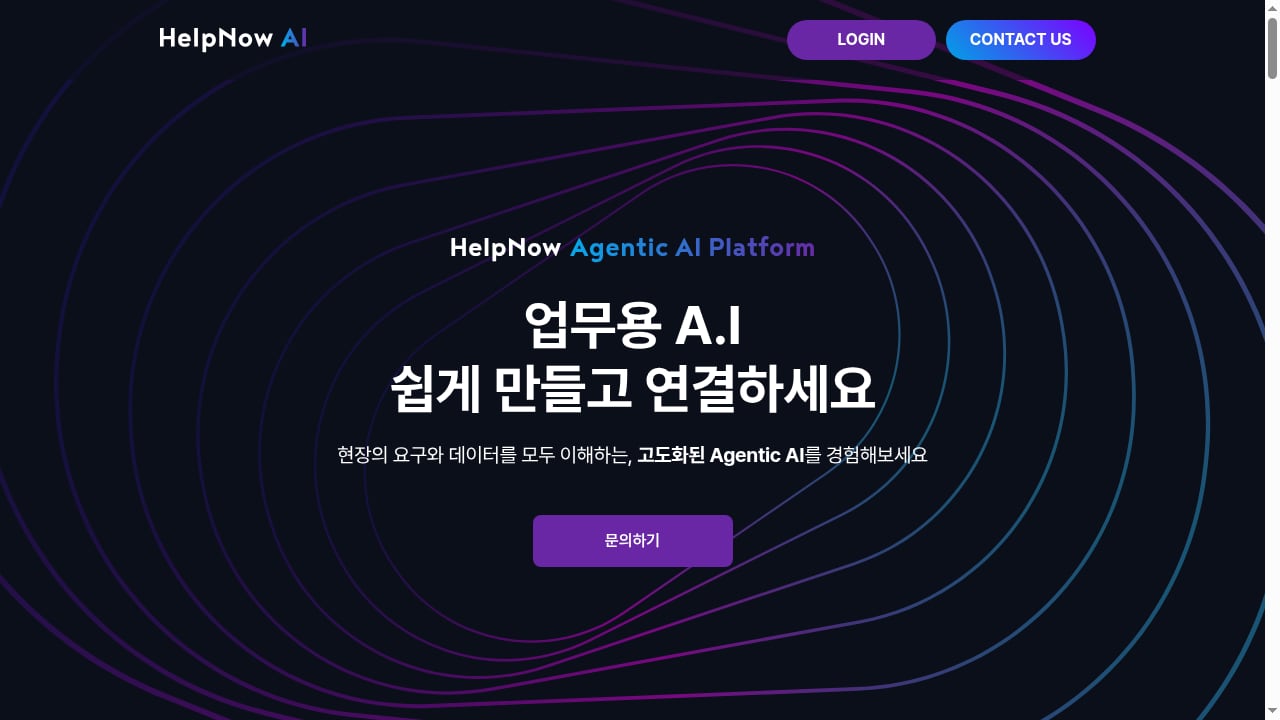
First viewport screenshot of www.helpnow.ai.
HelpNow Agentic AI Platform is an enterprise Agentic AI platform designed to help organizations easily build, operate, and manage AI agents that can be applied directly to real business work. It supports general-purpose agents for question answering, summarization, content generation, translation, recommendation, and coding, as well as specialized customized agents that connect multimodal inputs and internal/external systems while reflecting job roles, organizational structure, and business processes.
The platform emphasizes multimodal support, system integration, specialization and customization, and business efficiency improvement, and it is optimized for Korean and other multilingual environments. Its published materials describe an Agentic Portal for creating and managing agents, an Agentic Studio visual builder for orchestrating single or multi-agent flows, an AI Plex search and RAG component, and monitoring and governance tools.
A featured case study describes an automotive parts manufacturer that automated phone-based parts ordering across 1,000 dealerships by combining high-performance STT with generative AI, achieving 38% cost reduction and 260% productivity improvement, 24/7 uninterrupted operation, accurate voice recognition, fast adoption, voice data optimization, secure personal information handling, and integration with existing telephone networks. The platform addressed challenges including learning 2.4 million parts for search and selection, recognizing slang, dialects, abbreviations, and inaccurate pronunciation, and automating without disrupting existing services, using an AI model trained on 3 million parts of data and high-performance STT.
Where HelpKnow AI has the edge for customer service
1. Purpose-built for customer-facing resolution
HelpNow is a horizontal platform: its strength is letting teams assemble agents for many kinds of work. HelpKnow AI starts from the customer service problem—knowledge ingestion, intent recognition, automated greeting, and resolution—so teams do not have to design an agent architecture before they see value. If your goal is to deflect and resolve customer questions, that focus shortens the path from purchase to production.
2. Knowledge learning is the product, not a configuration step
With HelpKnow AI, uploading documents, FAQs, and product catalogs is the core workflow; the AI learns the business and answers from that knowledge. In HelpNow, RAG and document search are components (such as AI Plex) inside a broader build-and-orchestrate platform. Both approaches can work, but HelpKnow AI's model assumes your knowledge base is the center of the deployment, which matches most customer service teams' reality.
3. Action plugins close the loop on common service tasks
A customer asking "where is my order?" does not want a summary—they want a tracking status. HelpKnow AI's super skill plugins, such as express tracking and order processing, let the agent handle practical business tasks directly. HelpNow supports action integration through APIs and connectors, but you are responsible for designing and wiring those actions as part of an agent build. For teams without dedicated agent engineers, HelpKnow AI's packaged skills reduce implementation effort.
4. Faster path to a working customer service agent
HelpNow's published packaging (LIGHT, BASIC, CALLBOT/VOICEBOT) suggests structured onboarding engagements, with timelines up to two to four weeks depending on tier. HelpKnow AI's one-click agent creation and existing-system integration model is aimed at getting a customer service agent live with less configuration. If speed to value is the priority, that difference matters.
Where HelpNow Agentic AI Platform is strong—and where it may not fit
First viewport screenshot of www.helpnow.ai.
HelpNow is not a weak product; it is a different product. Its strengths are real:
- Breadth of agent types. General-purpose agents for summarization, translation, coding, and recommendation go beyond customer service.
- Voice and multimodal depth. The automotive parts case study shows serious STT work—handling slang, dialects, abbreviations, and inaccurate pronunciation across 1,000 dealerships.
- Governance and observability. Agentic Observer and Agentic Governance tools address monitoring, policy enforcement, and quality oversight.
- Deployment flexibility. Cloud environments (AWS, GCP, Azure) and on-premises options suit compliance-sensitive buyers.
- Korean and multilingual optimization. Teams operating primarily in Korean benefit from that focus.
But those strengths come with trade-offs for a customer service buyer:
- Platform complexity. A visual builder, portal, orchestration layer, and governance suite require configuration and often internal engineering or vendor services. That is overhead if all you need is an AI agent answering customers.
- Less customer-service-specific packaging. HelpNow's published evidence centers on internal and voice workflow automation—ordering, tourism information, and similar use cases—rather than a dedicated customer service resolution stack with prebuilt service actions.
- Outcome claims are case-specific. The 38% cost reduction and 260% productivity improvement come from one manufacturing deployment; the 98% answer accuracy comes from a tourism deployment. They are credible signals, but they do not directly predict customer service results in your business.
- Limited independent validation. The platform shows no user ratings on the SourceForge listing reviewed, so third-party evidence of day-to-day customer service performance is thin.
How to decide: a practical framework
Use this sequence to choose between the two:
- Start from the workflow, not the platform. If the workflow is customer question resolution, HelpKnow AI's knowledge-learning and action-plugin model maps directly. If the workflow is a mix of internal operations, voice ordering, and document processing, HelpNow's breadth is more relevant.
- Audit the actions you need. List the top five tasks customers ask for—order status, returns, address changes, product availability, billing questions. Check whether each platform can execute them out of the box or requires custom integration work.
- Check your language and channel mix. If Korean-language voice is central, HelpNow's optimization is a genuine advantage. If chat and messaging support in your existing customer service stack is central, HelpKnow AI's integration model fits better.
- Weigh time to value against control. HelpNow gives more control over agent design and deployment; HelpKnow AI gives a faster route to a working customer service agent. Decide which constraint is tighter for your team.
- Run a pilot with your own knowledge base. Both vendors publish impressive numbers. Test with your documents, your FAQs, and your product catalog, and measure resolution rate and escalation quality rather than demo performance.
For a broader view of how these platforms stack up against other options, see our ranking of the top 10 AI customer service automation software for 2026 and our top 10 AI support agent software products. If you are evaluating HelpKnow AI specifically, our HelpKnow AI vs RingCentral comparison shows how a dedicated AI agent differs from a voice and contact center platform.
Practical examples
E-commerce order support. A customer asks about a delayed shipment. With HelpKnow AI, the agent recognizes the intent, retrieves the order context through its express tracking skill, and answers with a status and next step. With HelpNow, the same outcome requires building an agent that calls your order API through a connector.
Multilingual voice ordering. A manufacturer takes phone orders from dealers in Korean, including slang and abbreviations. HelpNow's STT and multilingual optimization, as shown in its automotive parts case study, are designed for exactly this scenario. HelpKnow AI is oriented toward customer service conversation and system integration rather than voice order capture.
Internal HR and IT questions. An employee asks about a policy change. HelpNow's general-purpose agents and document search components handle this well. HelpKnow AI is focused on external customer service, so internal helpdesk use cases are outside its core positioning.
Related reading
- Severus AI Review 2026: AI Receptionist Cost & Fit - An evidence-based Severus AI review: pricing from $69/mo, 300 minutes, setup, strengths, limits, and who should choose it for AI call answering.
- How to Use HelpKnow AI with Slack: Setup, Workflow & Examples - Connect HelpKnow AI to Slack to automate customer service, route complex questions, and keep teams aligned. Setup steps, workflows, and real examples.
- HelpKnow AI vs Kayako vs Genesys Cloud CX: AI Support - Compare HelpKnow AI, Kayako, and Genesys Cloud CX for AI customer service. See strengths, gaps, and which platform fits your support operation.
FAQ
Is HelpKnow AI a replacement for HelpNow Agentic AI Platform?
Not exactly. HelpKnow AI is a customer service AI agent platform; HelpNow is a broader agentic platform for building and orchestrating many kinds of work agents. They overlap in question answering and system integration, but they target different primary jobs.
Which platform is better for customer service automation?
For teams whose main goal is resolving customer questions with knowledge-based answers and direct business actions, HelpKnow AI's focused design—knowledge learning, intent recognition, and super skill plugins—is the more direct fit. HelpNow is stronger when you need to build custom agents across multiple business functions.
Does HelpNow support customer service use cases?
Yes. Its platform supports agents that answer questions and connect to systems, and its tourism deployment delivered multilingual 24/7 service with 98% answer accuracy. The difference is that customer service is one use case among many rather than the platform's organizing principle.
Can HelpKnow AI handle voice interactions?
HelpKnow AI's published positioning emphasizes customer service conversation, knowledge learning, and integration with existing customer service systems, with action plugins for tasks like order processing. For voice-specific requirements, confirm capabilities directly with the vendor during evaluation.
How should I evaluate the vendors' outcome claims?
Treat vendor figures as directional. HelpKnow AI cites 1000+ enterprise customers, 70% cost reduction, and a 95% automated resolution rate; HelpNow cites 38% cost reduction and 260% productivity improvement in one manufacturing case and 98% accuracy in one tourism case. Validate with a pilot using your own knowledge base and success metrics.
Conclusion
HelpKnow AI and HelpNow Agentic AI Platform solve adjacent problems. HelpKnow AI is built for the customer service outcome: upload your knowledge, let the AI learn your business, integrate with your existing service systems, and resolve questions 24/7 while executing tasks like order tracking through super skill plugins. HelpNow is built for agent breadth: a visual builder, orchestration, governance, multimodal and voice depth, and Korean-language optimization for organizations that want to construct many kinds of agents.
If your priority is a customer service agent that goes live quickly and acts on real customer requests, HelpKnow AI is the more focused choice. If your priority is a general agent platform with strong voice and governance capabilities across workflows, HelpNow deserves a look. Evaluate both against your own workflows—and let resolution quality, not feature count, make the call.
Sources: HelpNow Agentic AI Platform, Best Agentic AI Platforms in 2026, HelpNow Agentic AI Platform on SourceForge.