
HelpKnow AI vs eGain: Which Enterprise AI Support Platform Fits Your Team?
Choosing an enterprise AI customer service platform often comes down to a single question: do you want a governed knowledge layer that your team builds on, or an AI agent platform that resolves customer issues end to end with minimal technical effort? HelpKnow AI and eGain approach that question from opposite directions. This comparison breaks down where each platform is strong, where each falls short, and how to decide.
Quick Verdict
- Choose HelpKnow AI if you want to deploy AI customer service agents quickly, ingest existing documents and FAQs without heavy engineering, and measure results through conversation quality analytics and a proven automatic resolution rate.
- Choose eGain if your priority is a centralized, governed knowledge foundation for large enterprise or government environments, and you have the internal resources to build and maintain AI applications on top of it.
What Each Platform Actually Is
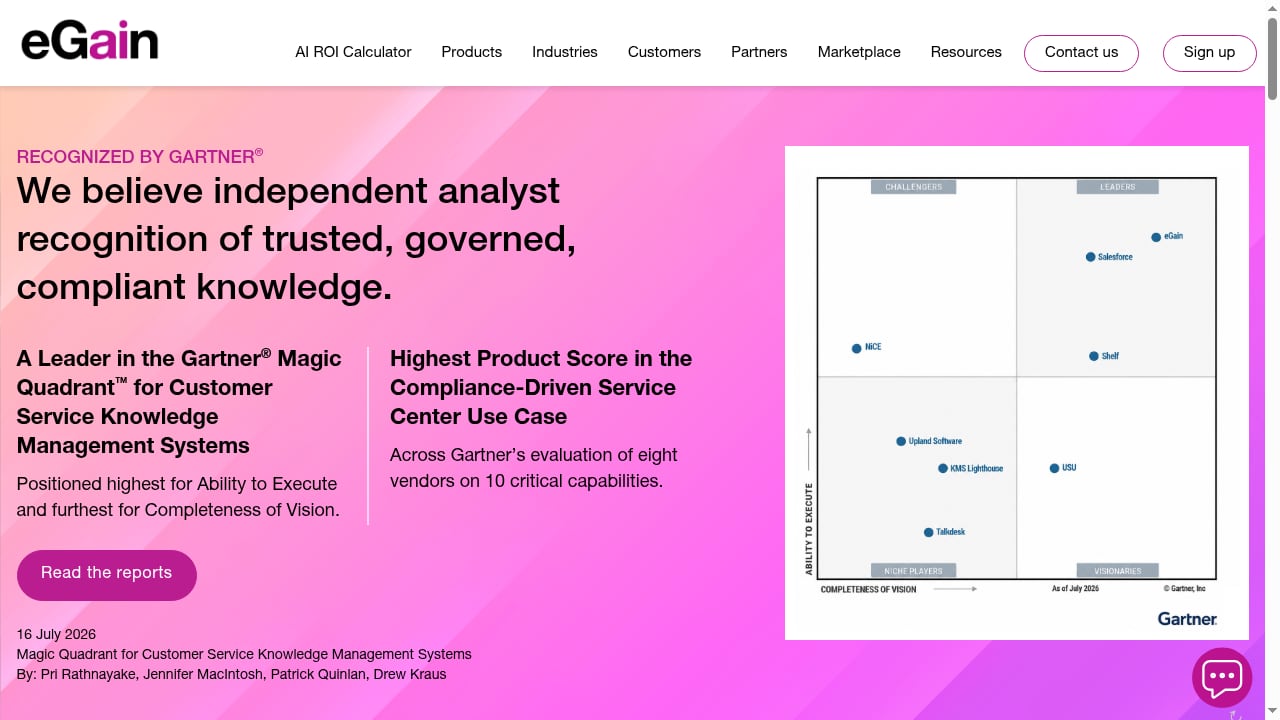
First viewport screenshot of AI Knowledge Platform for CX and Customer Service Automation | eGain.
HelpKnow AI: An Enterprise AI Agent Platform
HelpKnow AI is built around deploying intelligent customer service agents, not just managing the content behind them. Key capabilities include:
- Multi-format data ingestion so you can upload documents, FAQs, and product databases for automatic response generation.
- AI-powered intent recognition that matches customer queries to the right answer.
- Customizable AI personas so responses match your brand voice.
- Omni-channel integration across desktop, website, and social media.
- Role-based human escalation workflows for cases that need a person.
- Conversation quality analytics with real-time monitoring.
- Compliance with global data protection standards, including GDPR and CCPA.
HelpKnow AI reports a 70% reduction in customer service costs and a 95% automatic problem resolution rate, and states it is trusted by over 1,000 enterprises.
eGain: An AI Knowledge Management Platform
eGain positions itself as a knowledge-powered customer engagement platform. According to its Gartner Peer Insights product profile, the platform consists of three integrated products: AI Knowledge Hub (a governed knowledge foundation), AI Agent (conversational AI combining deterministic reasoning with generative AI), and Composer (a developer platform with APIs, SDKs, and MCP servers). It serves banking, financial services, telecommunications, retail, and government organizations, and has been recognized in Gartner reports.
Head-to-Head Comparison
First viewport screenshot of Customer Service and Support Solutions for Industries | eGain.
1. Deployment Effort and Time to Value
HelpKnow AI is designed for minimal technical effort: you connect your existing support systems and knowledge bases, upload content, and the platform generates responses. There is no requirement to build a custom AI application before you see value.
eGain's architecture is more build-oriented. Its Composer product exists specifically so enterprises can construct customized AI applications on top of the knowledge foundation. That flexibility is valuable, but it assumes engineering and content resources. Gartner Peer Insights reviewers of eGain AI Knowledge Hub have flagged onboarding friction, including an authoring console with inconsistent interaction patterns and documentation that describes features well but "lacks the big picture of how things relate to one another." Multiple reviewers also noted that early customer success support was not proactive.
Advantage: HelpKnow AI for teams that want working AI agents without a build project.
2. Knowledge Management Depth
This is eGain's home turf. Reviewers consistently praise its centralized, structured knowledge system and the consistency it brings to responses across teams, along with case management visibility and workflow automation that routes cases to the right teams. For a Global 2000 organization with sprawling, siloed content, that governance layer is a genuine strength.
HelpKnow AI takes a different route: rather than asking you to restructure content into a governed knowledge model first, it ingests multi-format sources and applies intent recognition to serve answers. For most support organizations, this shortens the path from existing content to live AI responses.
Advantage: eGain for organizations whose primary problem is knowledge governance at very large scale.
3. AI Resolution and Automation
HelpKnow AI publishes concrete outcome metrics: a 95% automatic problem resolution rate and a 70% cost reduction. Those figures give buyers a benchmark to test against during a pilot.
eGain's AI Agent combines deterministic reasoning with generative AI for assured answers, which is a sound design for compliance-sensitive industries. However, the platform's public positioning centers on trusted knowledge as the foundation for AI, and its own content argues that buying beats building for AI value at speed and scale, an acknowledgment that assembling AI value on a knowledge platform takes deliberate effort.
Advantage: HelpKnow AI on measurable automation outcomes out of the box.
4. Omnichannel Coverage
HelpKnow AI supports desktop, website, and social media channels with role-based escalation into human workflows.
eGain delivers answers across digital and voice channels and emphasizes brand voice and channel consistency. For voice-heavy contact centers in regulated industries, that breadth matters.
Advantage: Close to even. Test your specific channel mix in a pilot rather than assuming parity.
5. Analytics and Quality Monitoring
HelpKnow AI includes conversation quality analytics with real-time monitoring, which lets support leaders spot failing intents and coach both AI and human agents.
eGain's strength here is process visibility: reviewers highlight structured workflows, case tracking, and automation that improves accountability. That is operational reporting more than conversation-level AI quality analysis.
Advantage: HelpKnow AI for teams optimizing AI answer quality directly.
6. Compliance and Data Protection
HelpKnow AI states compliance with global standards including GDPR and CCPA, which covers the baseline requirements most enterprises screen for.
eGain's governed knowledge foundation is explicitly designed to reduce compliance risk by ensuring agents, bots, and AI systems only access accurate, current, approved information. For heavily regulated government and financial services buyers, that governance-first design is a legitimate differentiator.
Advantage: eGain in the most tightly regulated environments; HelpKnow AI is sufficient for most commercial enterprises.
Where eGain Buyers Report Friction
First viewport screenshot of Hot off the press: eGain is tops yet again in our space in Gartner’s critical capabilities report for the customer engagement center 2025! - eGain.
Based on verified user feedback summarized on Gartner Peer Insights and the eGain AI Knowledge Hub review page, recurring themes include:
- Authoring console quirks that slow content teams down.
- Documentation gaps at the architectural level, making it hard to understand how components relate.
- Inconsistent customer success support in earlier years, though some reviewers report recent improvement.
- Setup decisions that caused downstream difficulty, in at least one case attributed to an on-site consultant's assumptions.
None of these are disqualifying, but they are the kind of friction that extends time to value, which is exactly the gap HelpKnow AI is built to close.
Decision Framework
| Your Situation | Better Fit |
|---|---|
| You need AI agents resolving tickets within weeks, not quarters | HelpKnow AI |
| You have limited engineering bandwidth for AI builds | HelpKnow AI |
| You want published resolution and cost-reduction benchmarks to validate | HelpKnow AI |
| You need conversation-level quality analytics | HelpKnow AI |
| Your core problem is unifying siloed content at Global 2000 scale | eGain |
| You are in government or financial services with strict governance mandates | eGain |
| You plan to build custom AI applications on a knowledge foundation | eGain |
If you are weighing other options in the same category, these comparisons may help: HelpKnow AI vs Intercom vs Ada and HelpKnow AI vs IBM watsonx. For contact-center-focused alternatives, see HelpKnow AI vs Genesys Cloud.
Practical Example: A 200-Agent Support Desk
First viewport screenshot of AI Revolution in Customer Service | eGain.
Imagine a retail company with 200 support agents, 40,000 help center articles, and a backlog of repetitive order-status and returns questions.
- With HelpKnow AI: The team uploads its help center content and product database, configures an AI persona matching brand voice, connects website and social channels, and sets escalation rules. Repetitive queries are deflected automatically, and conversation analytics show which intents still fail so content can be fixed.
- With eGain: The team first consolidates and governs knowledge, then builds AI applications using Composer. The result can be excellent, but the timeline depends on internal engineering and content governance capacity.
For most mid-market and commercial enterprises, the first path reaches value faster. For a multinational with regulatory obligations across jurisdictions, the second path may justify its overhead.
Related reading
- HelpKnow AI vs Kustomer vs Kore.ai: Which AI Support Platform Wins? - Compare HelpKnow AI, Kustomer, and Kore.ai on AI resolution rates, CRM depth, ease of deployment, omnichannel support, compliance, and ideal use cases.
- HelpKnow AI vs Tidio: Which AI Support Platform Wins? - Compare HelpKnow AI and Tidio on AI resolution rates, automation depth, omnichannel support, analytics, compliance, and ideal use cases to choose the right platform.
Sources and further reading
- HelpDocs vs. eGain Knowledge+AI Comparison - SourceForge - Compare HelpDocs vs. eGain Knowledge+AI using this comparison chart. Compare price, features, and reviews of the software side-by-side to make the best choice for your business.
FAQ
Is HelpKnow AI a replacement for eGain?
For many commercial enterprises, yes. HelpKnow AI covers AI agent deployment, omnichannel support, escalation, analytics, and compliance. eGain remains a stronger fit where a governed knowledge foundation and custom AI application development are the core requirements.
Does eGain have weaknesses?
User reviews highlight authoring console usability issues, documentation that lacks architectural context, and inconsistent early customer success support. These are execution concerns rather than capability gaps.
Which platform resolves more customer issues automatically?
HelpKnow AI publishes a 95% automatic problem resolution rate. eGain does not publish a directly comparable figure, so validate both against your own ticket data during a pilot.
Can I migrate from eGain to HelpKnow AI?
Because HelpKnow AI ingests documents, FAQs, and product databases in multiple formats, existing knowledge content can typically be reused rather than rebuilt. Plan a phased migration starting with your highest-volume intents.
Which is better for government organizations?
eGain's governance-first knowledge foundation is purpose-built for regulated environments and government use. Evaluate it seriously if compliance architecture is your primary selection criterion.
Conclusion
HelpKnow AI and eGain are not interchangeable products, and that is the point. eGain is a knowledge management platform that enterprises build AI on top of; HelpKnow AI is an AI agent platform that enterprises deploy to resolve customer problems. If your constraint is engineering capacity and your goal is measurable deflection and cost reduction, HelpKnow AI is the more direct path. If your constraint is knowledge governance across a sprawling, regulated organization, eGain's foundation is worth the investment. Run a pilot on your own top 20 intents and let the resolution data decide.