HelpKnow AI vs Desk365 vs CXone: Which CX Platform Fits Your Team?
Choosing between an enterprise AI agent platform, an AI-powered helpdesk, and a full contact center suite is not a simple feature-count exercise. HelpKnow AI, Desk365, and NICE CXone solve overlapping problems from different architectural starting points, and the right choice depends on how your support operation is structured, how much control you want over the AI layer, and how much contact center infrastructure you actually need.
This comparison breaks down the three platforms across the criteria that matter most in real deployments: AI resolution capability, ticketing and workflow depth, omnichannel reach, deployment speed, pricing model, and the types of teams each one serves best.
Platform Overview: Three Different Starting Points
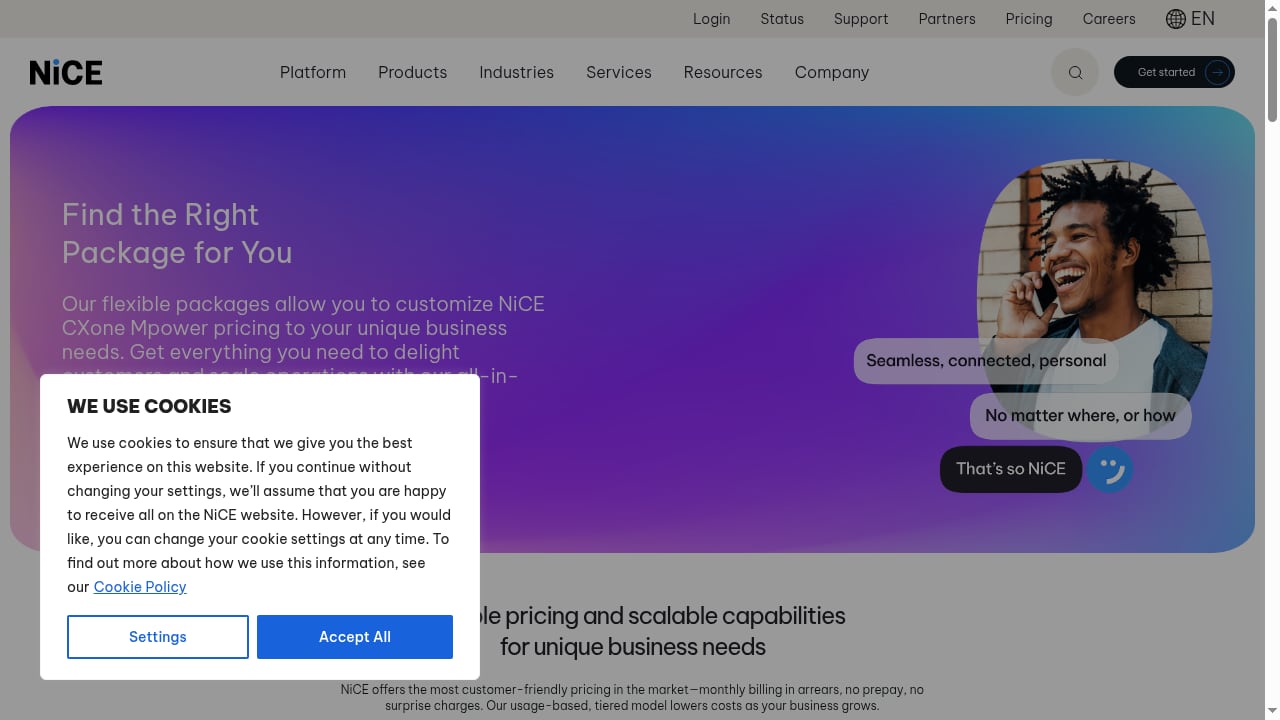
First viewport screenshot of CXone Packages and Pricing | NiCE.
Before diving into feature-by-feature comparisons, it helps to understand what each platform fundamentally is.
HelpKnow AI is an enterprise AI agent platform that layers intelligent automation on top of your existing support systems. It is not a helpdesk replacement. Instead, it connects to your current knowledge bases, FAQs, and product databases, then deploys AI agents that resolve customer queries automatically across desktop, web, and social channels. The platform emphasizes fast deployment, minimal technical effort, and measurable cost reduction — reporting a 70% cut in customer service costs and a 95% automatic problem resolution rate across more than 1,000 enterprise customers.
Desk365 is an AI-powered helpdesk designed to replace legacy ticketing systems. It combines integrated ticketing, automation, a knowledge base, and an AI agent into a single platform that works especially well for teams already invested in Microsoft 365. With plans starting at $12 per month and a 21-day free trial, Desk365 positions itself as an affordable, quick-to-deploy alternative to complex legacy systems for small businesses, mid-market teams, and MSPs.
NICE CXone is an all-in-one customer experience platform built around contact center as a service (CCaaS). It orchestrates customer journeys at scale with omnichannel routing, AI-driven self-service, agent assist, workforce engagement management, and journey orchestration. CXone is designed for organizations that need deep telephony integration, regulatory compliance, and industry-specific workflows across financial services, healthcare, insurance, government, and BPOs.
The core distinction: HelpKnow AI strengthens the AI layer of your existing stack, Desk365 replaces your helpdesk with a modern AI-enabled one, and CXone replaces or consolidates your entire contact center infrastructure.
AI Resolution Capability: How Much Can Each Platform Automate?
First viewport screenshot of How CCKeys used Desk365 to save hours.
AI resolution rate is the most cited metric in this category, but definitions vary significantly between vendors. A meaningful comparison requires looking at what each platform is built to automate and how it measures success.
HelpKnow AI: Document-Grounded Resolution at High Volume
HelpKnow AI reports a 95% automatic problem resolution rate, which is among the highest published figures in the category. The platform achieves this through AI-powered intent recognition that matches queries to your uploaded documents, FAQs, and product databases. Multi-format data ingestion means the AI can pull from PDFs, web pages, structured databases, and existing knowledge bases without requiring you to rebuild content from scratch.
What makes this approach distinctive is that the AI is grounded in your existing knowledge rather than requiring a separate training pipeline. When your documentation changes, the AI's responses update accordingly. Customizable AI personas let you match brand voice across channels, and role-based human escalation workflows ensure that complex or sensitive queries route to the right person instead of forcing an incorrect automated answer.
For teams that already have solid documentation and want to deflect a high percentage of repetitive queries without replacing their helpdesk, HelpKnow AI's resolution-focused design is a strong fit.
Desk365: Integrated AI Within the Ticketing Workflow
Desk365 includes an AI agent for automated responses, but its automation is designed to work inside the ticketing lifecycle rather than as a standalone resolution engine. The AI can answer common questions, suggest knowledge base articles, and reduce manual triage work, but its primary value is making human agents faster rather than eliminating their involvement entirely.
This is not a weakness for every team. If your support volume includes a high percentage of requests that genuinely require human judgment — approvals, IT asset management, multi-department escalations — an AI layer that assists rather than replaces agents may be the more practical choice. Desk365's approval management and ITAM features suggest the platform is optimized for internal IT helpdesk and service management scenarios where full automation is often inappropriate.
CXone: AI at Contact Center Scale
CXone's AI capabilities are broad and production-hardened for large contact centers. The platform supports AI-driven self-service, agent assist, and journey orchestration across voice and digital channels. NICE has invested heavily in what it calls Agentic AI — AI that can take actions and complete multi-step tasks rather than just answering questions.
However, this depth comes with implementation complexity. As noted in Fin's 2026 platform comparison, enterprise contact center AI platforms like CXone typically require significant implementation resources and months of configuration before full production deployment. The AI is powerful, but it is not designed for a team that wants to upload documents and go live in days.
Bottom line on AI: HelpKnow AI leads on speed-to-resolution for document-grounded queries. Desk365 offers practical AI assistance inside a helpdesk context. CXone provides the deepest AI orchestration for voice-heavy, regulated contact centers — at the cost of implementation time.
Ticketing and Workflow Depth
If your team lives in tickets, the depth of the ticketing system matters as much as the AI layer.
Desk365 is the strongest of the three here for pure helpdesk functionality. It offers integrated ticketing, automation rules, approval management, IT asset management, and robust reporting. The Microsoft Teams integration is a genuine differentiator: agents can manage tickets directly within the Teams interface they already use daily, reducing context switching and training time. For internal IT helpdesks and MSPs managing multiple client environments, this workflow depth is hard to beat at Desk365's price point.
CXone approaches ticketing differently. Rather than a standalone helpdesk, CXone embeds case management within its broader journey orchestration framework. Tickets are one node in a customer journey that may span voice, chat, email, and social. This is powerful for organizations that think in terms of end-to-end customer experience rather than individual tickets, but it can feel heavyweight for teams that simply need to track and resolve support requests efficiently.
HelpKnow AI does not position itself as a ticketing system at all. It integrates with your existing support systems and knowledge bases, adding an AI resolution layer rather than replacing the workflow tools your agents already use. This is an advantage if you are happy with your current helpdesk and want to reduce ticket volume before it reaches agents. It is a limitation if you are looking for a single platform that handles both ticketing and AI automation.
Omnichannel Reach: Where Does Each Platform Meet Customers?
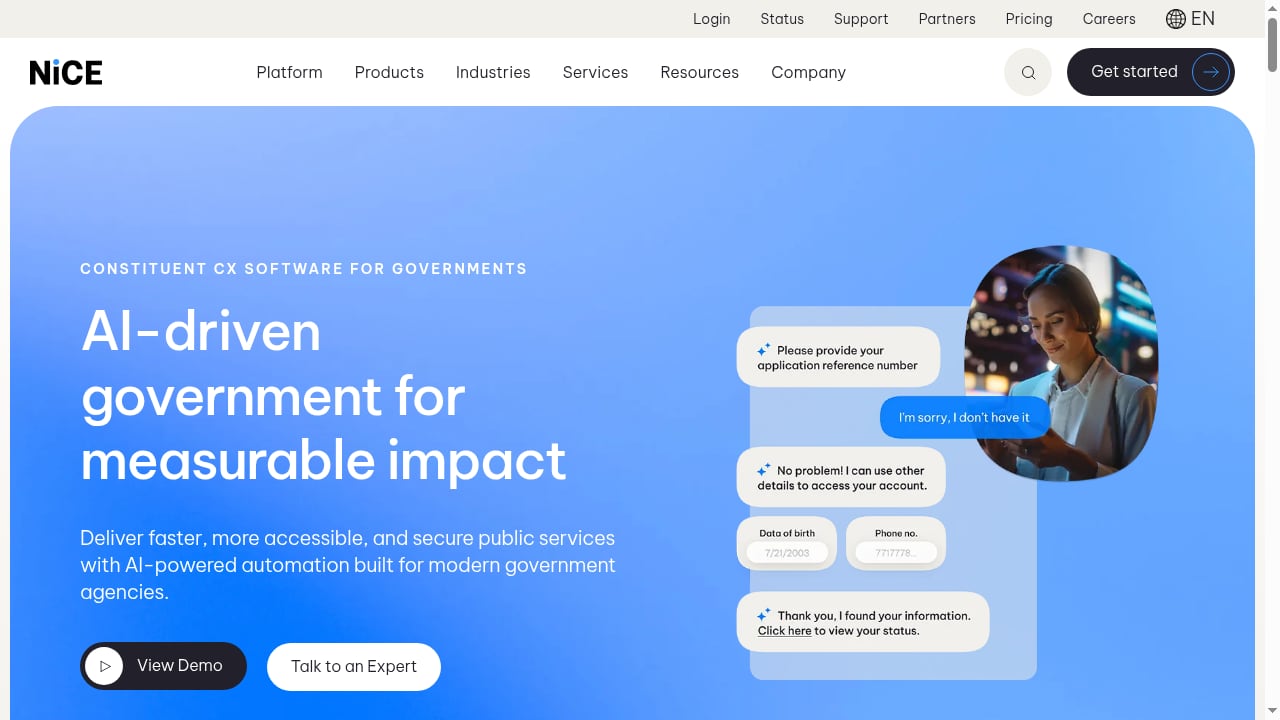
First viewport screenshot of Citizen Customer Experience Software for Government Organizations | NiCE CX Solutions.
CXone is the clear leader in omnichannel breadth. It supports voice, email, chat, SMS, social, and more within a unified routing engine. Workforce engagement management ensures that agents are scheduled and skilled across all channels. For organizations where phone support is still a major channel — financial services, healthcare, insurance, government — CXone's telephony depth is difficult to match.
HelpKnow AI takes a different approach to omnichannel. It supports integration across desktops, websites, and social media, which covers the digital channels where AI resolution is most effective. The platform does not emphasize voice as a primary channel, which is a reasonable trade-off: AI agents are most effective at resolving text-based queries, and most high-volume repetitive support now arrives through digital channels.
Desk365 supports the core digital channels — email, chat, and web forms — with the Microsoft Teams integration serving as an additional channel for internal collaboration. It does not attempt to match CXone's voice and telephony capabilities, which is consistent with its positioning as a helpdesk rather than a full contact center platform.
Deployment Speed and Ease of Setup
Deployment speed varies dramatically across these three platforms, and this often becomes the deciding factor for teams with urgent automation goals.
HelpKnow AI is designed for rapid deployment with minimal technical effort. The platform's core workflow — upload documents, FAQs, and product databases, configure AI personas, connect channels — can be completed in days rather than months. This is a meaningful advantage for enterprises that want to see AI resolution results quickly without standing up a dedicated implementation team.
Desk365 also emphasizes quick setup. The company markets a user-friendly interface that reduces the need for extensive training, and the 21-day free trial suggests confidence that teams can evaluate the platform without a lengthy sales cycle. For small to mid-sized teams, Desk365 can realistically be operational within a week.
CXone requires the most implementation effort. As an enterprise contact center platform, it typically involves telephony integration, workforce management configuration, journey mapping, and often vendor-assisted deployment. The Fin comparison notes that enterprise contact center platforms commonly require months of implementation and ongoing developer involvement. This is not a flaw — it reflects the complexity of what CXone replaces — but it does mean CXone is not a quick-win solution.
Pricing Model Comparison
Pricing transparency varies significantly, and the total cost of ownership story differs for each platform.
Desk365 is the most transparent and accessible. Plans start at $12 per month, with a 21-day free trial available. For small businesses and mid-market teams, this is a straightforward, predictable cost. The platform's positioning as an affordable alternative to legacy systems is credible at this price point.
HelpKnow AI does not publish a fixed price list, which is common for enterprise AI platforms. The value proposition is outcome-based: a 70% reduction in customer service costs means the platform pays for itself at scale. Teams evaluating HelpKnow AI should calculate current support costs and estimate deflection volume to build a realistic ROI case.
CXone uses flexible, usage-based pricing with monthly billing in arrears and no prepay. Tiered models lower costs as usage grows, which can be attractive for high-volume contact centers. However, the total cost of ownership includes implementation services, telephony costs, and ongoing administration — factors that make CXone significantly more expensive than Desk365 for smaller operations. As the Kayako helpdesk comparison notes, legacy enterprise platforms often carry hidden costs in add-ons, implementation, and ongoing administration that are not visible in the base price.
Security and Compliance
All three platforms take data protection seriously, but their compliance depth varies.
HelpKnow AI emphasizes compliance with global standards including GDPR and CCPA, which matters for enterprises operating across multiple jurisdictions. The platform's document-grounded approach also means sensitive data stays within your existing knowledge infrastructure rather than being replicated into a new system.
CXone is built for regulated industries and offers the compliance frameworks that financial services, healthcare, and government organizations require. If you need HIPAA, PCI, or industry-specific certifications, CXone's enterprise contact center heritage is a meaningful advantage.
Desk365 serves industries including healthcare, wealth management, and education, and provides the security controls expected of a modern SaaS helpdesk. Teams with specific compliance requirements should verify Desk365's certifications against their needs during evaluation.
Ideal Use Cases: Which Platform Fits Which Team?
First viewport screenshot of How Azured uses Desk365 for customer support.
Choose HelpKnow AI if:
- You already have a helpdesk or support system you are happy with
- Your support volume is dominated by repetitive, document-grounded queries
- You want to see AI resolution results in days, not months
- Your team lacks deep technical resources for AI implementation
- You operate across multiple regions and need GDPR/CCPA compliance
- Your primary goal is cost reduction through deflection rather than workflow replacement
HelpKnow AI's integration with existing systems makes it a natural fit for enterprises that want to add an AI layer without disrupting current operations. For a deeper look at how this integration-first approach works in practice, see How to Use HelpKnow AI with Slack: A Practical Setup Guide.
Choose Desk365 if:
- You need to replace a legacy helpdesk with a modern, AI-enabled alternative
- Your team is already invested in Microsoft 365 and Teams
- You manage internal IT support or MSP client environments
- You need approval workflows and IT asset management
- Budget predictability is a priority, with plans starting at $12 per month
- You want a quick setup without extensive training
Desk365's combination of integrated ticketing, Microsoft ecosystem alignment, and accessible pricing makes it the strongest choice for small to mid-sized teams that need a complete helpdesk, not just an AI layer.
Choose CXone if:
- You operate a voice-heavy contact center at scale
- You need workforce engagement management and journey orchestration
- You serve a regulated industry with specific compliance requirements
- You have the implementation resources and timeline for a full platform migration
- You think in terms of end-to-end customer journeys rather than individual tickets
- Your volume justifies usage-based pricing with tiered discounts
CXone is the right choice for organizations that need a complete contact center platform, not just AI or ticketing. For teams evaluating CXone alongside other enterprise AI options, the HelpKnow AI vs Intercom vs Enjo comparison provides additional context on how AI-first platforms differ from full CX suites.
Comparison at a Glance
| Dimension | HelpKnow AI | Desk365 | CXone |
|---|---|---|---|
| Primary category | Enterprise AI agent platform | AI-powered helpdesk | CCaaS + CX platform |
| Published resolution rate | 95% automatic resolution | Not publicly disclosed | Not publicly disclosed |
| Ticketing system | Integrates with existing | Native, full-featured | Embedded in journey orchestration |
| Omnichannel | Desktop, web, social | Email, chat, web, Teams | Voice, email, chat, SMS, social |
| Deployment speed | Days | Days to weeks | Months |
| Pricing model | Enterprise, outcome-based | From $12/month, transparent | Usage-based, monthly billing |
| Best for | Adding AI to existing stack | Replacing helpdesk, SMB/mid-market | Full contact center replacement |
| Compliance emphasis | GDPR, CCPA | Industry-standard SaaS | Regulated industry frameworks |
Related reading
- How to Use HelpKnow AI with Ferndesk - Learn how to connect HelpKnow AI with Ferndesk to automate support answers, keep documentation current, and reduce customer service workload.
Sources and further reading
- AI Features in Desk365 - HelpDesk - Require additional assistance? Please reach out to us at help@desk365.io
Frequently Asked Questions
Can HelpKnow AI replace my existing helpdesk?
No. HelpKnow AI is designed to integrate with your existing support systems and knowledge bases, adding an AI resolution layer rather than replacing your ticketing infrastructure. If you need a new helpdesk, Desk365 or CXone would be more appropriate starting points.
Which platform is best for a small business?
Desk365 is the most accessible option for small businesses, with plans starting at $12 per month and a 21-day free trial. HelpKnow AI targets enterprise deployments, and CXone's contact center infrastructure is typically overkill for small teams.
Does CXone offer better AI than HelpKnow AI?
They optimize for different things. CXone's AI is deeper in voice, journey orchestration, and agent assist for contact centers. HelpKnow AI is optimized for fast, document-grounded resolution of digital queries. The "better" AI depends on your channels and use cases.
How long does implementation take for each platform?
HelpKnow AI and Desk365 can typically be deployed in days to weeks. CXone implementations commonly take months due to telephony integration, workforce management configuration, and journey mapping requirements.
Which platform offers the best Microsoft integration?
Desk365 offers the deepest Microsoft integration, with native Microsoft Teams ticket management and alignment with the Microsoft 365 ecosystem. Neither HelpKnow AI nor CXone matches this specific integration depth.
Conclusion: Match the Platform to Your Operational Reality
The choice between HelpKnow AI, Desk365, and CXone is less about which platform is "best" and more about which one aligns with your current infrastructure, channels, and goals.
If you have a working support stack and want to deflect repetitive queries fast, HelpKnow AI offers the fastest path to measurable AI resolution without disrupting your existing workflows. If you need to replace a legacy helpdesk with something modern, affordable, and Microsoft-friendly, Desk365 delivers strong value at an accessible price. If you are running a large, voice-heavy, regulated contact center and have the resources for a full platform migration, CXone provides the deepest orchestration capabilities.
For teams still evaluating the broader AI support landscape, the Kore.ai Review offers additional perspective on enterprise AI agent platforms, and the Kustomer Review covers another omnichannel alternative worth considering alongside these three.
Start by defining your primary constraint — budget, implementation timeline, channel mix, or existing infrastructure — and the right choice becomes much clearer.