
Kore.ai Review 2026: A Deep Look at the Enterprise AI Agent Platform
Kore.ai positions itself as an enterprise-grade platform for building, deploying, and scaling AI agents that handle customer and employee interactions. Founded in 2013 and headquartered in Orlando, the company serves large organizations across banking, healthcare, HR, and IT. Its Artemis foundation provides an AI-programmable layer for creating autonomous agents that automate workflows, integrate with existing systems, and operate across multiple channels.
This review draws on verified user feedback from Gartner Peer Insights and G2, along with the platform's documented capabilities, to help you decide whether Kore.ai fits your organization.
What Is Kore.ai?
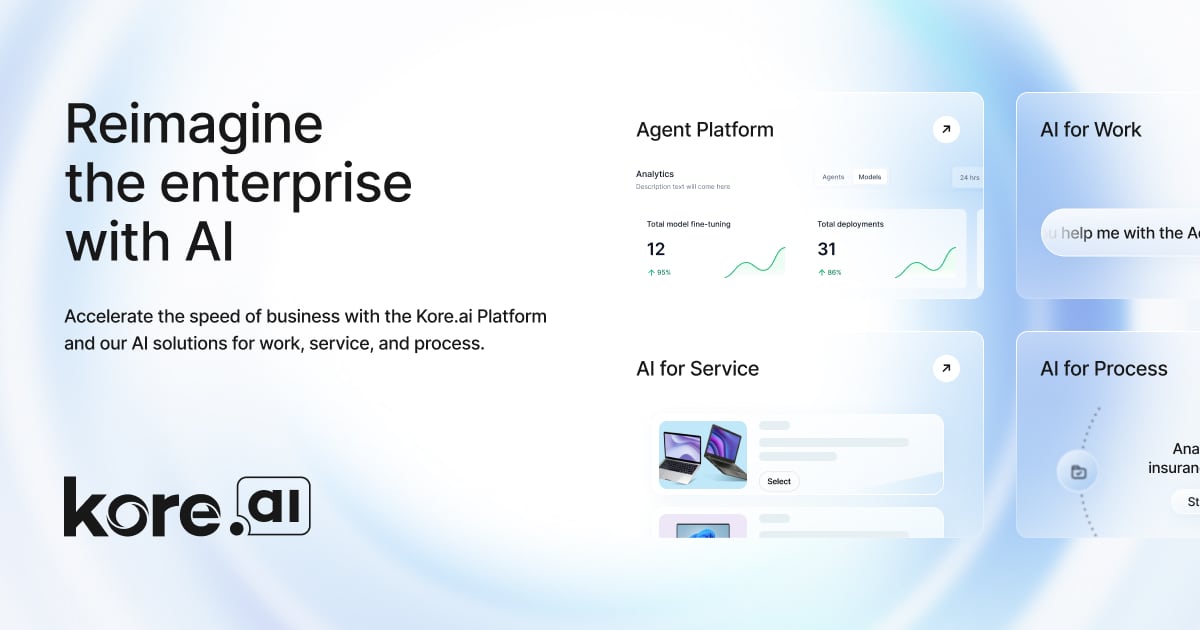
Kore.ai product interface.
Kore.ai is not a single chatbot tool. It is a full AI agent platform built on Artemis, its AI-programmable foundation. Organizations use it to design, train, deploy, and monitor conversational AI agents that can handle complex, multi-step interactions rather than simple FAQ responses.
The platform includes:
- Natural language understanding (NLU) for intent detection and entity extraction
- Dialog management for multi-turn conversations and context retention
- Pre-built industry applications for banking, healthcare, HR, and IT
- Integration marketplace with connectors to common enterprise systems
- No-code and pro-code tools for building custom agents
- Multi-channel deployment across web, mobile, voice, and messaging platforms
- Analytics and workflow automation for monitoring and optimization
Kore.ai emphasizes production-ready AI agents that are secure, scalable, and model-agnostic. That last point matters: the platform lets enterprises choose their preferred large language models, cloud providers, and data environments rather than locking them into a single stack.
Who Is Kore.ai For?
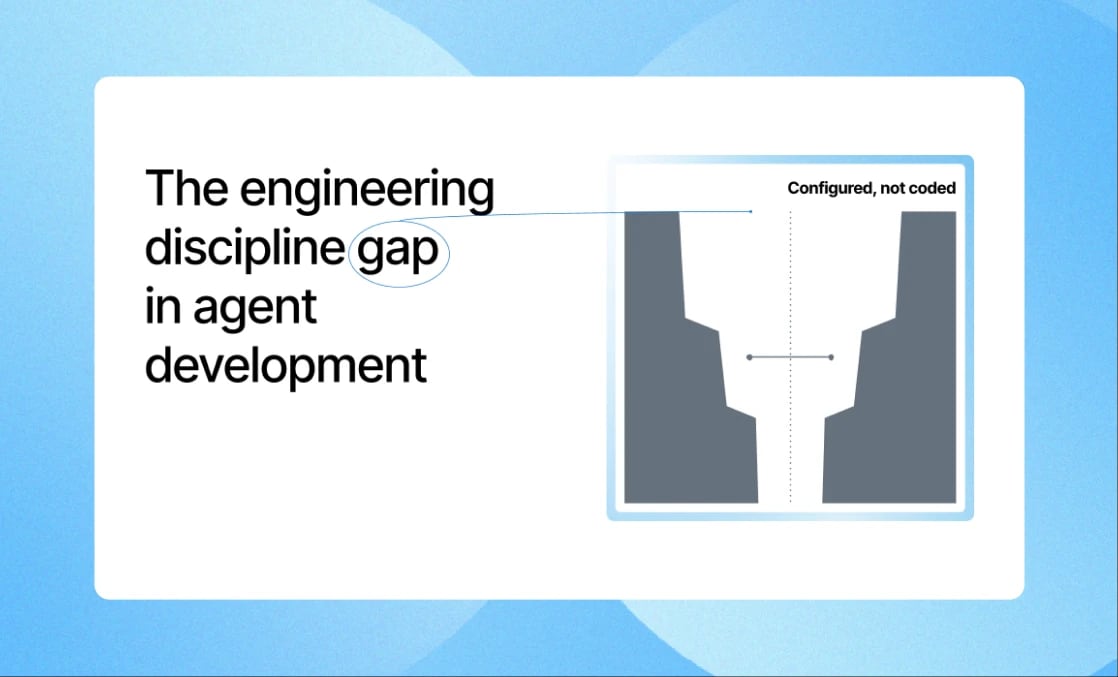
Configured, not coded. The engineering discipline gap in agent development.
Kore.ai targets mid-market and large enterprises that need more than a basic support chatbot. The ideal user profile includes:
- Enterprise IT and digital transformation teams building internal AI agents for employee self-service
- Customer experience leaders automating high-volume support interactions across channels
- Banking and financial services organizations that require strict security, compliance, and private deployment options
- Healthcare providers automating patient intake, appointment scheduling, and common inquiries
- HR departments deploying agents for onboarding, benefits questions, and policy lookups
- Development teams that want low-code speed without sacrificing custom scripting flexibility
Small businesses or teams looking for a simple plug-and-play chatbot will likely find Kore.ai overbuilt for their needs. The platform's strength is depth and enterprise control, not instant simplicity.
Key Strengths of Kore.ai
Kore.ai product interface.
1. Depth and Flexibility
Verified reviewers consistently highlight the platform's breadth. One Gartner Peer Insights reviewer noted that Kore.ai "has a high learning curve but has a multitude of possibilities that other providers simply lack." The platform overcomes a common developer objection to low-code systems by making custom scripts a native part of the workflow. Teams can build sophisticated solutions without sacrificing technical flexibility.
2. Strong Integration Ecosystem
Kore.ai offers a large marketplace of ready-to-configure integrations. This reduces the time required to connect agents to CRM systems, ticketing tools, HR platforms, and other enterprise software. For organizations with complex tech stacks, this is a significant advantage over platforms that require custom API work for every connection.
3. Enterprise-Grade Security and Deployment Options
Kore.ai supports private instance deployments, which matters for regulated industries. Organizations can run the platform in their own environment rather than relying solely on a shared SaaS instance. The company's model-agnostic approach also extends to data and cloud choices, giving enterprises flexibility in how and where their AI agents operate.
4. Supportive Partnership Approach
Multiple reviewers describe Kore.ai's team as responsive and genuinely invested in customer success. One software development manager wrote that the Kore.ai team "operates as a genuine extension of our own team," balancing enterprise power with a people-first approach. For large deployments, this level of vendor partnership can be as important as the technology itself.
5. Pre-Built Industry Solutions
Kore.ai offers pre-built applications for common enterprise use cases. This accelerates deployment for organizations that need proven starting points rather than building every agent from scratch. Banking, healthcare, HR, and IT teams can adapt these templates to their specific workflows.
Limitations and Considerations
1. Steep Learning Curve
The platform's power comes with complexity. Reviewers acknowledge that Kore.ai requires meaningful onboarding and training. Teams without dedicated technical resources may struggle to realize the platform's full potential quickly.
2. Private Instance Update Lag
One critical review highlighted a real trade-off: private instance deployments may lag behind the SaaS version in feature updates. A product manager at a large financial services company reported needing to open multiple tickets to resolve bugs in newer GenAI capabilities, noting that their private instance was "always a few versions behind." This is not unique to Kore.ai, but it is a factor to weigh when choosing deployment models.
3. Pricing Is Enterprise-Tier
Kore.ai does not publish transparent pricing. G2 reviewers note that pricing "is not the cheapest, but considering the features, scalability, and enterprise support, it provides good value." Organizations should expect enterprise-level pricing and budget accordingly. Smaller teams may find the cost difficult to justify.
4. Implementation Time
Given the platform's depth, implementation is not a weekend project. Enterprises should plan for a phased rollout, starting with a defined use case and expanding from there. Working with Kore.ai's professional services or a certified partner can accelerate this process.
Pricing Signals
Kore.ai uses a quote-based pricing model. While exact figures are not public, several signals help set expectations:
- Enterprise positioning: Kore.ai targets large organizations with complex needs, and pricing reflects that positioning.
- Deployment model matters: SaaS deployments typically have different cost structures than private instances. Private deployments often carry higher infrastructure and support costs.
- Feature tiers: The platform's capabilities span basic chatbot functionality to advanced agentic AI. Expect pricing to scale with the features and usage levels you require.
- Professional services: Implementation, training, and ongoing optimization support may be separate line items.
For accurate pricing, organizations should request a quote and clearly define their use cases, expected interaction volumes, deployment model, and integration requirements.
Setup and Implementation
Deploying Kore.ai typically follows this path:
- Use case definition: Identify the specific workflows or interactions you want to automate. Starting with a narrow, high-value use case is more effective than trying to automate everything at once.
- Environment setup: Choose between SaaS and private instance deployment based on security, compliance, and infrastructure requirements.
- Integration configuration: Connect Kore.ai to your existing systems using the integration marketplace or custom APIs.
- Agent building: Use the no-code tools for standard flows and custom scripting for complex logic. Pre-built industry applications can serve as starting points.
- Testing and refinement: Run the agent through real-world scenarios, refine intents and dialog flows, and validate integration behavior.
- Deployment and monitoring: Launch across your chosen channels and use the platform's analytics to track performance and identify improvement opportunities.
Organizations with dedicated AI or automation teams will move faster. Teams relying entirely on non-technical staff should plan for additional training or partner support.
Kore.ai vs. Alternatives
Kore.ai product interface.
When evaluating Kore.ai, consider how it compares to other enterprise AI platforms:
| Factor | Kore.ai | Typical Enterprise Chatbot Platforms | Niche AI Support Tools |
|---|---|---|---|
| Depth of customization | High | Medium | Low to medium |
| Learning curve | Steep | Moderate | Low |
| Industry pre-built solutions | Strong | Varies | Limited |
| Private deployment | Yes | Sometimes | Rarely |
| Pricing | Enterprise-tier | Varies | Lower |
| Best for | Complex, regulated enterprise use cases | General enterprise automation | Focused support automation |
If your primary need is AI-powered customer support with fast setup and lower complexity, a focused platform like HelpKnow AI may be a better fit. Kore.ai earns its place when you need deep customization, industry-specific solutions, private deployment, and the ability to build agents that go well beyond support into workflow automation.
For teams comparing enterprise options, understanding how Kore.ai stacks up against platforms like IBM watsonx can clarify whether you need a full AI development platform or a more focused solution.
Decision Criteria: Should You Choose Kore.ai?
Choose Kore.ai if:
- You are a mid-market or large enterprise with complex automation needs
- You require private deployment for security or compliance reasons
- You want pre-built solutions for banking, healthcare, HR, or IT
- Your team has technical resources or budget for implementation support
- You need deep integration with existing enterprise systems
- You value a vendor partnership over a purely self-serve tool
Look elsewhere if:
- You need a simple chatbot live in days, not months
- Your budget is limited to SMB-level pricing
- Your use case is primarily customer support with standard workflows
- You lack technical resources and cannot invest in training or services
- You want transparent, self-serve pricing
Related reading
- How to Use HelpKnow AI with Ferndesk - Learn how to connect HelpKnow AI with Ferndesk to automate support answers, keep documentation current, and reduce customer service workload.
- HelpKnow AI vs Intercom vs Enjo: Which AI Support Platform Fits? - Compare HelpKnow AI, Intercom, and Enjo on AI resolution, integrations, pricing, analytics, and ideal use cases to choose the right customer service platform.
- HelpKnow AI vs Crescendo: Which CX Platform Fits You? - Compare HelpKnow AI and Crescendo on AI resolution, integrations, deployment speed, analytics, compliance, and ideal use cases to choose the right CX platform.
Sources and further reading
- Anyone used Kore.ai for agent assistance in banking? Does ... - Reddit - Apr 1, 2026 ... We have onboarded kore's 'AI for IT'. It's an agentic app that you can tweak however you like. Now I don't know the exact pricing, but bosses ...
Frequently Asked Questions
Is Kore.ai a chatbot platform or an AI agent platform?
Kore.ai is an AI agent platform. While it can build chatbots, its core strength is creating autonomous agents that handle multi-step workflows, integrate with enterprise systems, and operate across channels. The Artemis foundation enables more sophisticated, agentic behavior than traditional rule-based chatbots.
How much does Kore.ai cost?
Kore.ai does not publish pricing. Costs are quote-based and depend on deployment model, feature requirements, usage volumes, and professional services. G2 reviewers describe pricing as enterprise-tier but reasonable for the capabilities offered.
Does Kore.ai support private deployment?
Yes. Kore.ai supports private instance deployments for organizations with strict security or compliance requirements. However, reviewers note that private instances may receive feature updates more slowly than the SaaS version.
What industries does Kore.ai serve?
Kore.ai offers pre-built solutions for banking, healthcare, HR, and IT, among others. The platform is designed for regulated industries that need secure, scalable AI agents with deep integration capabilities.
How long does Kore.ai implementation take?
Implementation timelines vary based on use case complexity, integration requirements, and team resources. Enterprises should plan for a phased rollout rather than expecting immediate production deployment. Starting with a single, well-defined use case is the most effective approach.
Is Kore.ai suitable for small businesses?
Generally, no. Kore.ai's depth, pricing, and learning curve make it better suited for mid-market and enterprise organizations. Small businesses with straightforward support needs will likely find simpler, more affordable alternatives.
Final Verdict
Kore.ai is a powerful, enterprise-focused AI agent platform that delivers genuine depth for organizations willing to invest in it. Its strengths—customization flexibility, integration breadth, private deployment options, and pre-built industry solutions—make it a strong contender for regulated industries and complex automation initiatives.
The trade-offs are real: a steep learning curve, enterprise pricing, and potential update lag for private instances. But for organizations that need more than a basic chatbot and have the resources to support a serious AI initiative, Kore.ai offers capabilities that many competitors simply do not match.
If you are evaluating AI platforms for customer support specifically, compare Kore.ai against focused alternatives to ensure you are not paying for enterprise depth you will not use. For broader automation across customer and employee experiences, Kore.ai deserves a place on your shortlist.
For more context on how different AI platforms compare, see our analysis of HelpKnow AI vs Intercom vs Enjo or read our Wonderchat review for a look at a more focused AI support tool.
Sources: Gartner Peer Insights – Kore.ai Artemis Reviews, G2 – Kore.ai Reviews