
CCSI Review 2026: Nearshore Contact Center Services and AI Automation, Evaluated
Choosing a contact center partner is rarely a simple cost decision. You are weighing labor arbitrage against service quality, cultural fit against operational control, and human agents against AI automation. Call Center Services International (CCSI) sits at the intersection of all three tensions. This review examines what CCSI actually delivers, who benefits most, where the model creates friction, and how to decide if it fits your customer experience strategy.
What Is CCSI?
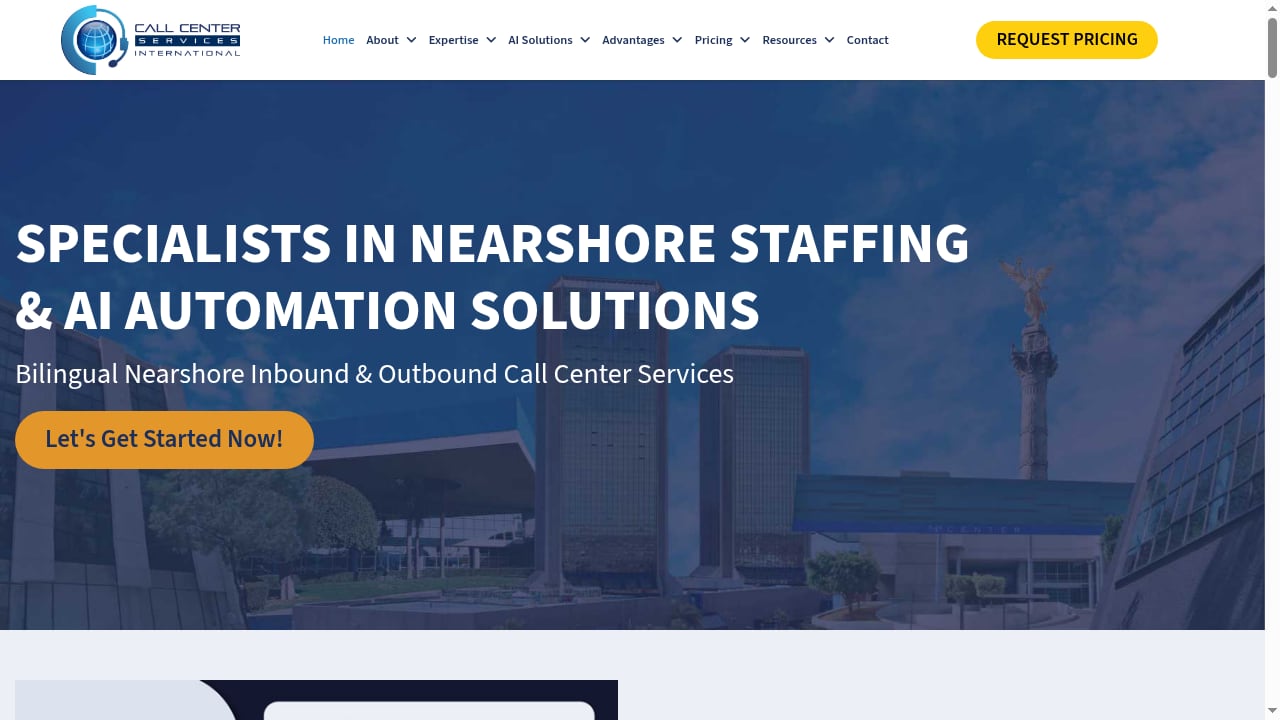
First viewport screenshot of Call Center Services International, Nearshore contact and development center in mexico..
CCSI is a nearshore contact center and AI automation provider headquartered in Mexico. The company delivers bilingual English/Spanish inbound and outbound call center services, positioning itself as a cost-effective alternative to U.S.-based centers without sacrificing cultural alignment or professional service standards.
The core value proposition is straightforward: businesses can reduce labor and operational costs by up to 50% compared to domestic centers while maintaining high-touch, culturally aligned customer interactions. But CCSI has evolved beyond traditional staffing. The provider now layers AI-powered solutions on top of its human workforce, including generative AI voice and text virtual agents, intelligent document processing, and compliance-focused QA automation.
This hybrid approach—human talent plus AI automation—is what makes CCSI worth a closer look in 2026, especially for companies that need bilingual support but are wary of fully automated customer service.
Who CCSI Is Best For
First viewport screenshot of Generative AI Voice & Text Agents | CCSI.
CCSI is not a one-size-fits-all vendor. The model works best for specific profiles:
- Mid-market and enterprise companies with bilingual customer bases. If a meaningful share of your customers prefer Spanish-language support, a Mexico-based nearshore team offers native fluency that domestic bilingual hiring often struggles to match at scale.
- Organizations seeking 30–50% cost reduction without offshore risks. Nearshore Mexico avoids many pain points associated with offshore destinations: time zone misalignment, cultural distance, and accent-related friction.
- Companies that want AI automation without abandoning human oversight. CCSI's virtual agents handle routine queries, but escalation paths to live agents remain intact—useful for regulated industries or complex products.
- Businesses with seasonal or fluctuating call volume. The turnkey model allows rapid scaling without capital investment in infrastructure or long-term hiring commitments.
- Teams that need compliance monitoring at scale. The QA and compliance AI agents provide continuous monitoring that would be prohibitively expensive to staff manually.
CCSI Engagement Models Explained
First viewport screenshot of Generative AI Voice & Text Agents | CCSI.
CCSI offers two distinct paths, and the choice between them shapes everything from cost structure to operational control.
Turnkey Program
The turnkey model is designed for rapid deployment. CCSI handles facility, technology, recruiting, training, and management. You provide the brand guidelines, product knowledge, and escalation protocols; CCSI delivers a functioning contact center team.
Advantages:
- Minimal capital investment
- Reduced legal exposure in Mexico
- Fast launch timelines
- Predictable per-agent or per-hour pricing
Limitations:
- Less direct control over hiring and culture
- Shared or semi-dedicated team structures in some configurations
- Dependency on CCSI's management quality
Corporate Advantage Program
This model is for organizations that want full ownership and customization of a dedicated contact center. CCSI helps establish the operation, but the client retains ownership, branding, and direct control over staffing and processes.
Advantages:
- Complete operational control
- Fully dedicated facility and team
- Custom technology stack integration
- Stronger brand continuity
Limitations:
- Higher upfront investment
- Longer setup timeline
- Greater legal and administrative responsibility in Mexico
- Requires internal management bandwidth
The decision between these models often comes down to a simple question: do you want a partner or a build-operate-transfer arrangement? The turnkey program favors speed and simplicity; the Corporate Advantage Program favors control and long-term ownership.
AI Automation Capabilities
First viewport screenshot of AI-Powered Call Center Solutions | CCSI.
CCSI's AI layer is the most significant differentiator from traditional nearshore BPOs. Four capabilities stand out:
Generative AI Voice and Text Virtual Agents
These agents provide 24/7 customer engagement across voice and text channels. Unlike rule-based IVR systems, generative AI agents can handle natural language, context switching, and multi-turn conversations. They are best suited for high-volume, low-complexity interactions: order status, appointment scheduling, FAQs, and account inquiries.
Integrated Payment Platform
Secure payment processing within the contact center environment reduces PCI compliance burden and eliminates the awkward "let me transfer you to a payment system" moment. This is particularly valuable for ecommerce and subscription businesses.
Intelligent Document Processing
Automated data extraction from documents—invoices, claims, applications, identity documents—reduces manual data entry and improves accuracy. For insurance, healthcare, and financial services clients, this capability can meaningfully reduce processing times.
QA & Compliance AI Agents
Continuous monitoring of agent interactions for quality, compliance, and sentiment. This replaces sampling-based QA with full-coverage monitoring, which is a significant upgrade for regulated industries.
Strengths of the CCSI Model
Cultural alignment is a genuine advantage. Mexican nearshore agents share North American cultural references, time zones, and consumer expectations more closely than offshore alternatives. For U.S. businesses, this reduces the customer friction often associated with overseas support.
Bilingual fluency is native, not learned. English/Spanish bilingualism in Mexico is not an acquired skill bolted onto a monolingual workforce. Many agents are natively bilingual or highly proficient, which matters for nuanced customer conversations.
The hybrid human-AI approach is pragmatic. Pure AI platforms often overpromise resolution rates. CCSI's model acknowledges that complex, emotional, or high-stakes interactions still require human empathy—and builds AI around that reality rather than replacing it wholesale.
Cost savings are substantial and defensible. The 50% figure is achievable for certain roles and volumes, though actual savings depend on program complexity, required skill levels, and the engagement model chosen.
Limitations and Risks to Consider
Pricing transparency is limited. CCSI does not publish standard rates. Pricing depends on program scope, agent skill requirements, technology needs, and contract length. You will need a discovery call and proposal process to get concrete numbers.
The turnkey model creates dependency. If you choose the turnkey path, you are relying on CCSI's management quality, hiring practices, and technology uptime. Due diligence on their current client outcomes is essential.
AI capabilities are still maturing. While CCSI's AI offerings are credible, they are not as battle-tested as dedicated AI platforms from vendors like CXone or Talkdesk. If AI-first automation is your primary goal, a pure-play AI platform may be a better fit.
Not ideal for highly specialized or technical support. If your product requires deep technical expertise—enterprise software, complex financial products, specialized medical knowledge—the training burden may erode the cost advantage.
Setup and Implementation Timeline
CCSI does not publish standardized implementation timelines, but based on the model structure, realistic expectations are:
- Turnkey Program: 4–8 weeks for basic inbound programs; 8–12 weeks for complex or regulated programs requiring extensive training and compliance certification.
- Corporate Advantage Program: 3–6 months, depending on facility requirements, legal structuring, and technology integration.
Key setup considerations include knowledge base development, CRM and telephony integration, compliance training, and AI agent configuration. Companies with well-documented processes and existing knowledge bases will onboard faster.
Pricing Signals
While CCSI does not publish pricing, the nearshore BPO market provides useful benchmarks:
- Entry-level bilingual agents: $12–$18 per hour fully loaded
- Specialized or technical agents: $18–$28 per hour
- AI virtual agent interactions: Often priced per resolved interaction or per minute, typically 60–80% below human agent cost
- Setup fees: Vary widely; turnkey programs may include setup in the per-agent rate, while Corporate Advantage programs involve separate infrastructure investment
Compared to U.S.-based centers charging $25–$40 per hour for comparable bilingual talent, the savings are real. Compared to offshore destinations at $6–$10 per hour, CCSI is more expensive—but the cultural and time zone advantages often justify the premium.
CCSI vs. Alternatives
| Factor | CCSI | Offshore BPO (Philippines/India) | U.S. Domestic Center | Pure AI Platform |
|---|---|---|---|---|
| Cost per agent hour | $12–$28 | $6–$12 | $25–$40 | Variable |
| Cultural alignment | High | Moderate to low | High | N/A |
| Bilingual English/Spanish | Native | Limited | Variable | Depends on model |
| AI automation depth | Moderate | Low | Moderate | High |
| Setup speed | Fast (turnkey) | Moderate | Slow | Fast |
| Control level | Moderate to high | Low | High | High |
If your priority is maximum automation with minimal human staffing, platforms like Retell AI or Ferndesk may be more relevant. If you need human agents with strong bilingual capabilities and cultural alignment, CCSI's nearshore model is compelling.
Decision Criteria: Is CCSI Right for You?
Choose CCSI if:
- You need bilingual English/Spanish support at scale
- Cost reduction of 30–50% is a strategic priority
- You want human agents augmented by AI, not replaced by it
- Nearshore time zone alignment matters for your customer base
- You value cultural alignment over maximum cost savings
Look elsewhere if:
- Your primary goal is full AI automation with minimal human staffing
- You need maximum cost savings and are willing to accept offshore trade-offs
- Your support requirements are highly technical or specialized
- You need transparent, published pricing before engaging
- You require complete in-house control over all operations
Related reading
- HelpKnow AI vs CoSupport AI vs Gumloop: Which AI Fits? - Compare HelpKnow AI, CoSupport AI, and Gumloop on setup, AI resolution, integrations, analytics, compliance, and pricing to choose the right support AI.
Sources and further reading
- Working at Coordinated Care Services, Inc: 31 Reviews - Indeed - Nov 27, 2025 ... Report review; Copy link. February 19, 2022. CCSI is a great place to work. The organization tries hard to be open, communicate to employees ...
- CCSI Reviews (65): Pros & Cons of Working At CCSI - 65 CCSI reviews. A free inside look at company reviews and salaries posted anonymously by employees.
- CCSI (Coordinated Care Services) Reviews (49) - Glassdoor - Ratings by category ... CCSI (Coordinated Care Services) has an employee rating of 2.7 out of 5 stars, based on 49 company reviews on Glassdoor which indicates ...
Frequently Asked Questions
What does CCSI stand for?
CCSI stands for Call Center Services International. The company is based in Mexico and provides nearshore contact center and AI automation solutions.
How much can I save with CCSI compared to a U.S.-based center?
CCSI positions savings at up to 50% compared to U.S.-based centers. Actual savings depend on agent skill requirements, program complexity, and the engagement model selected. Typical bilingual agent rates range from $12–$28 per hour fully loaded.
Does CCSI offer both English and Spanish support?
Yes. CCSI provides bilingual English/Spanish inbound and outbound call center services. This is a core differentiator, as agents are natively bilingual or highly proficient rather than trained in a second language.
What is the difference between the Turnkey Program and Corporate Advantage Program?
The Turnkey Program is a rapid-deployment model where CCSI manages facility, technology, recruiting, and operations. The Corporate Advantage Program gives the client full ownership and customization of a dedicated contact center, with CCSI assisting in establishment and ongoing support.
Does CCSI offer AI-powered customer service?
Yes. CCSI offers generative AI voice and text virtual agents, an integrated payment platform, intelligent document processing, and QA and compliance AI agents. These capabilities work alongside human agents rather than replacing them entirely.
How long does it take to set up a CCSI contact center?
Turnkey programs typically launch in 4–12 weeks depending on complexity. Corporate Advantage programs generally require 3–6 months due to facility, legal, and technology setup requirements.
Conclusion
CCSI occupies a distinctive position in the contact center market: a nearshore BPO with genuine bilingual capabilities, meaningful cost savings, and a credible AI automation layer. It is not the cheapest option, nor the most AI-forward, nor the most control-oriented. But for companies that need culturally aligned bilingual human agents augmented by practical AI tools, the combination is hard to match.
The decision ultimately hinges on your priorities. If you need Spanish-language support at scale with North American cultural alignment and are willing to invest in a partnership rather than a transaction, CCSI deserves a place on your shortlist. If your roadmap is AI-first automation or maximum cost arbitrage, other options may serve you better. As with any contact center decision, request client references, pilot a small program, and measure outcomes against your specific customer experience metrics before committing.