
CXone Review 2026: An Evidence-Based Look at the Enterprise CX Platform
CXone, the cloud-native customer experience platform from NICE, is one of the most frequently evaluated contact center solutions in the enterprise space. It promises to unify omnichannel routing, AI-driven self-service, workforce engagement management, and journey analytics into a single platform. But does it deliver for real-world teams? This review draws on verified user feedback, hands-on practitioner reports, and platform documentation to help you decide whether CXone fits your organization.
What Is CXone?

CXone product interface.
CXone is an all-in-one, AI-powered customer experience platform that combines contact center as a service (CCaaS) with advanced automation and analytics. It is designed to orchestrate customer journeys at scale across voice, email, chat, SMS, and social messaging channels. The platform serves industries including financial services, healthcare, insurance, retail, telecommunications, government, education, and business process outsourcers (BPOs).
At its core, CXone aims to help organizations move beyond isolated AI experiments into full-scale production. It does this by harmonizing agentic AI, real-time interaction data, and human expertise. The platform positions itself as a unified solution to improve customer satisfaction, boost agent efficiency, and scale operations without stitching together a dozen point tools.
Who Is CXone Best For?
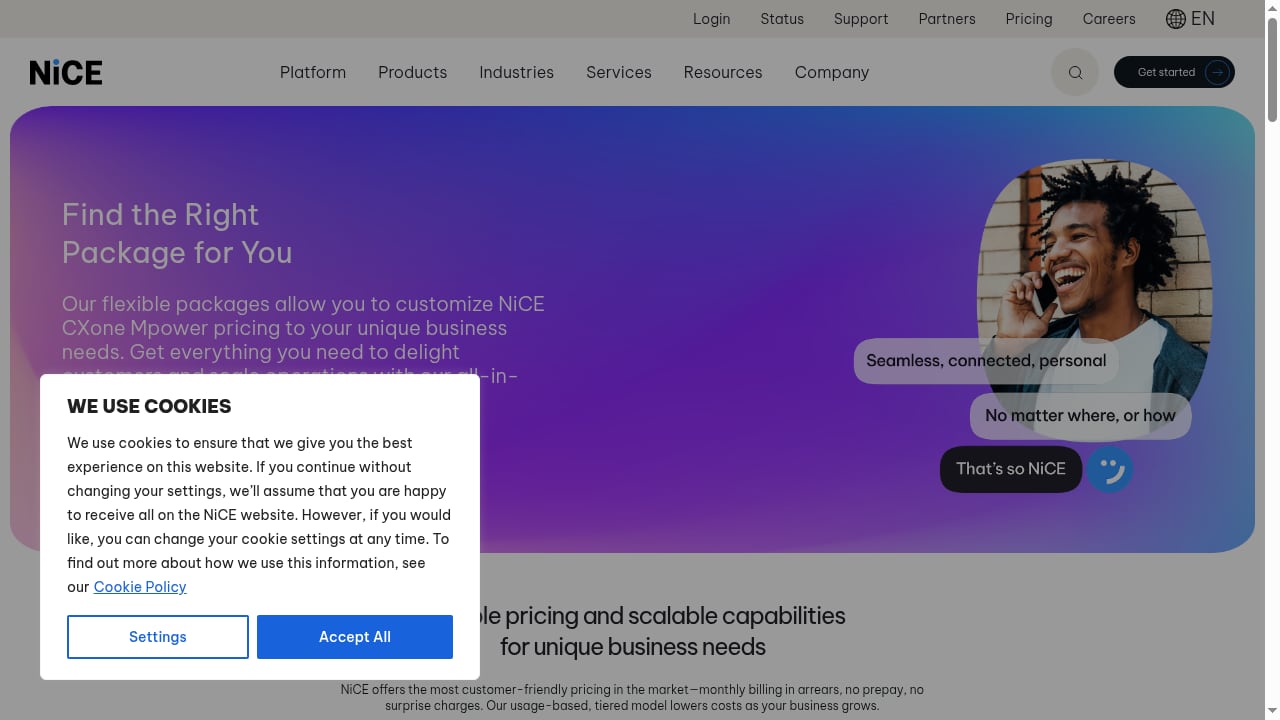
First viewport screenshot of CXone Packages and Pricing | NiCE.
CXone is purpose-built for mid-market and enterprise organizations that need deep, integrated coverage across the entire customer experience journey. It is not a lightweight tool for small teams.
Ideal Users
- Enterprise contact centers managing hundreds or thousands of agents across multiple sites and channels
- Organizations consolidating legacy systems that currently juggle separate tools for routing, quality management, workforce management, and analytics
- Regulated industries such as financial services, healthcare, and insurance that require strong compliance, security, and audit capabilities
- BPOs that need flexible, usage-based pricing and multi-tenant management for diverse client portfolios
- Teams prioritizing AI maturity and looking to scale virtual agents, agent assist, and journey orchestration in production
Who Should Look Elsewhere
- Small businesses or startups with fewer than 20 agents and straightforward voice or chat needs
- Budget-conscious buyers who need predictable, flat-rate pricing without enterprise contract complexity
- Organizations requiring on-premises deployments — CXone is cloud-only
- Teams that want fast time-to-value without a dedicated administrator or implementation program
If you fall into these categories, lighter platforms may be a better fit. For a comparison of AI support platforms across different scales and needs, see our HelpKnow AI vs Udesk vs Talkdesk comparison.
Core Capabilities and Strengths
Omnichannel Routing and Journey Orchestration
CXone routes customers to the best available resource across voice, email, chat, SMS, and social messaging apps while preserving conversation context. Skills-based and priority-based routing support VIP handling, and universal queuing lets agents manage concurrent interactions without losing the thread. The native dialer enables proactive outreach to reduce drop-offs and prevent avoidable contacts.
AI-Driven Self-Service and Agent Assist
A recurring theme across verified reviews is the platform's ability to use AI to personalize journeys while reducing handle time. Intelligent virtual agents and chatbots can authenticate users, resolve common requests, and escalate to human agents with full context. Knowledge management and guardrailed generative responses help keep answers consistent across channels.
During live interactions, real-time guidance suggests next-best actions and surfaces knowledge snippets. Automated Summary drafts post-interaction notes, reducing wrap time and improving consistency. This agent-assist approach augments rather than replaces human agents — a distinction that matters for organizations concerned about customer experience quality.
Workforce Engagement Management
The WEM suite brings AI-driven forecasting, quality management, and performance coaching into the same platform as routing and analytics. Managers can evaluate interactions at scale, auto-distribute coaching tasks, and track skill development over time. Additional modules include gamification, real-time supervisor tools, and centralized recording storage for audits and compliance.
Analytics and Reporting
CXone captures and analyzes interactions to surface patterns, root causes, and friction points. Natural-language interfaces let non-technical stakeholders ask questions in plain English without writing SQL. Omnichannel visibility supports tracking of trending topics, intents, and keywords by region, product line, or customer segment.
Security and Compliance
The platform's cloud foundation emphasizes high availability, strong data protection, and broad compliance coverage. This is a standout strength for regulated industries that need to demonstrate audit readiness and data governance.
Limitations and Weaknesses
Complex and Expensive Pricing
Between agent licenses, suite bundles, usage-based telephony, and paid add-ons, total cost can escalate quickly. Buyers should model total cost of ownership carefully before committing. The platform carries a higher price tag than SMB-first tools.
Heavy Footprint and Learning Curve
The breadth of features can feel like overkill for simple needs. Most teams will want a dedicated administrator or power user to get full value. Rolling out omnichannel routing, WEM, analytics, and AI at once is a sizeable program that requires data cleanup, knowledge base work, and agent coaching.
Support Variability
Verified user feedback on Gartner Peer Insights shows a split. Many users praise the platform's responsiveness and the strength of the Mpower community. Others report frustration with troubleshooting intermittent issues, noting that effective support sometimes requires executive escalation. This variability is worth probing during vendor evaluation.
Cloud-Only Deployment
If your organization mandates on-premises deployments, CXone will not work. There is no on-premises option.
Pricing Signals
CXone is typically sold on a per-agent, per-month subscription model with tiered packages. While exact pricing requires a formal quote, published signals from third-party reviews indicate the following structure:
Agent Packages
- Digital: approximately $71 per agent per month — covers email, chat, and 30+ digital channels with unified routing and reporting
- Voice: approximately $94 per agent per month — built for high-volume voice operations with IVR, recording, and voice analytics
- Omnichannel: approximately $110 per agent per month — blends voice and digital for true omnichannel support and universal queuing
Suite Packages
- Essential: approximately $135 per agent per month — adds quality management, screen recording, and supervisor monitoring
- Core: approximately $169 per agent per month — adds WFM with AI forecasting and performance reporting
- Complete: approximately $209 per agent per month — adds advanced analytics and voice-of-the-customer capabilities
- Ultimate: approximately $249 per agent per month — full end-to-end orchestration and automation
Add-ons include AI assistants, knowledge management, and additional analytics modules. Contract terms, minimums, and discounts vary by deployment size and requirements. NICE also offers flexible, usage-based pricing with monthly billing in arrears and no prepay, with tiered models that lower costs as usage grows.
Setup and Implementation
Implementing CXone is not a weekend project. Expect a phased rollout that includes:
- Discovery and design — mapping channels, routing rules, and integration points
- Data cleanup and migration — consolidating knowledge bases and customer data
- Configuration — setting up IVR flows, queues, skills, and workforce schedules
- Agent training and change management — avoiding "tool shock" through structured onboarding
- Go-live and optimization — monitoring KPIs and tuning AI models over time
Most organizations benefit from a dedicated implementation team or external partner. The platform's breadth means you can start with core voice and digital routing, then layer on WEM, analytics, and AI capabilities as your team matures.
How CXone Compares to Alternatives
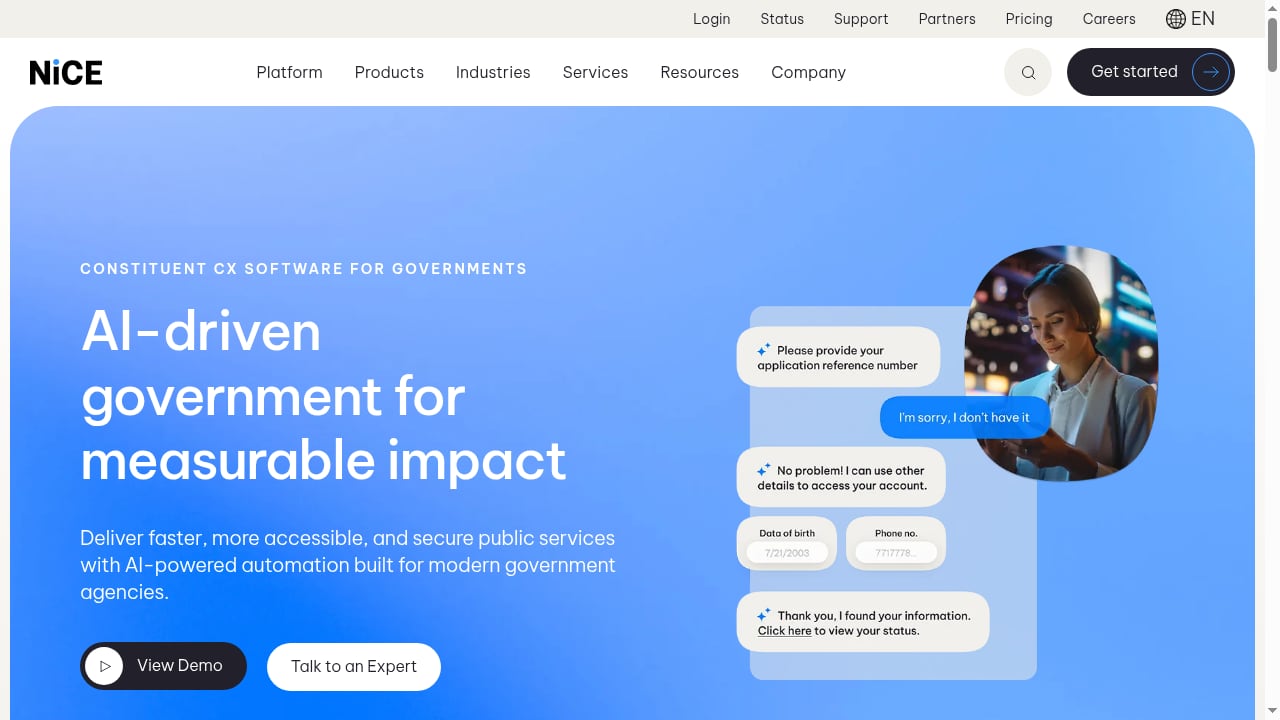
First viewport screenshot of Citizen Customer Experience Software for Government Organizations | NiCE CX Solutions.
When evaluating CXone, it helps to understand the competitive landscape:
- CXone vs. SMB-first platforms: Tools like Nextiva or Aircall offer faster time-to-value and simpler pricing for small teams. CXone wins on depth, scale, and AI maturity.
- CXone vs. point solutions: If you only need AI-powered self-service or a help center, lighter tools may be more appropriate. For example, Ferndesk focuses on AI help centers that update themselves, while Retell AI specializes in voice agent quality.
- CXone vs. other enterprise CCaaS platforms: Competitors like Genesys Cloud and Talkdesk offer overlapping capabilities. CXone differentiates on the breadth of its WEM suite, journey orchestration, and industry-specific packages.
For teams weighing enterprise CX AI options, our HelpKnow AI vs Enterprise Bot comparison explores how different platforms approach AI resolution, compliance, and ideal use cases.
Decision Criteria: Should You Choose CXone?

CXone product interface.
Choose CXone if:
- You manage a mid-market or enterprise contact center with complex routing needs
- You want to consolidate routing, WEM, analytics, and AI on one platform
- You operate in a regulated industry requiring strong compliance and audit capabilities
- You have the budget and resources for a dedicated implementation program
- You plan to scale AI from experimentation to production
Reconsider if:
- You have fewer than 20 agents or simple contact center needs
- You need predictable, flat-rate pricing without enterprise contract complexity
- You require on-premises deployment
- You want fast time-to-value without a dedicated administrator
Sources and further reading
- Anyone use Nice CXOne? : r/workforcemanagement - Reddit - Sep 28, 2023 ... Nice CXOne is a pretty good telephony. I've admin-ed it for two companies and there are quite a few ways to automate maintenance for it. However ...
- Nice CXone Review - NICE CXone is a cloud-native customer experience (CX) platform that deserves strong consideration from enterprises that want to consolidate sprawling CX stacks into one unified...
Frequently Asked Questions
Is CXone worth the cost?
For enterprises that can leverage its full breadth — omnichannel routing, WEM, analytics, and AI — CXone often delivers strong ROI through reduced vendor sprawl, lower handle times, and improved agent efficiency. For smaller teams, the cost and complexity may outweigh the benefits.
How long does CXone implementation take?
Implementation timelines vary widely based on scope. A basic voice and digital deployment may take 6–12 weeks. Full omnichannel with WEM, analytics, and AI can take 3–6 months or longer, especially with data cleanup and change management.
Does CXone replace human agents?
No. CXone's agent assist and virtual agent capabilities are designed to augment human agents, not replace them. AI handles repetitive tasks and common requests, while agents focus on complex, high-value interactions.
What industries use CXone?
CXone serves financial services, healthcare, insurance, retail, telecommunications, government, education, and BPOs. Industry-specific packages address unique needs such as student journey orchestration in higher education and patient experience in healthcare.
Is CXone cloud-only?
Yes. CXone is a cloud-native platform with no on-premises deployment option.
Conclusion
CXone is a powerful, comprehensive customer experience platform that earns its reputation as an enterprise-grade solution. Its strengths — unified omnichannel routing, AI-driven self-service and agent assist, workforce engagement management, and deep analytics — make it a strong candidate for organizations that need to consolidate sprawling CX stacks and scale AI in production.
However, the platform's complexity, pricing structure, and implementation demands mean it is not the right fit for every team. Small businesses, budget-conscious buyers, and organizations requiring on-premises deployment should explore alternatives.
Before committing, validate total cost of ownership with a formal quote, probe support responsiveness during evaluation, and plan a phased rollout that respects your team's change management capacity. For a broader view of how CXone stacks up against other AI-driven support platforms, explore our HelpKnow AI vs CoSupport AI vs Gumloop comparison or the Richpanel review for ecommerce-focused alternatives.