
HelpKnow AI vs Salesforce Agentic CRM: Which Platform Fits Your Business?
Choosing between a dedicated enterprise AI customer service platform and a full-scale agentic CRM can feel like comparing a specialized surgical tool with an entire operating room. HelpKnow AI focuses on one job: automating customer service conversations with high accuracy and minimal setup. Salesforce Agentic CRM aims to unify AI, data, and customer operations across sales, service, and marketing. Both are powerful, but they solve different problems.
This comparison breaks down how each platform handles AI resolution, integrations, analytics, compliance, and practical implementation so you can decide which one matches your support goals and existing tech stack.
What Is HelpKnow AI?
HelpKnow AI is an enterprise AI agent platform built specifically for customer service. Businesses use it to create, deploy, and manage intelligent support agents without heavy technical work. You can upload documents, FAQs, and product databases, and the platform automatically generates responses from that material.
The platform supports multi-format data ingestion, AI-powered intent recognition, and customizable AI personas that match your brand voice. It also includes real-time conversation quality analytics, omni-channel deployment across desktop, web, and social media, and role-based human escalation workflows. According to its published metrics, HelpKnow AI reports a 70% reduction in customer service costs and a 95% automatic problem resolution rate, with compliance coverage for GDPR, CCPA, and other global standards.
HelpKnow AI is best understood as a focused support automation layer: it connects to your existing knowledge base and support systems rather than replacing your entire customer operations stack.
What Is Salesforce Agentic CRM?
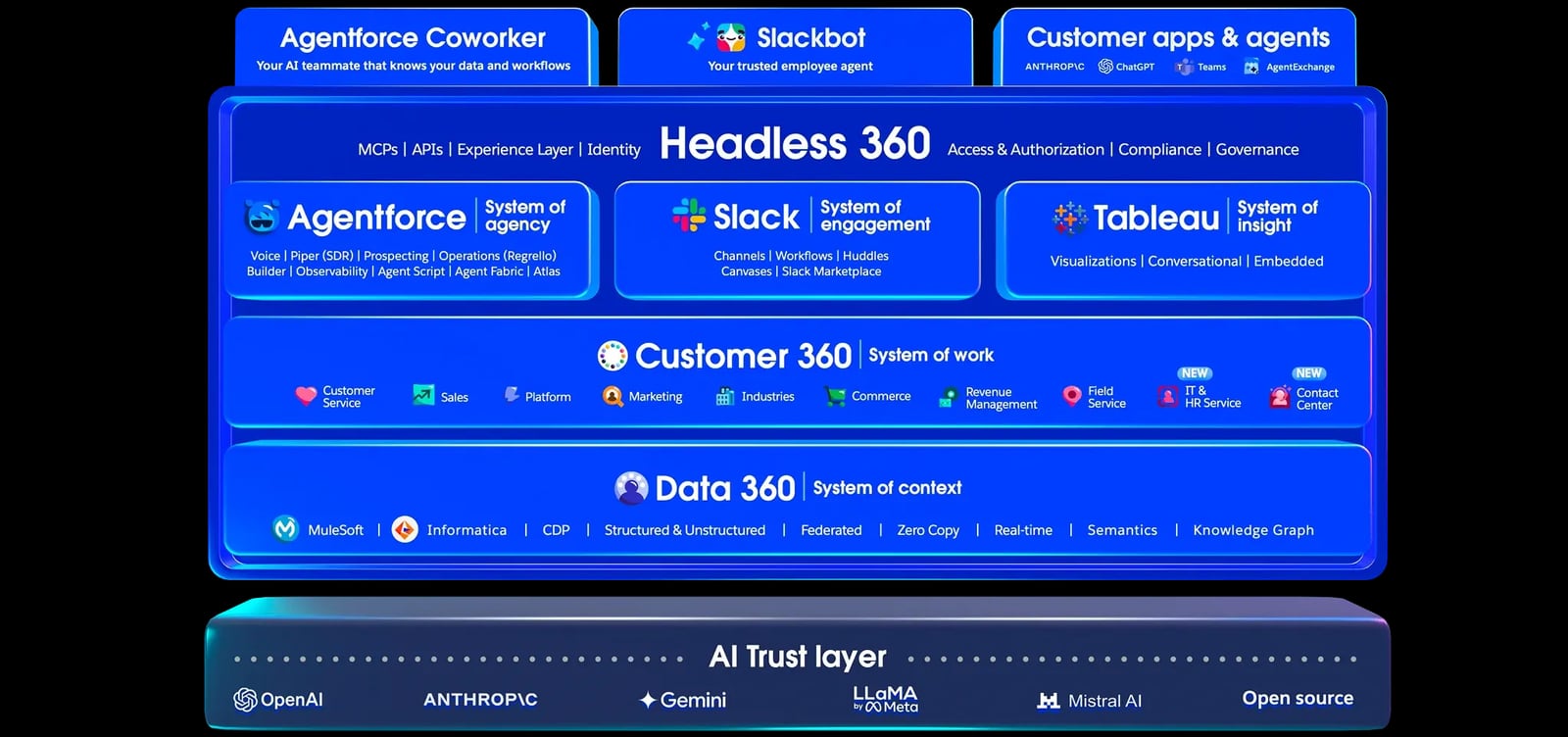
Salesforce Agentic CRM product interface.
Salesforce positions itself as the #1 Agentic AI CRM, designed to help companies become "Agentic Enterprises" where humans and AI agents work together. The platform unifies AI, data, and Customer 360 to automate sales, service, and marketing workflows. It includes Agentforce for autonomous agents, Data Cloud for unified customer profiles, and Slack integration for team productivity.
Salesforce offers quick setup, pre-built agents, secure Sandboxes, Success Plans, and a partner marketplace called AgentExchange. It serves businesses of all sizes across industries like automotive, financial services, healthcare, and retail. Salesforce reports proof points such as an 83% ROI for Signature Success Plan customers and 70,000+ meeting hours saved by Vercel using Slack agents.
Salesforce Agentic CRM is a broad platform play. It can handle customer service, but it also extends into sales automation, marketing personalization, and data management. That breadth is both its strength and its complexity.
Head-to-Head Comparison
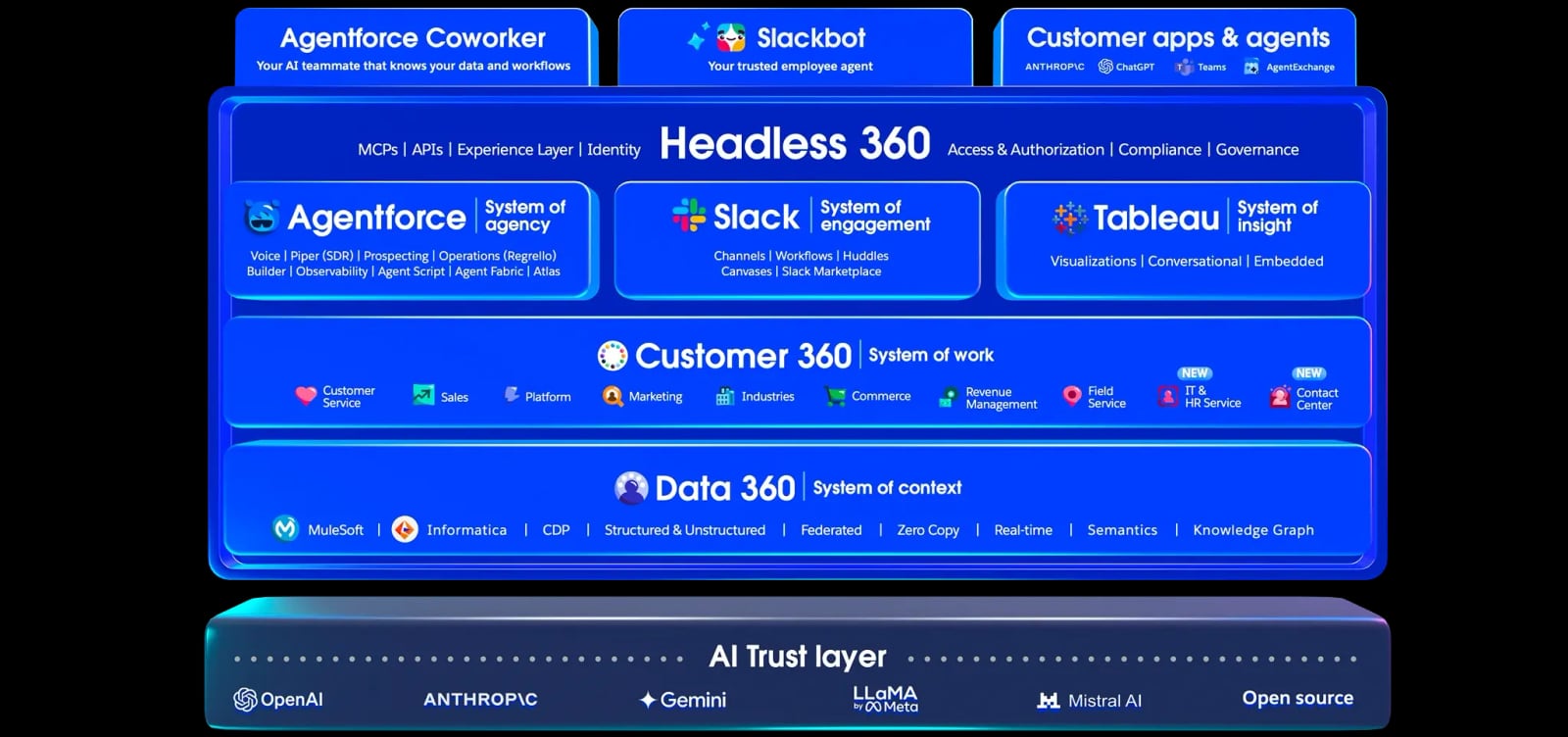
Salesforce Agentic CRM product interface.
Core Focus: Support Automation vs Unified CRM
The most important difference is scope. HelpKnow AI concentrates on customer service conversations: answering questions, resolving issues, and escalating to humans when needed. Its metrics are support-specific, which makes them easy to evaluate against support goals.
Salesforce Agentic CRM treats service as one part of a larger automation strategy. Agentforce can handle service tasks, but the platform also manages sales pipelines, marketing campaigns, and data infrastructure. If your primary need is faster, cheaper customer support, you may be paying for capabilities you do not use. If you need a unified system across departments, that breadth becomes valuable.
AI Resolution and Accuracy
HelpKnow AI reports a 95% automatic problem resolution rate. That number is tied directly to its intent recognition and knowledge base ingestion. Because the platform is built for support, its AI is optimized for query matching, document understanding, and response generation from your existing help content.
Salesforce Agentforce has demonstrated measurable outcomes in specific deployments. For example, Hero FinCorp achieved a 72% improvement in loan turnaround time using Agentforce and Data 360, according to Salesforce development trend reporting. Those results are impressive, but they reflect a broader automation use case rather than pure support resolution. Salesforce's agent performance depends heavily on configuration, data quality, and the specific Agentforce product you deploy.
Setup and Technical Effort
HelpKnow AI emphasizes minimal technical effort. You upload documents, FAQs, and product data, and the system generates responses automatically. Custom AI personas and role-based escalation workflows are configurable without deep engineering resources.
Salesforce offers quick setup and pre-built agents, but the platform's full potential often requires more configuration. Low-code tools like Salesforce Flow help, but enterprise deployments frequently involve custom development, data modeling, and integration work. The Salesforce ecosystem includes Sandboxes, Success Plans, and implementation partners precisely because many organizations need expert guidance to get the most from the platform.
Integrations and Channel Coverage
HelpKnow AI integrates with existing customer support systems and knowledge bases. Its omni-channel support covers desktop, website, and social media, which matches the channels where most customer service conversations happen.
Salesforce connects to a wider range of business tools through MuleSoft, Slack, and the AgentExchange marketplace. That ecosystem is a major advantage if you need deep integration with ERP, marketing automation, or custom internal systems. However, those integrations add implementation complexity and cost.
Analytics and Monitoring
HelpKnow AI includes conversation quality analytics with real-time monitoring. Support leaders can see how agents are performing, identify gaps in knowledge coverage, and adjust responses without waiting for periodic reports.
Salesforce offers analytics through Tableau and CRM Analytics, which provide broader business intelligence across sales, service, and marketing. The tradeoff is that support-specific insights may require more configuration to surface from the larger data model.
Compliance and Data Protection
HelpKnow AI states compliance with GDPR, CCPA, and other global data protection standards. For support teams handling sensitive customer information, that built-in compliance posture reduces legal and security review time.
Salesforce also emphasizes trust, security, and scalability, with Hyperforce providing data residency options across 18 countries as of July 2026. Salesforce's compliance infrastructure is robust, but it is part of a larger platform that may require more governance configuration depending on your industry.
Pricing Signals
Neither platform publishes simple, transparent pricing on its main product pages. HelpKnow AI's value proposition centers on cost reduction: a 70% cut in customer service costs is a direct ROI argument for support budgets.
Salesforce pricing varies significantly by product, edition, and add-on. The Flex Credit Calculator and custom pricing requests suggest that total cost depends on which clouds you license, how many agents you deploy, and whether you purchase Success Plans or implementation services. For support-only use cases, that pricing complexity can make Salesforce harder to evaluate.
When to Choose HelpKnow AI
HelpKnow AI is the stronger choice when:
- Customer service is your primary automation target. You want faster answers, lower support costs, and fewer repetitive tickets without rebuilding your entire CRM.
- You already have a CRM or support stack. HelpKnow AI integrates with existing systems and knowledge bases, so you can add AI resolution without ripping out current tools.
- You need quick deployment. Upload your documents and FAQs, configure your AI persona, and start resolving queries with minimal engineering effort.
- Support metrics matter most. A 95% automatic resolution rate and 70% cost reduction are directly relevant to support leaders.
- Compliance is a priority. Built-in GDPR and CCPA alignment simplifies procurement and security reviews.
For a deeper look at how HelpKnow AI compares with other support-focused AI tools, see the HelpKnow AI vs My AskAI comparison.
When to Choose Salesforce Agentic CRM
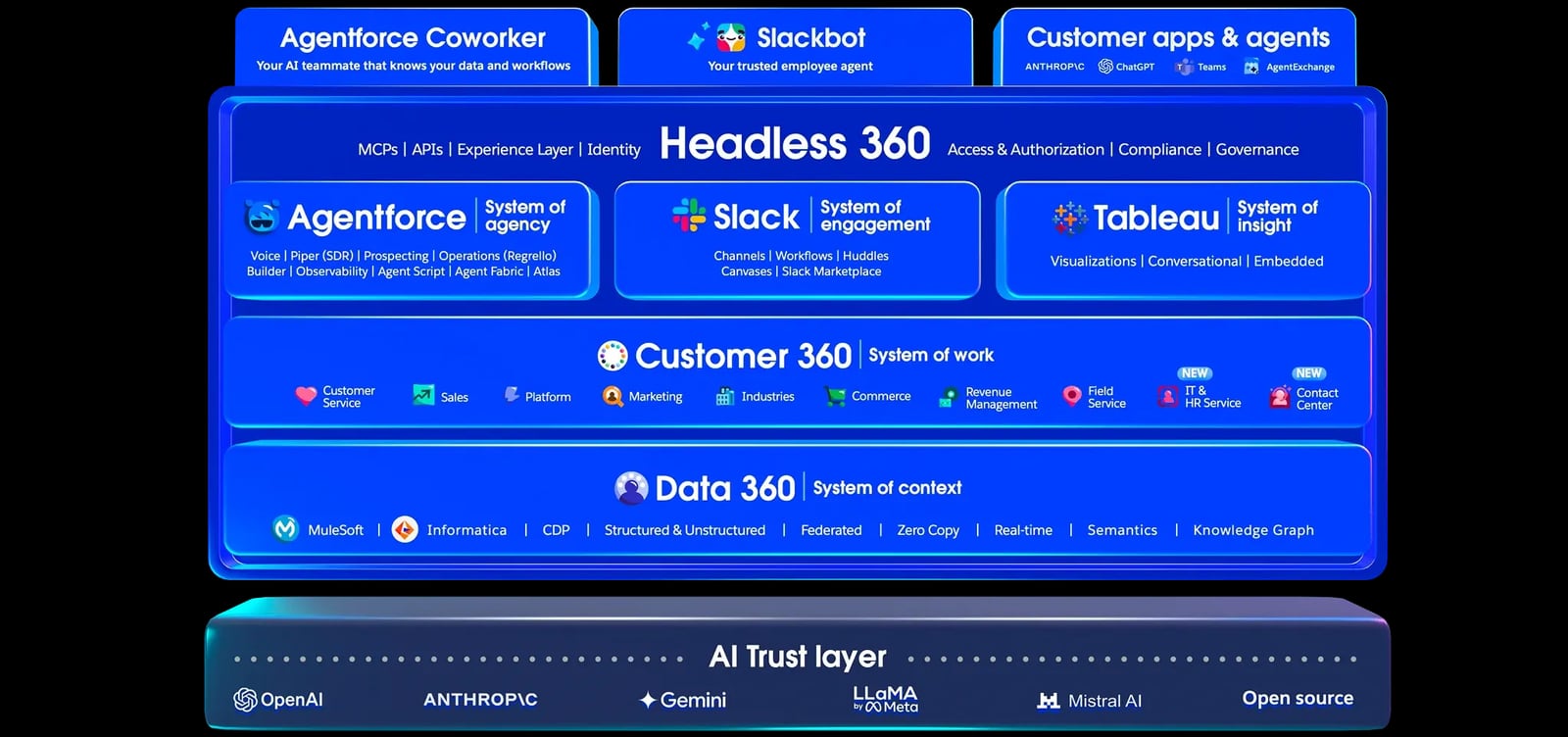
Salesforce Agentic CRM product interface.
Salesforce Agentic CRM is the better fit when:
- You need unified automation across sales, service, and marketing. If your goal is an "Agentic Enterprise" with AI agents working across departments, Salesforce's breadth is a genuine advantage.
- You are already invested in the Salesforce ecosystem. Existing Sales Cloud, Service Cloud, or Slack deployments make adding Agentforce more natural.
- You need deep enterprise integrations. MuleSoft, Data Cloud, and AgentExchange provide connectivity options that go well beyond support channels.
- You have implementation resources. Salesforce's full value often requires developers, admins, or implementation partners.
- Your use cases extend beyond support. Sales automation, marketing personalization, and data unification are core Salesforce strengths.
If you are evaluating broader AI agent platforms for workflow automation beyond support, the Gumloop review offers a useful comparison point.
Practical Example: Support Team Automation
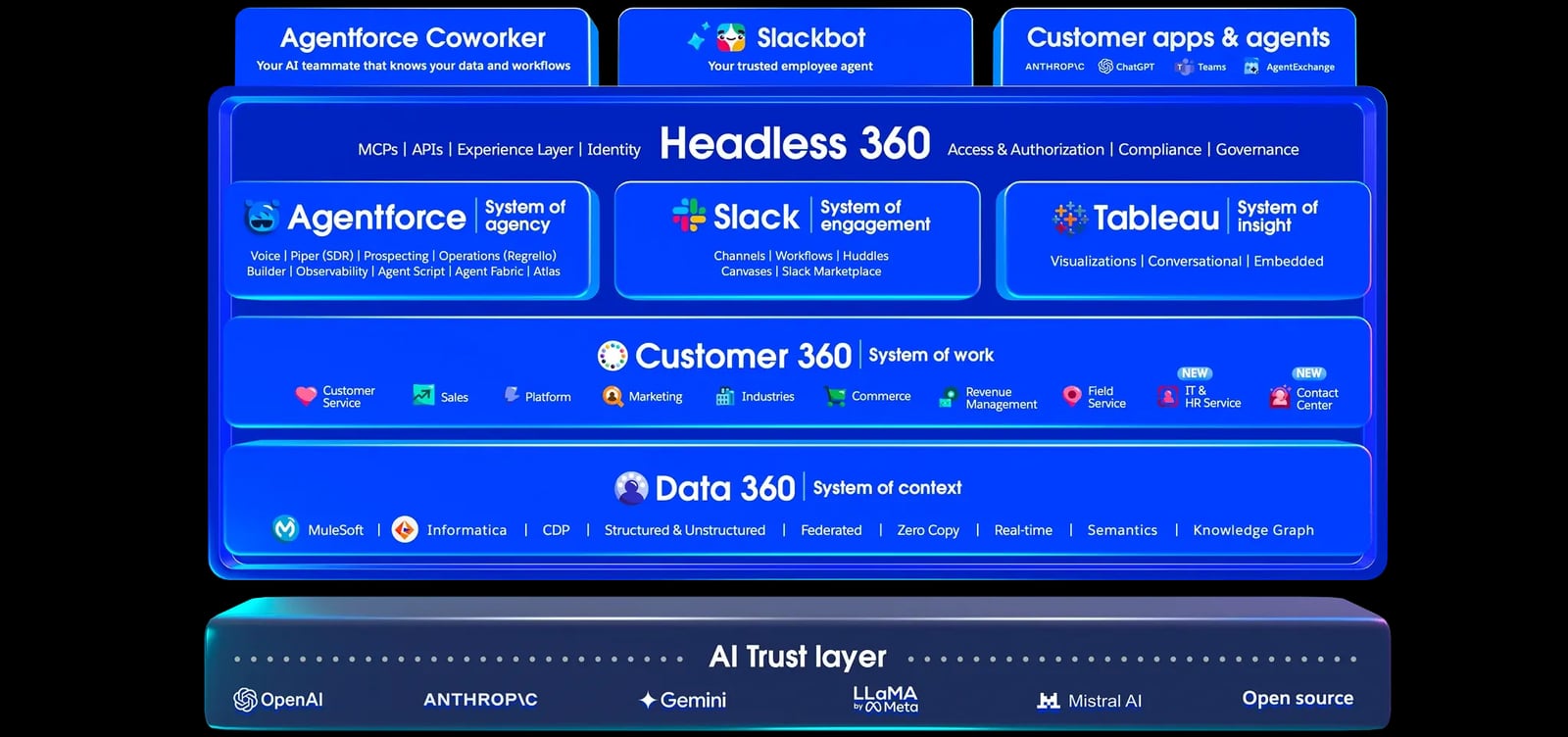
Salesforce Agentic CRM product interface.
Imagine a mid-sized ecommerce company receiving 5,000 support tickets per month. Most questions involve order status, return policies, and product details.
With HelpKnow AI, the team uploads its FAQ, product catalog, and return policy documents. The AI agent resolves common queries across website chat and social media, escalating only complex cases to human agents. The company sees a measurable drop in ticket volume and response time without changing its existing help desk.
With Salesforce Agentic CRM, the same company could deploy Agentforce for service, but would likely also need to configure Data Cloud, set up Service Cloud, and possibly license additional products. The result could be powerful, but the implementation timeline and cost would be higher. If the company also wanted to automate sales follow-ups and marketing campaigns, Salesforce would justify that investment.
Practical Example: Enterprise-Wide Automation
A financial services firm wants to automate client onboarding, sales outreach, and customer service inquiries in one system. Salesforce's industry-specific Financial Services Cloud, combined with Agentforce and Data Cloud, provides a unified platform for that scope. The firm can automate loan application follow-ups, personalize marketing offers, and resolve service tickets using the same customer data foundation.
HelpKnow AI would excel at the service portion of that workflow, but it would not replace the sales and marketing automation capabilities the firm needs. In this scenario, Salesforce's breadth wins, while HelpKnow AI could still serve as a specialized support layer if the firm wanted best-in-class resolution rates.
Decision Framework
Ask these questions before choosing:
- What is your primary goal? If it is support cost reduction and faster resolution, HelpKnow AI is purpose-built for that outcome. If it is cross-department automation, Salesforce is the broader platform.
- What is your current stack? If you already use Salesforce, extending with Agentforce is natural. If you use another CRM or help desk, HelpKnow AI integrates without forcing a platform migration.
- How fast do you need results? HelpKnow AI's document upload and automatic response generation support rapid deployment. Salesforce implementations can take weeks or months depending on scope.
- What is your budget structure? HelpKnow AI's value is tied to support cost savings. Salesforce's total cost depends on product mix, implementation services, and ongoing administration.
- Do you need support-specific analytics or enterprise-wide BI? HelpKnow AI provides real-time conversation quality monitoring. Salesforce provides broader analytics through Tableau and CRM Analytics.
Related reading
- Richpanel Review 2026: Features, Pricing, and Verdict - Evidence-based Richpanel review covering AI automation, ecommerce support features, pricing signals, ideal users, limitations, and who should choose it.
Sources and further reading
- Digital Senate - AI will significantly impact the evolution of CRM: Here's how #ArtificialIntelligence #BigData #CRM...
Frequently Asked Questions
Is HelpKnow AI a CRM replacement?
No. HelpKnow AI is an AI customer service platform that integrates with existing support systems and knowledge bases. It automates support conversations but does not replace CRM functions like sales pipeline management or marketing automation.
Can Salesforce Agentic CRM handle customer service only?
Yes, but it may be overkill. Salesforce Service Cloud and Agentforce can handle support use cases, but you may pay for platform capabilities you do not use. HelpKnow AI offers a more focused alternative for support-only needs.
Which platform resolves customer queries more accurately?
HelpKnow AI reports a 95% automatic problem resolution rate for support queries. Salesforce Agentforce has demonstrated strong results in specific deployments, but its performance varies based on configuration and use case.
Does HelpKnow AI integrate with Salesforce?
HelpKnow AI integrates with existing customer support systems and knowledge bases. If your support content lives in Salesforce, HelpKnow AI can typically ingest that data, but specific integration details should be confirmed with the vendor.
Which platform is easier to set up?
HelpKnow AI is designed for minimal technical effort: upload documents, configure your AI persona, and deploy. Salesforce offers quick setup and pre-built agents, but enterprise deployments often require more configuration, development, or implementation partner support.
Which platform is more cost-effective for support teams?
HelpKnow AI's value proposition centers on a 70% reduction in customer service costs, making it easier to calculate support ROI. Salesforce pricing depends on product mix, licenses, and services, which can make support-only cost comparisons more complex.
Conclusion
HelpKnow AI and Salesforce Agentic CRM are not direct competitors in the traditional sense. HelpKnow AI is a specialized support automation platform that delivers high resolution rates and fast deployment for customer service teams. Salesforce Agentic CRM is a comprehensive platform for automating sales, service, and marketing across the enterprise.
Choose HelpKnow AI when support automation is the priority and you want measurable cost savings without rebuilding your tech stack. Choose Salesforce Agentic CRM when you need unified AI, data, and customer operations across multiple departments and are prepared for a larger implementation investment.
For teams comparing support-focused AI platforms, the HelpKnow AI vs Desk365 vs CXone comparison provides additional context on how these tools stack up against other customer experience platforms. You can also explore Salesforce development trends and Salesforce's financial services onboarding solution to understand how the Agentic CRM ecosystem continues to evolve.