HelpKnow AI vs Desk365 vs Tidio: Which Support Platform Fits?
Choosing a customer service platform in 2026 means deciding how much of your support you want AI to handle, where your team already works, and what compliance bar you need to clear. HelpKnow AI, Desk365, and Tidio all promise faster resolutions and lower costs, but they are built for different starting points. This comparison breaks down where each platform is strong, where it is limited, and which one matches your support model.
Quick comparison: HelpKnow AI vs Desk365 vs Tidio
First viewport screenshot of How CTS streamlined IT support, ticketing, and asset management for schools.
| Dimension | HelpKnow AI | Desk365 | Tidio |
|---|---|---|---|
| Primary focus | Enterprise AI agent platform | AI-powered helpdesk and ITSM | AI customer service for ecommerce and SMBs |
| Best for | Enterprises needing high AI resolution and governance | Microsoft 365-centric support and IT teams | Ecommerce stores and small customer-facing teams |
| AI approach | Multi-format knowledge ingestion, intent recognition, customizable personas | Ticket summarization, draft replies, KB suggestions | Lyro conversational AI with RAG over product catalogs |
| Data model | Knowledge and conversation-centric | Ticket-centric (ITSM-style) | Contact and conversation-centric |
| Native ecosystem | Omnichannel: web, desktop, social | Microsoft 365, Teams, Entra ID, Power Automate, Copilot | Shopify, WooCommerce, Shopware, social messaging |
| Human escalation | Role-based escalation workflows | Approval and change management workflows | Live chat handoff to agents |
| Analytics | Real-time conversation quality monitoring | SLA, CSAT, and operational reporting | Chat performance and AI effectiveness analytics |
| Compliance | GDPR, CCPA, and global data protection standards | SOC 2 Type 2, GDPR; HIPAA-aligned controls on Premium | GDPR and CCPA-aligned; no documented HIPAA BAA |
| Pricing model | Enterprise (custom) | From $12/agent/month | Free tier; paid plans from roughly $24/month |
Where HelpKnow AI stands out
HelpKnow AI is built for organizations that want AI to resolve the majority of customer questions, not just assist agents. The platform ingests documents, FAQs, and product databases in multiple formats, then uses AI-powered intent recognition to match queries to the right answer. Customizable AI personas let you tune tone and brand voice without rebuilding flows.
That design shows up in the numbers: HelpKnow AI reports a 95% automatic problem resolution rate and a 70% reduction in customer service costs across more than 1,000 enterprise deployments. Conversation quality analytics with real-time monitoring give support leaders a live view of how the AI is performing, and role-based human escalation workflows keep complex cases moving to the right person.
Compliance is another differentiator. HelpKnow AI aligns with GDPR, CCPA, and other global data protection standards, which matters when support data crosses regions or includes sensitive customer information. If your priority is enterprise-grade AI resolution with governance built in, this is the strongest fit among the three.
For a deeper head-to-head, see HelpKnow AI vs Desk365: Enterprise AI Support Compared.
Where Desk365 stands out
First viewport screenshot of Concurrent uses Desk365's helpdesk to boost agent efficiency.
Desk365 is an AI-powered helpdesk built natively for the Microsoft 365 ecosystem. Instead of bolting a Teams connector onto a legacy helpdesk, Desk365 was architected Teams-first: agents create, assign, and manage tickets directly inside Microsoft Teams, with identity flowing through Entra ID and automation through Power Automate.
Its strengths are structural. Desk365 follows a ticket-centric ITSM model with statuses, priorities, SLA timers, multi-timezone escalation, round-robin and load-based assignment, approval and change management, and IT asset management. The AI agent summarizes tickets and suggests replies, and a knowledge base helps deflect repeat questions. The platform maintains SOC 2 Type 2 certification and GDPR compliance with US and EU data centers, and the Premium plan documents HIPAA-aligned controls with a Business Associate Agreement available on request.
Pricing is transparent and linear: plans start at $12 per agent per month, with no per-ticket fees and no agent caps on paid plans. Most Microsoft 365 organizations with 10–50 agents go live in one to two weeks. Desk365 reports more than 7,000 customers across 60+ countries, and it is a strong choice for internal IT helpdesks, HR service management, and multi-departmental support in regulated industries. If your team lives in Microsoft 365 and needs structured ticketing, Desk365 is hard to beat.
Where Tidio stands out
First viewport screenshot of How HPSC used Desk365 to streamline IT support.
Tidio combines live chat, the Lyro AI agent, and help desk ticketing in one dashboard, and it is especially popular with ecommerce stores. Lyro can solve up to 67% of customer problems in seconds, and Tidio reports that some businesses reach resolution rates above 85% without agent involvement. The platform supports 12+ languages and uses retrieval-augmented generation over your product catalog, so it can recommend products and answer pre-purchase questions.
Tidio's contact-centric data model threads every chat, email, and bot conversation under the visitor profile, which suits real-time engagement. Native integrations cover Shopify, WooCommerce, Shopware, Facebook Messenger, Instagram, and WhatsApp, and a Shopify store can embed the chat widget and configure basic Lyro responses in under 48 hours. Proactive triggers can reach shoppers who linger on a page or abandon a cart, turning support into a revenue channel.
A documented case study with Cove Smart showed a 70% increase in self-service resolution, an 80% reduction in response times, and a 35% boost in customer satisfaction. Tidio is trusted by over 300,000 businesses, offers a free tier, and its paid plans start at roughly $24 per month. For small ecommerce teams that want fast setup and strong chat engagement, Tidio is a compelling option.
How to choose: decision guidance by scenario
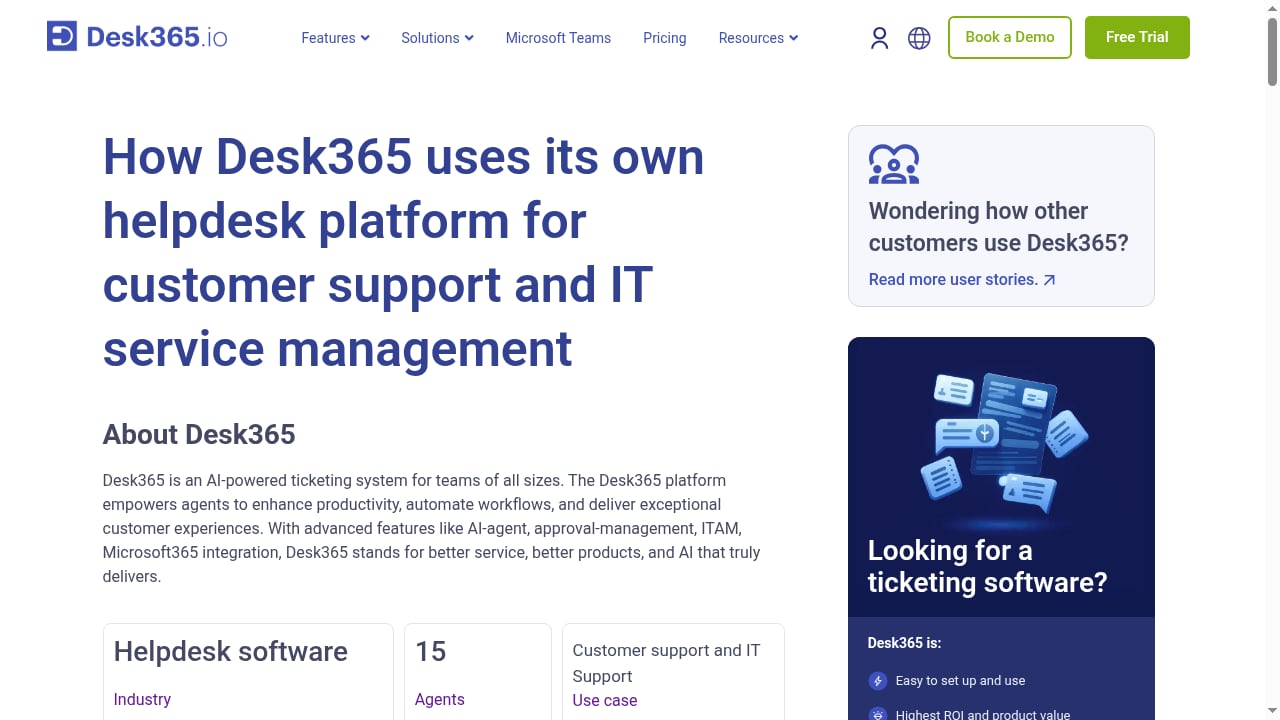
First viewport screenshot of How Desk365 uses their own helpdesk platform to manage both customer and IT support.
Choose HelpKnow AI if you are an enterprise that needs AI to resolve most customer questions across web, desktop, and social channels, with real-time conversation analytics, customizable AI personas, and compliance with GDPR, CCPA, and other global standards. It fits teams that want to reduce headcount pressure without sacrificing governance.
Choose Desk365 if your support organization already runs on Microsoft 365 and needs ticket-centric workflows, SLA management, approval and change management, and IT asset management inside Teams. It is the better fit for internal IT helpdesks, HR service management, and regulated industries that need SOC 2 Type 2 and a path to HIPAA-aligned controls.
Choose Tidio if you run an ecommerce store or a small customer-facing team that needs live chat, a fast-deploying AI agent, and native Shopify or WooCommerce integrations. It is cost-efficient for stores with under 500 monthly support interactions and teams that value proactive engagement and product recommendations.
One practical note: these platforms are not always direct substitutes. Desk365 occupies the ITSM and Microsoft 365 layer, Tidio occupies the ecommerce chat layer, and HelpKnow AI occupies the enterprise AI resolution layer. Some organizations combine a ticketing system with an AI resolution platform rather than replacing one with the other.
If you are also weighing other enterprise AI platforms, the comparison in HelpKnow AI vs Tidio vs CXone: Enterprise Support Compared covers AI resolution, deployment effort, omnichannel support, analytics, and compliance in more detail.
Related reading
- HelpKnow AI vs Nextiva vs Five9: Best Enterprise AI Support - Compare HelpKnow AI, Nextiva, and Five9 on AI resolution, deployment effort, omnichannel support, analytics, and compliance to pick the right platform.
Sources and further reading
- Helpdesk 365 vs Tidio: Which Helpdesk Tool Is Right for You? - Compare Helpdesk 365 vs Tidio to find the best support tool for businesses. Explore features, integrations, use cases, and which one fits your team.
- Desk365 vs Tidio (2026): Architecture, TCO & Migration - Desk365 vs Tidio compared on architecture, real-world TCO, API portability, AI features, and migration paths. Data-backed guidance for 2026.
- Smart Support Checklist: AI Help Desk vs. Traditional Tools - Compare traditional help desks with AI-powered platforms. This checklist shows how Lyro AI Agent and Copilot help cut costs and deliver 24/7 support.
Frequently asked questions
Is HelpKnow AI a replacement for Desk365 or Tidio?
Not necessarily. HelpKnow AI focuses on enterprise AI resolution and governance, while Desk365 focuses on ticket-centric helpdesk and ITSM workflows and Tidio focuses on ecommerce chat and live engagement. Some teams use HelpKnow AI alongside a ticketing system rather than replacing it.
Which platform has the highest AI resolution rate?
HelpKnow AI reports a 95% automatic problem resolution rate. Tidio reports that Lyro can solve up to 67% of customer problems, with some businesses reaching above 85%. Desk365's AI is primarily assistive, summarizing tickets and drafting replies rather than fully resolving conversations.
Which platform is best for Microsoft Teams users?
Desk365. It was architected Teams-first and integrates natively with Microsoft 365, Teams, Entra ID, Power Automate, and Copilot, so agents can manage tickets without leaving Teams.
Which platform is best for Shopify stores?
Tidio. It has native Shopify, WooCommerce, and Shopware integrations, can import products as a RAG data source, and can be live with basic Lyro responses in under 48 hours.
How do the compliance profiles compare?
HelpKnow AI aligns with GDPR, CCPA, and other global data protection standards. Desk365 maintains SOC 2 Type 2 and GDPR compliance with US and EU data centers, and offers a BAA on its Premium plan for HIPAA-aligned environments. Tidio is GDPR and CCPA-aligned but has no documented HIPAA certification or BAA offering.
How does pricing compare?
Desk365 starts at $12 per agent per month with no per-ticket fees. Tidio has a free tier and paid plans starting around $24 per month, with conversation-based quotas and a significant jump to its Plus plan. HelpKnow AI is priced for enterprise deployments. Always verify current pricing directly with each vendor before modeling total cost of ownership.
Conclusion
HelpKnow AI, Desk365, and Tidio solve different problems well. HelpKnow AI is the strongest choice when enterprise AI resolution, omnichannel coverage, real-time analytics, and global compliance are the priority. Desk365 wins when your team lives in Microsoft 365 and needs structured, SLA-driven ticketing with ITSM capabilities. Tidio wins when you run an ecommerce store and want fast, affordable live chat with an AI agent that can recommend products and engage shoppers proactively.
Start by identifying where your support volume comes from and what your compliance requirements are. That single exercise will narrow the decision faster than any feature checklist. For a broader view of enterprise options, compare HelpKnow AI vs Intercom vs EasyAgent on AI resolution, deployment, analytics, and pricing.