
HelpKnow AI vs CXone: Enterprise AI Support Compared
Choosing an enterprise AI customer service platform often comes down to a simple question: do you want a full contact-center suite, or a focused AI agent layer that sits on top of the systems you already run? HelpKnow AI and NiCE CXone represent those two paths. This comparison breaks down how each platform handles AI resolution, deployment effort, omnichannel coverage, analytics, escalation, and compliance — so you can match the tool to your support model instead of the other way around.
Quick comparison at a glance

CXone product interface.
| Dimension | HelpKnow AI | NiCE CXone |
|---|---|---|
| Primary positioning | Enterprise AI agent platform for building, deploying, and managing customer service agents | All-in-one AI-powered customer experience (CX) platform combining CCaaS with AI, automation, and analytics |
| Deployment effort | Minimal technical effort; integrates with existing support systems and knowledge bases | Full platform migration to an extensible cloud foundation; AI technologies require additional licenses |
| Knowledge ingestion | Upload documents, FAQs, and product databases; multi-format data ingestion | Unified data layer with pre-built integrations and no/low-code tools |
| AI resolution | 95% automatic problem resolution rate reported | Virtual agents and agentic AI across voice and digital channels |
| Escalation | Role-based human escalation workflows | Seamless escalation from virtual agents to live agents |
| Analytics | Conversation quality analytics with real-time monitoring | Interaction analysis, sentiment, summaries, and next-best-action guidance |
| Compliance | GDPR, CCPA, and other global standards | Sovereign-ready infrastructure, global compliance, AI governance and observability |
| Pricing | Not specified in available product context | Usage-based, monthly billing in arrears, no prepay, tiered models |
What each platform is actually built for
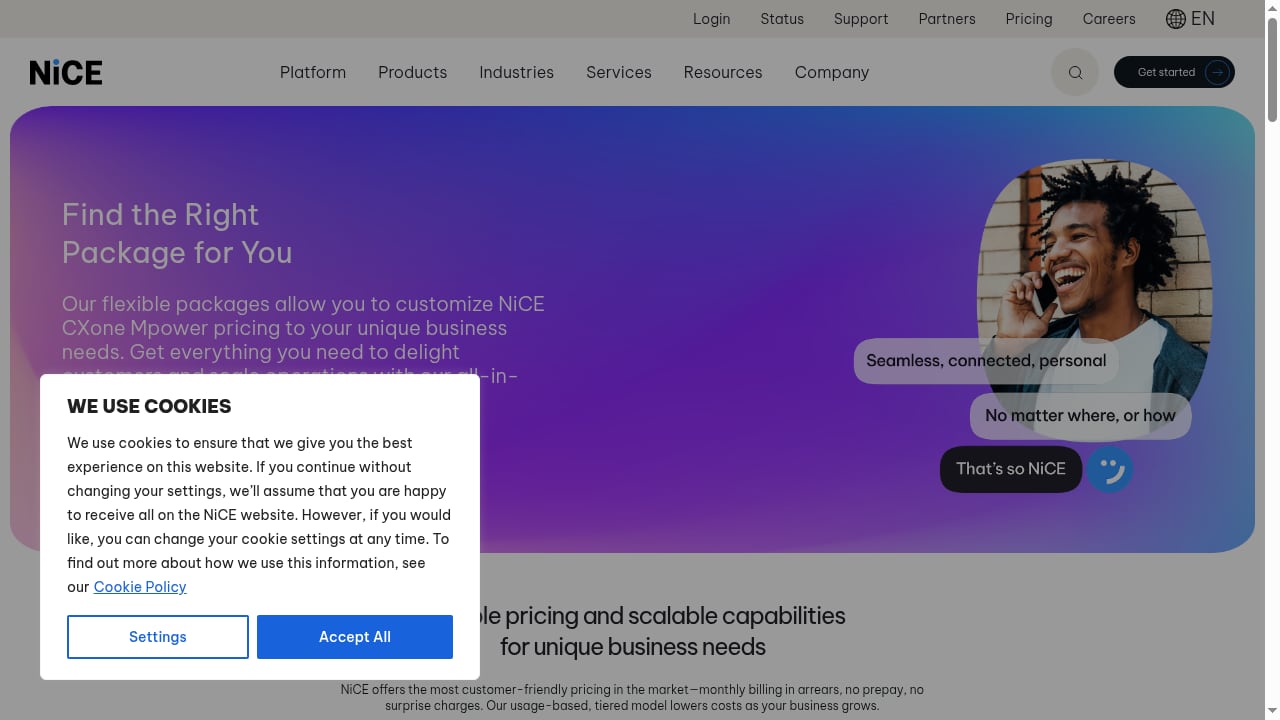
First viewport screenshot of CXone Packages and Pricing | NiCE.
HelpKnow AI: an AI agent layer for existing support stacks
HelpKnow AI is an enterprise AI agent platform. Its design goal is to let businesses build, deploy, and manage intelligent customer service agents with minimal technical effort. Rather than replacing your help desk or contact center, it integrates with the customer support systems and knowledge bases you already use.
That integration-first approach shows up in how the platform handles knowledge. Teams upload documents, FAQs, and product databases, and the platform generates responses automatically. Multi-format data ingestion means you are not forced to restructure content before it becomes useful. AI-powered intent recognition then matches incoming queries to the right answer, and customizable AI personas let you align tone with your brand voice.
HelpKnow AI reports being trusted by over 1,000 enterprises, with a 70% reduction in customer service costs and a 95% automatic problem resolution rate. Those are vendor-reported figures, but they point to the platform's core promise: high automation on top of your existing stack, not a rip-and-replace project.
NiCE CXone: a full CX platform with AI woven through it
NiCE CXone is an all-in-one, AI-powered customer experience platform designed to orchestrate customer journeys at scale. It combines contact center as a service (CCaaS) with advanced AI, automation, and analytics. The platform targets a broad set of industries, including financial services, healthcare, insurance, retail, telecommunications, government, education, and business process outsourcers (BPOs).
CXone's core capabilities span omnichannel routing, AI-driven self-service, agent assist, workforce engagement management, and journey orchestration. Its AI story is broad: virtual agents can handle entire conversations, improve routing, analyze data for resolution and cost improvements, and generate visualizations. Agent assist applications generate post-interaction summaries, surface relevant articles in real time, authenticate contacts by voice, suggest next-best actions and responses, detect sentiment, and remind agents about required statements.
One important operational detail: AI technologies in NiCE CXone require additional licenses. That matters when you model total cost, because the platform's headline capabilities are not all included by default.
AI resolution: focused automation vs. a portfolio of virtual agents
HelpKnow AI's resolution model is centralized. You feed it your knowledge, it recognizes intent, and it resolves queries automatically. The reported 95% automatic resolution rate is the platform's headline metric, and the design supports it by keeping the AI close to your existing content and systems.
CXone takes a portfolio approach. It offers multiple virtual agent solutions, including AI Agents (Cognigy), Autopilot (Omilia), Autopilot (Amelia), and Bot Builder, plus third-party integrations. Bot Builder supports existing use cases and lets people create bots without coding knowledge. AI Agents (Cognigy) provides advanced conversational and agentic AI for voice and digital interactions.
This is a real architectural difference. A portfolio gives you options and lets you match the virtual agent to the channel or use case. It also means more components to evaluate, license, and maintain. A single AI layer is simpler to reason about, but it depends on how well it connects to your existing systems.
Deployment effort and time to value
HelpKnow AI is explicitly positioned around minimal technical effort. Because it integrates with existing support systems and knowledge bases, the work shifts from platform migration to knowledge preparation and persona configuration. For teams that already have a functioning help desk, that is a shorter path to a working AI agent.
CXone is built for enterprises that want a unified foundation. The platform describes migrating to an extensible, flexible cloud foundation that scales and integrates broadly. That is attractive for organizations consolidating vendors, but it is a larger undertaking than layering AI onto an existing stack. The connected-by-design approach — pre-built integrations, no/low-code tools, and a partner ecosystem — is meant to reduce that effort, but the scope is still a full CX platform.
If your priority is replacing a fragmented contact center with one system, CXone's scope is the point. If your priority is adding AI resolution without disrupting current operations, HelpKnow AI's narrower footprint is the advantage.
Omnichannel coverage and escalation
HelpKnow AI supports omni-channel integration across desktops, websites, and social media. It also provides role-based human escalation workflows, so when the AI cannot resolve an issue, the handoff follows defined roles rather than a generic queue.
CXone's omnichannel routing is a core capability, and its virtual agents support escalation to live agents when needed. Because CXone is a CCaaS platform at its foundation, routing and workforce management are native rather than bolted on. For organizations with complex routing rules, blended voice and digital queues, and workforce engagement requirements, that native depth is a meaningful strength.
The trade-off is focus. HelpKnow AI is built around AI resolution and escalation; CXone is built around running the entire customer engagement operation. Which one fits depends on whether your bottleneck is AI resolution quality or contact center orchestration.
Analytics and quality monitoring
HelpKnow AI includes conversation quality analytics with real-time monitoring. That keeps the feedback loop tight: you can see how conversations are going and adjust knowledge or personas accordingly.
CXone's analytics are broader by design. The platform analyzes every interaction to show ways to improve issue resolution, decrease costs, and strengthen self-service. Agent assist adds sentiment detection, real-time guidance, and post-interaction summaries. For leadership teams that want a single analytical view across voice, digital, and workforce data, CXone's unified data layer is a strong fit.
The practical question is whether you need analytics for the AI agent alone or for the whole operation. HelpKnow AI answers the first question; CXone answers the second.
Compliance and data protection

CXone product interface.
HelpKnow AI states that it ensures data protection compliance with global standards including GDPR, CCPA, and others. For teams in regulated industries, that baseline matters when AI agents touch customer data.
CXone emphasizes sovereign-ready infrastructure, global compliance, encrypted data, and AI governance and observability. Governance and observability are particularly relevant for enterprises moving AI from experimentation to production, because they need to explain and monitor what the AI did.
Both platforms treat compliance as a first-class concern. The difference is emphasis: HelpKnow AI frames compliance around data protection standards, while CXone frames it around infrastructure sovereignty and AI governance at enterprise scale.
Pricing and commercial model
CXone offers flexible, usage-based pricing with monthly billing in arrears, no prepay, and tiered models that lower costs as usage grows. That structure rewards scale and avoids upfront commitment. Remember, though, that AI technologies require additional licenses, so the effective cost depends on which AI capabilities you enable.
HelpKnow AI's available product context does not specify a pricing model. Buyers should request current commercial terms directly, especially if cost reduction is a primary goal — the platform reports a 70% reduction in customer service costs, which is the outcome to validate against your own volumes.
When to choose HelpKnow AI
- You want AI resolution layered onto your existing support systems and knowledge bases rather than a platform migration.
- Your priority is fast deployment with minimal technical effort.
- You need multi-format knowledge ingestion from documents, FAQs, and product databases.
- Customizable AI personas and brand-voice alignment matter to your customer experience.
- You want role-based human escalation workflows without rebuilding your contact center.
- You are optimizing for cost reduction and automatic resolution rate as primary metrics.
When to choose CXone
- You are consolidating contact center technology and want CCaaS, AI, automation, and analytics on one platform.
- You need native omnichannel routing, workforce engagement management, and journey orchestration.
- You operate in an industry with specific journey needs, such as healthcare patient experience or insurance policyholder management.
- You want usage-based pricing with no prepay and tiered costs that decrease as usage grows.
- AI governance, observability, and sovereign-ready infrastructure are procurement requirements.
- You prefer a portfolio of virtual agent options, including AI Agents (Cognigy), Autopilot (Omilia), Autopilot (Amelia), and Bot Builder.
How to run a fair evaluation
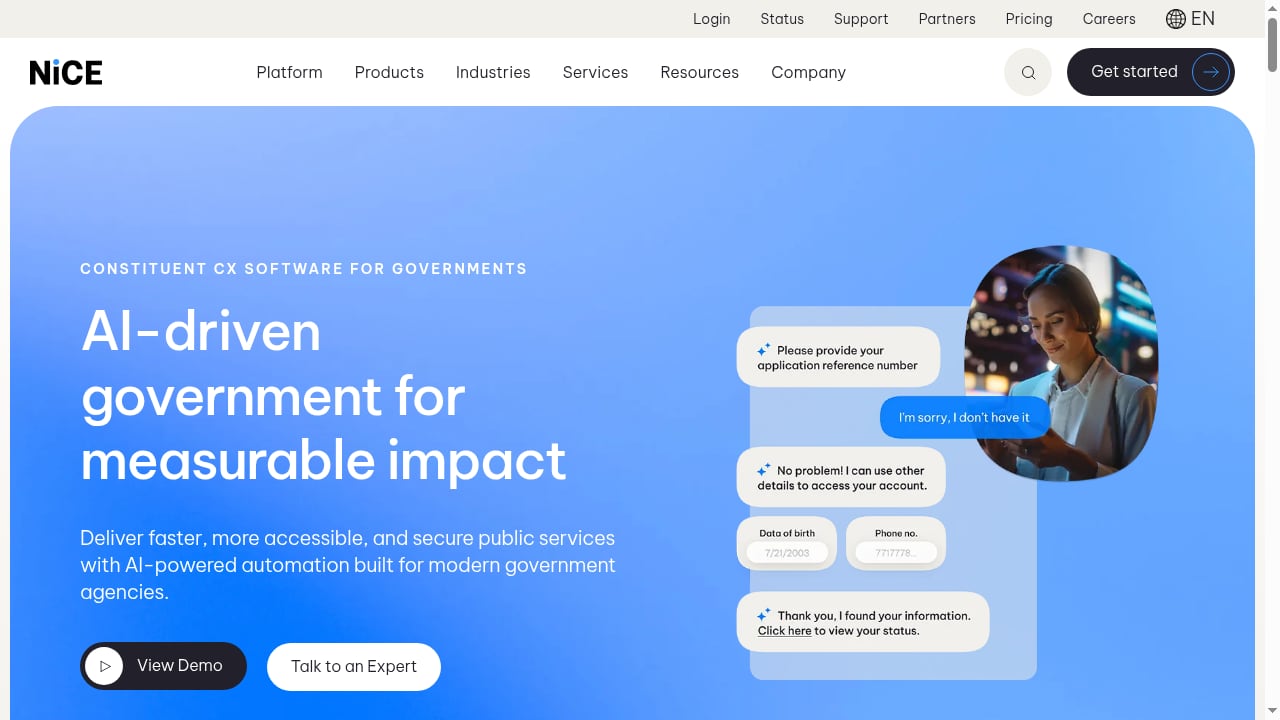
First viewport screenshot of Citizen Customer Experience Software for Government Organizations | NiCE CX Solutions.
- Define the bottleneck. If unresolved tickets are the problem, test AI resolution first. If fragmented systems are the problem, test platform consolidation.
- Measure deployment in your environment. Ask each vendor what is required to connect to your existing knowledge base and support systems.
- Model total cost, including licenses. CXone's AI capabilities require additional licenses; confirm which ones you need.
- Test escalation paths. Verify that role-based or virtual-agent-to-live-agent handoffs match your operating model.
- Check compliance evidence. Map GDPR, CCPA, governance, and observability claims to documentation your legal team can review.
For broader context on how AI support platforms fit into a larger tool stack, see our comparison of top AI-powered team collaboration and work management platforms. If you are evaluating other AI-first support options, our breakdowns of HelpKnow AI vs CoSupport AI and HelpKnow AI vs Talkdesk cover similar decision criteria.
Related reading
- HelpKnow AI vs Help Scout vs Retell AI: 2026 Comparison - Compare HelpKnow AI, Help Scout, and Retell AI on AI resolution, deployment, omnichannel support, analytics, and compliance for enterprise support teams.
- HelpKnow AI vs IBM watsonx vs Richpanel: 2026 Comparison - Compare HelpKnow AI, IBM watsonx, and Richpanel on AI resolution, deployment effort, omnichannel support, analytics, and compliance for enterprise support.
FAQ
Is HelpKnow AI a replacement for a contact center platform like CXone?
Not necessarily. HelpKnow AI is an enterprise AI agent platform that integrates with existing customer support systems. CXone is an all-in-one CX platform that includes CCaaS. If you need to replace your contact center infrastructure, CXone's scope is broader. If you need AI resolution on top of what you already run, HelpKnow AI is the more focused choice.
Does CXone include AI, or is it an add-on?
CXone includes AI capabilities, but its documentation states that AI technologies require additional licenses. Budget for those licenses when comparing platforms.
Which platform reports a higher automatic resolution rate?
HelpKnow AI reports a 95% automatic problem resolution rate. CXone describes virtual agents that can fully resolve issues via self-service, but the available sources do not publish a single comparable resolution percentage. Treat vendor-reported figures as claims to validate in a pilot.
How do the pricing models differ?
CXone uses usage-based pricing with monthly billing in arrears, no prepay, and tiered models that lower costs as usage grows. HelpKnow AI's pricing model is not specified in the available product context, so request current terms directly.
Can both platforms handle human escalation?
Yes. HelpKnow AI provides role-based human escalation workflows. CXone supports escalation from virtual agents to live agents, and its CCaaS foundation adds native routing and workforce management.
Which is better for regulated industries?
Both address compliance. HelpKnow AI cites GDPR, CCPA, and other global standards. CXone emphasizes sovereign-ready infrastructure, global compliance, encrypted data, and AI governance and observability. The right answer depends on which specific regulations and governance requirements apply to you.
Conclusion
HelpKnow AI and NiCE CXone solve related but different problems. HelpKnow AI is the focused option: an AI agent platform that turns your existing documents, FAQs, and product databases into automated resolution, with minimal technical effort, customizable personas, real-time conversation analytics, and role-based escalation. CXone is the comprehensive option: a full CX platform that unifies CCaaS, AI, automation, and analytics, with native omnichannel routing, workforce engagement management, and a portfolio of virtual agent technologies.
If your goal is to reduce support costs and automate resolution without rebuilding your stack, HelpKnow AI's reported 70% cost reduction and 95% automatic resolution rate are the metrics to test. If your goal is to consolidate customer engagement technology at enterprise scale, CXone's unified foundation and usage-based pricing are built for that. Start with your bottleneck, not the feature list — then pilot against your own volumes and knowledge base.
For further reference, see NiCE CXone alternatives on Gartner Peer Insights, the official NiCE CXone product page, and NiCE CXone documentation on AI assistants and bots.