Enterprise Bot Review 2026: Features, Pricing, and Verdict
Enterprise Bot is a conversational AI platform built for large organizations that need to automate customer and employee interactions across chat, email, and voice without sacrificing control, security, or language coverage. Rather than offering a generic chatbot builder, the platform positions itself as an enterprise-grade layer that combines large language models (LLMs) with contact center workflows, agent assist tools, and industry-specific templates.
This review examines what Enterprise Bot actually delivers, who benefits most, where it falls short, and how to decide whether it fits your automation roadmap.
What Is Enterprise Bot?
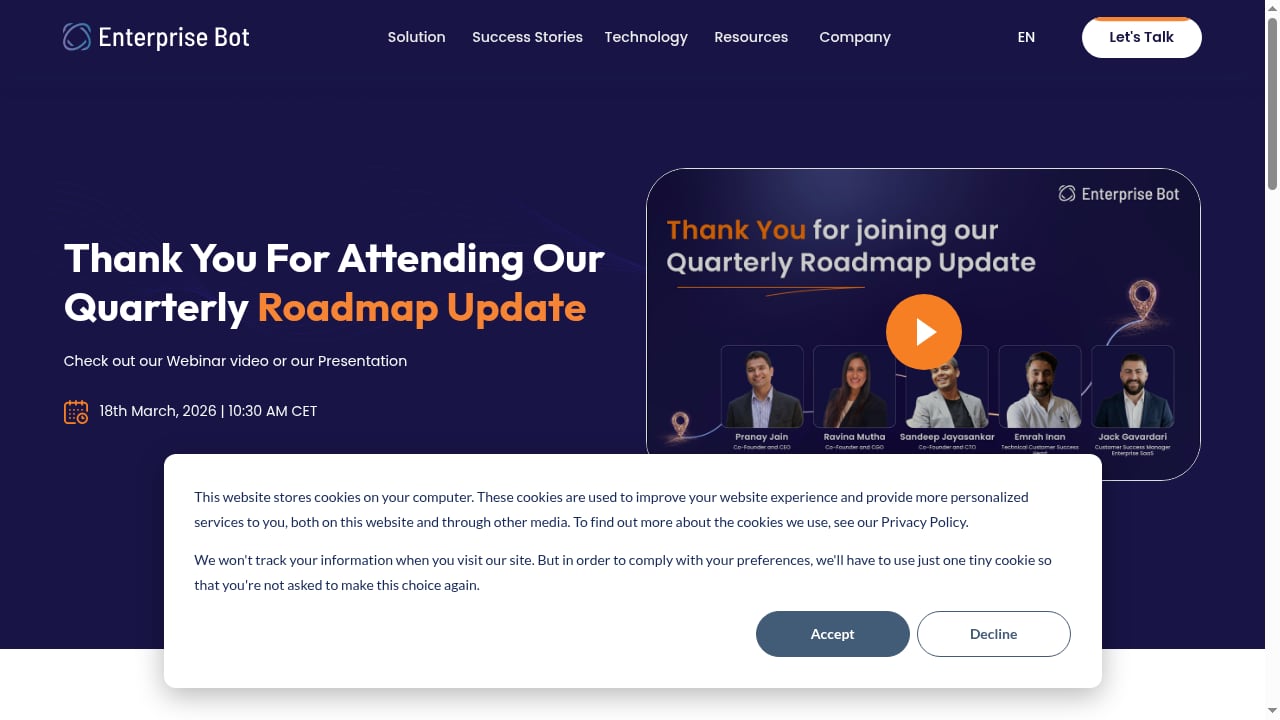
First viewport screenshot of Q1 Roadmap Update.
Enterprise Bot is a Switzerland-based conversational automation vendor founded in 2016. The company focuses on enterprise-ready AI for customer experience and employee support, with a product suite that spans AI voice assistants, email automation, web and messaging chatbots, and agent assist capabilities.
The platform's core promise is simple: reduce contact center costs and resolution times while improving first-call resolution and employee productivity. The vendor cites outcomes such as up to 40% reduction in average handle time, though individual results depend heavily on use case, data quality, and integration depth.
Key architectural characteristics include:
- LLM-powered conversations that go beyond scripted flows
- Omnichannel support for chat, email, and voice from one orchestration layer
- Multilingual capabilities for global deployments
- Privacy and security controls aimed at regulated industries
- Industry-specific solutions for travel, retail, insurance, banking, wealth management, healthcare, HR, IT, and finance
Ideal Users and Primary Use Cases
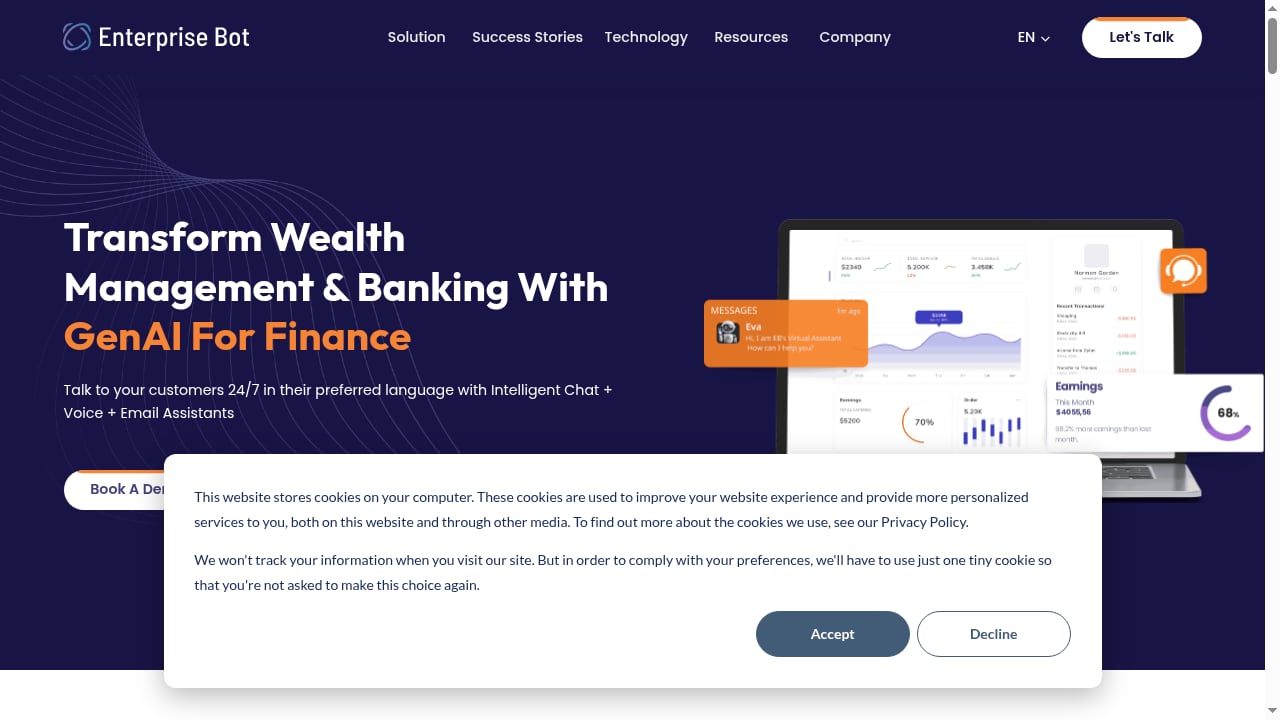
First viewport screenshot of ChatGPT for Finance, Banking and Wealth Management | Enterprise Bot.
Enterprise Bot is not a lightweight widget for small businesses. The platform targets organizations with complex support ecosystems, high interaction volumes, and a need for consistent AI behavior across channels.
Contact Center Automation
The strongest fit is mid-to-large contact centers that handle repetitive inquiries across voice and digital channels. Enterprise Bot's AI voice assistant can deflect routine calls, authenticate users, and escalate to human agents when needed. Email automation addresses the often-neglected backlog of written inquiries, while agent assist tools surface suggested responses and knowledge in real time.
Internal Employee Support
Enterprise Bot markets a "digital co-worker" for HR, IT, and finance departments. This use case works well for organizations with thousands of employees asking similar questions about benefits, password resets, procurement policies, or onboarding steps. The AI resolves tier-one requests and routes complex cases to the right internal team.
Regulated Industries
Banking, insurance, and healthcare buyers often need more than a generic ChatGPT wrapper. Enterprise Bot's emphasis on privacy, security, and controlled deployments makes it a candidate for organizations that must keep customer data within defined boundaries while still benefiting from generative AI.
Core Capabilities in Practice
AI Voice Assistants
The voice channel is where many enterprise AI projects fail. Enterprise Bot's voice assistant aims to handle natural, multi-turn conversations rather than rigid IVR menus. This matters for contact centers where callers describe problems in unpredictable ways. The platform supports sentiment analysis and intent detection, which helps route frustrated callers to human agents before the interaction deteriorates.
Email Support Automation
Email remains a high-volume, high-cost channel for many enterprises. Enterprise Bot can read incoming emails, classify intent, extract relevant details, and draft responses that agents review or that go out automatically for low-risk cases. This is particularly useful for insurance claims status, order updates, and account inquiries.
Chatbots and Digital Assistants
Web and messaging chatbots handle routine questions on websites, mobile apps, and messaging platforms. The LLM foundation means the bot can handle paraphrased questions and follow-up context better than older intent-based systems.
Agent Assist
Agent assist tools work alongside human agents, listening to conversations and surfacing relevant knowledge articles, policy documents, or suggested responses. This reduces average handle time and helps newer agents perform at a higher level.
Strengths: What Enterprise Bot Does Well
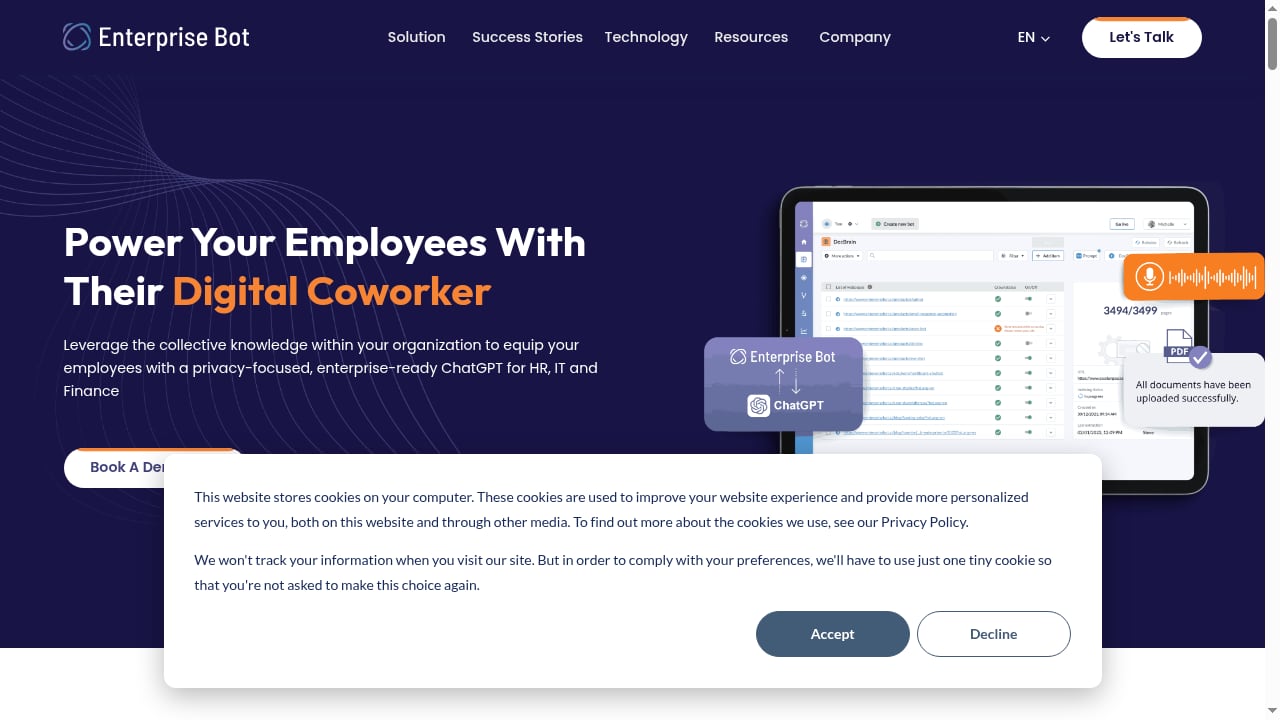
First viewport screenshot of Digital Co Worker - Solution.
Enterprise-Grade Positioning
Unlike many conversational AI tools that treat enterprise features as an afterthought, Enterprise Bot builds its offering around enterprise requirements from the start. Multilingual support, security controls, and omnichannel orchestration are core rather than add-ons.
LLM-Native Architecture
The platform was early to integrate ChatGPT-class models into enterprise workflows. This gives it a conversational quality that older, rule-based systems struggle to match. Users on Gartner Peer Insights rate the platform 4.9 out of 5 based on six verified reviews, with reviewers highlighting enterprise scalability, security, and support quality.
Vertical Solutions
Pre-built solutions for banking, insurance, healthcare, travel, and retail reduce time-to-value. Instead of building every intent and workflow from scratch, teams can start from industry-specific templates and customize from there.
Strong Employee Sentiment
Glassdoor data shows a 4.1 out of 5 employee rating across 30 reviews, with 96% CEO approval and 89% positive business outlook. Employees describe the company as innovative, supportive, and ahead of the curve on technology. While employee satisfaction does not guarantee product quality, it often correlates with responsive support and continued investment.
Limitations and Considerations
Limited Public Pricing Information
Enterprise Bot does not publish pricing. Buyers must request a quote, which typically means enterprise-level contracts with annual commitments. This is standard for the category but makes budget planning harder without a sales conversation.
Small Public Review Footprint
The Gartner Peer Insights sample is small (six reviews), which limits statistical confidence. The reviews are overwhelmingly positive, but a larger independent sample would strengthen the evidence base. Buyers should request reference calls with customers in their industry and region.
Implementation Complexity
Enterprise-grade platforms require meaningful setup effort. Integrations with CRM, telephony, knowledge bases, and identity systems take time. Organizations without a dedicated implementation team or strong vendor support may find the initial phase slower than expected.
AmbitionBox Employee Reviews Diverge
One employee review platform, AmbitionBox, shows a lower rating of 1.7 out of 5 based on a small number of reviews. This contrasts sharply with Glassdoor. The discrepancy may reflect regional differences, role-specific experiences, or sample size limitations. Buyers should weigh this as a signal to ask the vendor about support responsiveness and implementation resources in their specific geography.
Pricing Signals and What to Expect
Enterprise Bot follows a quote-based pricing model. Based on the platform's positioning and typical enterprise conversational AI pricing, buyers should expect:
- Annual contracts rather than month-to-month plans
- Volume-based pricing tied to conversations, messages, or voice minutes
- Implementation fees for integration and customization
- Ongoing support tiers that vary by response time and dedicated resources
Organizations evaluating Enterprise Bot should budget for both software and implementation. A realistic comparison requires a proof of concept with your own data and use cases, not just a vendor demo.
Setup and Implementation
Implementation typically follows this path:
- Discovery and use case selection: Identify the highest-volume, lowest-complexity interactions to automate first.
- Integration: Connect CRM, telephony, knowledge base, and identity systems.
- Knowledge ingestion: Feed the platform with FAQs, policies, and historical conversation data.
- Testing and tuning: Run the AI in shadow mode alongside human agents, then refine responses.
- Gradual rollout: Start with one channel or one department, measure results, and expand.
Enterprise Bot's industry templates can compress the early phases, but organizations should still plan for several weeks to a few months before full production deployment, depending on integration complexity.
Decision Criteria: Who Should Choose Enterprise Bot?
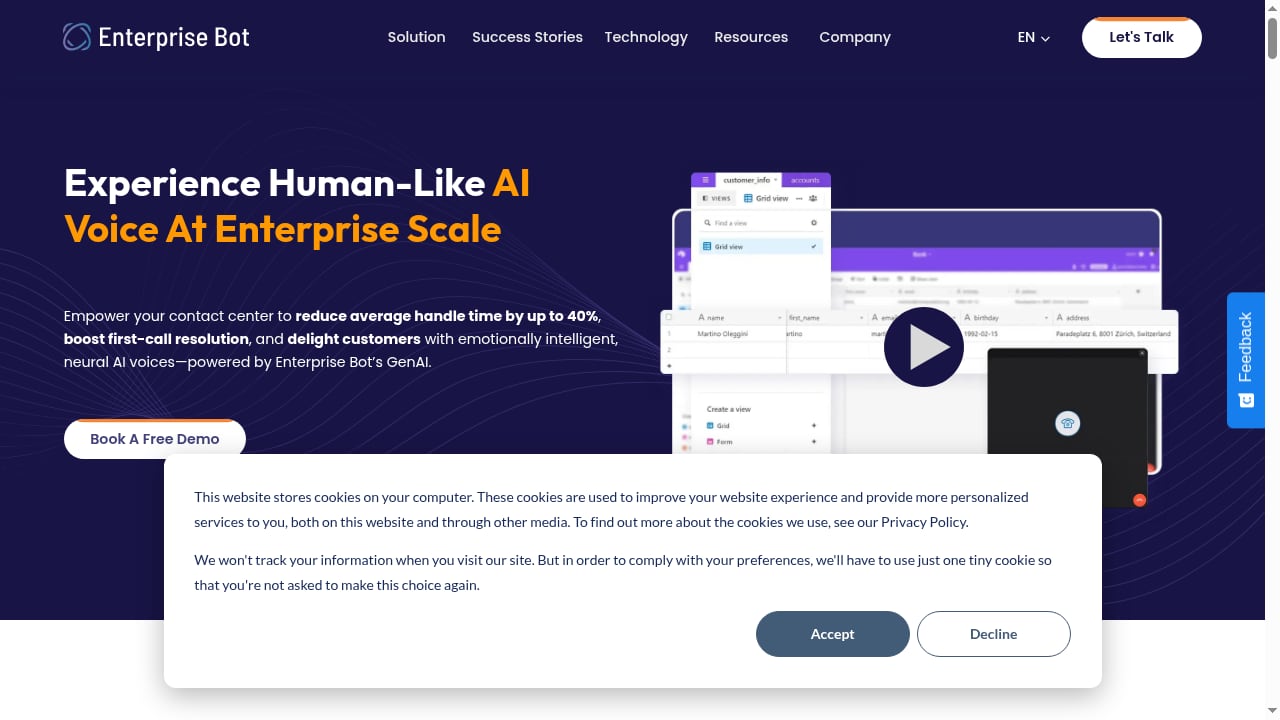
First viewport screenshot of Voice bots powered by AI | | Enterprise Bot.
Choose Enterprise Bot If:
- You run a mid-to-large contact center with high volumes of repetitive inquiries across voice, email, and chat
- You operate in a regulated industry that requires strong privacy and security controls
- You need multilingual support across multiple geographies
- You want LLM-powered conversations without building and maintaining your own AI infrastructure
- You value industry-specific starting points over a blank-slate builder
Consider Alternatives If:
- You are a small business or startup with simple chatbot needs and a limited budget
- You need transparent, self-serve pricing without a sales process
- You require deep integration with a specific contact center platform not supported by Enterprise Bot
- You want maximum control over model selection and prompt engineering
For teams comparing platforms, our Talkdesk review examines another omnichannel contact center option with AI capabilities. If you are evaluating AI support platforms more broadly, the HelpKnow AI vs Crescendo vs Kore.ai comparison breaks down resolution rates, deployment speed, and compliance across three enterprise contenders.
Related reading
- Salesforce Agentic CRM Review: Strengths, Gaps, Verdict - Evidence-based Salesforce Agentic CRM review covering AI agents, use cases, strengths, limitations, pricing signals, setup, and who should choose it.
- HelpKnow AI vs Retell AI: Which AI Support Platform Wins? - Compare HelpKnow AI and Retell AI on channels, resolution rates, integrations, analytics, and compliance to choose the right enterprise AI support platform.
Sources and further reading
- Enterprise Bot Reviews (30): Pros & Cons of Working At Enterprise Bot - 30 Enterprise Bot reviews. A free inside look at company reviews and salaries posted anonymously by employees.
- Enterprise Bot Reviews, Ratings & Features 2026 | Gartner Peer Insights - Read the latest, in-depth Enterprise Bot reviews from real users verified by Gartner Peer Insights, and choose your business software with confidence.
- Enterprise Bot Reviews by 10+ Employees | Rated 1.7/5 | AmbitionBox - I have worked for Enterprise Bot for a short period of time. If the employee is sincere about their work they will not face any challenge. It's a growing ...
Frequently Asked Questions
What does Enterprise Bot do?
Enterprise Bot provides conversational AI for large organizations, automating customer and employee interactions across chat, email, and voice. The platform includes AI voice assistants, email automation, chatbots, and agent assist tools built on large language models.
How much does Enterprise Bot cost?
Enterprise Bot does not publish pricing. The platform uses a quote-based model with annual contracts, volume-based pricing, and implementation fees. Organizations should request a custom quote based on expected conversation volume and required integrations.
Is Enterprise Bot suitable for small businesses?
Enterprise Bot is designed for large enterprises with complex support ecosystems. Small businesses with simpler needs may find the platform's implementation requirements and enterprise pricing disproportionate to their requirements.
Does Enterprise Bot support multiple languages?
Yes. Multilingual support is a core platform capability, making it suitable for organizations serving customers across multiple geographies and languages.
What industries does Enterprise Bot serve?
Enterprise Bot offers industry-specific solutions for travel, retail, insurance, banking and wealth management, and healthcare. It also provides a digital co-worker for HR, IT, and finance departments.
How does Enterprise Bot compare to IBM Watson or AWS conversational AI?
Gartner Peer Insights data shows that 67% of Enterprise Bot reviewers also considered IBM, while 17% considered AWS. Enterprise Bot positions itself as a more specialized, LLM-native alternative with industry templates and enterprise support, while IBM and AWS offer broader cloud ecosystems.
Conclusion
Enterprise Bot is a credible option for large organizations that want LLM-powered conversational automation across voice, email, and chat without building the underlying AI infrastructure themselves. Its strengths lie in enterprise positioning, multilingual support, industry-specific templates, and a strong employee satisfaction record that suggests a healthy vendor culture.
The main trade-offs are typical for the category: opaque pricing, a relatively small independent review footprint, and meaningful implementation effort. The divergent employee review on AmbitionBox is worth investigating through direct reference calls, especially if you are deploying in a specific region.
For enterprises that prioritize security, omnichannel consistency, and industry-specific starting points, Enterprise Bot deserves a place on the shortlist. Run a focused proof of concept on one high-volume use case, measure resolution rates and handle time against your baseline, and let the data drive the final decision.